Tuesday, May 23, 2006

Immigration and Trade are Focus of Fox’s Visit to U.S.


(Source Article: Mexico's President Visits U.S. - CNN)

Today in Utah, his first stop on a three-state visit, Mexican President Vicente Fox urged that the U.S. and Mexico work to strengthen their economic, educational and cultural relationship, insisting that continued regional prosperity will result from such efforts.

Fox’s encouragement is not surprising, considering Mexico is Utah’s third largest trading partner—and one of the nation’s top trading partners overall. In 2005, the U.S. exported commodities to Mexico in the value of approximately US$ 120 billion dollars. Additionally, the U.S. imported over 170 billion dollars worth of commodities from Mexico, resulting in a substantial trade deficit (Source: TradeStats Express).

Fox is expected to focus on discussion of immigration as well given the growing concern amongst U.S. citizens. Utah’s Hispanic population—primarily Mexican—has tripled since 1990, and the reason why is a source of dispute.

Anti-immigrant groups within Utah say the state attracts illegal immigrants because of the nonchalance of the state’s citizens who don’t report such immigrants to the authorities. Critics of Fox say he’s trying to influence U.S. policy on illegal immigration by not visiting Washington on this trip and instead opting to meet with governors of Western states.

Fox’s visit to the states coincides with the U.S. Senate’s expected vote on immigration legislation that could result in a new guest-worker program and opportunity of citizenship for the millions of illegal immigrants already in the U.S. (see Immigration Legislation - CNN). His encouragement of the strengthening of the two countries’ relationship echoes his response to previous congressional plans to build a 700 mile fence along the border: “[barriers] do not offer an effective answer for a relationship of friends and partners,” he said. The late poet Robert Frost might agree.

Despite the obvious importance and sheer immensity of U.S.-Mexico relations, immigration remains a hot-blooded issue—especially in conservative red states such as Utah.

Is Fox right in suggesting, at least impliedly, that relations with Mexico can prosper and benefit from legislation granting citizenship status to many would-be illegal immigrants?

Is he further implying that current relations might deteriorate in the absence of such legislation?

While critics might say Fox is making this trip for political reasons (though for his party alone, since he cannot run for President again), those immigrants whose status is at stake have more on the line.


India's Proposed Increase in University Quotas Sparks Protests

Yahoo! News
New York Times

In April, the government of India announced a plan to increase the number of seats reserved for members of the lower cast groups. The plan calls for an increase in the percentage of jobs and seats reserved for select groups in medical, engineering, and other professional schools. The plan would increase the current reservation of 22.5% to 49.5% of the total spots. The current level incorporates “scheduled” castes and tribes, including those formerly known as untouchables. The plan would expand those benefited to include those who are one-step higher in the caste system or the “other backwards castes.”

Opposition, in the form of protests and hunger strikes, are coming primarily from medical students, who desire admissions based solely on merit. Hospitals affected by the strikes have refused new admissions, save emergencies, and cancelled all surgeries. The government is hoping to prevent a situation similar to the 1990 incident where numerous students committed suicide, which led to the fall of the government, after the number of reserved seats in university admissions and jobs were doubled by the government.

Some believe that the politicians are unwilling to address the plan because nearly two-thirds of India’s population are members of lower castes. Political backlash for decreasing the quotas could be severe. Prime Minister Manmohan Singh’s silence on the proposal is evidence of this. He opted instead to appoint a committee to evaluate the plan and its possible effects.

A further argument is that the better way to empower the lower social groups is to focus on basic primary education, which could benefit many more people than the current plan and lead to a long-term solution. Others argue that the only way for members of the lower group to succeed in the unequal society is by a specific quota system.

Poor Nutrition Halts Growth in Niger

(Source Article: Niger Malnutrition - Reuters)

UNICEF, the U.N Children’s fund, reports that half of Niger’s children suffer from growth retardation resulting from food shortages and the world’s lowest rate of baby breastfeeding; a UNICEF representative says that 50% of children under 5 years suffer growth retardation, and only 1.2% receive exclusive breastfeeding. UNICEF data suggests that breastfeeding, considered the most nutritious source of food for growing babies, could save millions of lives if it served as the exclusive source of nutrition for babies until around 6 months of age.

Niger is a region in Africa accustomed to food shortages: last year a plague of locusts and poor harvests left some 3.6 million people largely without food.

Social and cultural attitudes in Niger, including the belief that the first born child shouldn’t be breastfed, result in Nigerian babies receiving a mixture of water and other liquids—leading to chronic infections because of unsanitary water in many areas. This lack of breastfeeding, plus other food shortages, combine to create high child mortality rates.

A recent study shows that 15.3% of all Nigerian children suffer from malnutrition. The Nigerian government, in response, has drawn up a 10-year plan intending to improve healthcare and child nutrition.

Monday, May 22, 2006

World Bank Supports Efforts to Save African Child Soldiers

(Source Article: Saving the Smallest Soldiers - World Bank News)

Through the Multi-Country Demobilization & Reintegration Program (MDRP), a collaborative effort amongst several nations and international organizations to disarm and reintegrate combatants in war-torn central Africa, the World Bank provides financial and technical assistance primarily to the MDRP’s efforts in easing ex-combatants' transition to civilian life.

The MDRP is currently working to reintroduce some 400,000 former combatants in the African Great Lakes countries: a region of Africa that has suffered decades-long wars, but in light of recent stability allows for programs such as the MDRP to attempt to rebuild societies therein. Of the 400,000 former combatants, some 18,000 are children as young as 6 years old. Rebel groups, including the Lord’s Resistance Army (LRA), are notorious for snatching up children at night and forcing them into service as soldiers, spies, cooks and even sex slaves. Despite The MDRP’s efforts, an estimated 30,000 children are still engaged in active combat in the Democratic Republic of Congo alone, and thousands more elsewhere in the region—all while groups like the LRA continue their efforts to kidnap and recruit these child soldiers.

While the MDRP has strong financial support for its efforts (over US$500 million, approximately 200 million of which is funded by the Bank), it is not an easy process to reintegrate children who were deprived of a normal childhood: while most children go to school and play with friends, these kids killed people. As a result, they suffer from severe psychological problems, nightmares, and are prone to violence towards others. Because of this, the MDRP oftentimes only succeeds in reuniting these children with their families, with whom the children aren't always familiar after spending years apart, and not in completely transitioning them into their communities: around 60% of children, once returned to their homes, are engaged in an activity, such as school, with the purpose of providing them with the skills they need to successfully reintegrate. Nevertheless, the MDRP and its partners aim to increase the success rate to 85%, though they remain unconvinced that a 100% success rate is on the horizon.

The MDRP is in the process of helping the local communities form their own child protection groups for the purpose of monitoring and providing reintegration support to the children upon return to their communities. In the Democratic Republic of Congo, for instance, a national program already in place that assists adult ex-combatants will soon combine its efforts with the MDRP to provide similar assistance to children.

The World Bank and the MDRP both realize that disarmament and reintegration is necessary for prosperous development in the region. With continued peace, future generations of children will not be subjected to such horrid conditions and life experiences.

Friday, May 19, 2006

Gangland Style Killings Rock Brazilian Financial Capital

Sao Paulo Gangster Killings - Reuters

Recently, organized crime in Brazilian Sao Paulo, the country's financial and industrial center, has simultaneously illustrated its own strength and the weakness of the Brazilian criminal justice system by successfully killing 30 plus police officers in the world's third largest metropolitan area. Despite incarceration of many Brazilian gang bosses, easy access to smuggled cell phones and other means of communication allow the organizations to continue functioning effectively--well enough to pull off organized attacks on police officers.

On Friday, relatives took to the streets to collect the corpses of suspected gang members who have been massacred all week in what appears to be a retaliatory attack by police. While Brazilian officials deny the attacks were carried out to avenge the death of police colleagues, several international organizations and citizens of Brazil desire investigations to be made. A human rights advisor in the Sao Paulo state government commented that, given the tainted history of the police in the region, he would be unsurprised if it were found that innocents were brutally killed along with the gangsters.

A Brazilian Senate committee looks to put together a package of reforms for stricter regulations in Brazil's notorious prisons, in an effort to curtail the operations often run by those gang bosses who are imprisoned.

Sao Paulo state Gov. Lembo commented that the recent violence is reflective of Brazil's social inequalities.

The “Wal-Mart Effect” on Healthcare

An article by The Atlantic’s Joshua Green discusses Wal-Mart’s role in the U.S. Healthcare system. (“The New War Over Wal-Mart”. The Atlantic, June 2006.)

Recently, Maryland enacted legislation requiring companies with more than 10,000 employees to spend at least 8% of their payroll on employee healthcare—this legislation is targeted at Wal-Mart, since the retailer, in its position as the apotheosis of American Capitalism, is the only employer who fits the bill (and accordingly is being asked to foot the bill).

Legislation like this is largely in response to activist groups, like Wal-Mart Watch and the Service Employees International Union, putting the pressure on Wal-Mart via leaked internal documents and grass-root campaigns illustrating the impact Wal-Mart has on the U.S. With its 1.7 million worldwide employees, Wal-Mart is the largest private employer in the history of the world. Critics of the mega-corp have attributed large losses of U.S. manufacturing jobs to Wal-Mart’s business practice of “Always low prices. Always," which requires a constant flow of cheaply manufactured goods (unionized factory workers in America would drive up Wal-Mart’s prices, preventing them from rolling back the prices.)

The mega-corp’s effect, or overall relationship, on healthcare in the nation is also staggering: its healthcare policy covers less than half of its employees, leaving the government to care for tens of thousands of its employees and their children through programs such as Medicaid. Given the immensity of this relationship, the president of the SEIU hopes to back Wal-Mart into a corner via proposals of “fair share” legislation like that recently passed in Maryland—effectively forcing Wal-Mart to publicly favor the adoption of a national healthcare policy.

This plan is bold, considering corporations such as Wal-Mart are reflexively opposed to government regulation—but the plan is not implausible. If Wal-Mart is forced via legislation to foot the bill for increasing healthcare expenses, its own self-interest in profits will encourage it to favor government regulation of the healthcare system. And with its 65,000 suppliers of goods, many of whom are largely if not entirely dependent on Wal-Mart for their continued prosperity, the mega-corp’s influence could be just enough to bring real healthcare reform to the States—and potentially abroad. (For a detailed discussion on Wal-Mart’s potential to effectuate systemic social, political and economic change, see Global System Change - Wal-Mart's Sustainability Strategy).

Thus, while groups like the SEIU campaign for and support legislation like that of Maryland’s, clearly it is a short-term remedy to a major crisis; just as clear is the fact that Wal-Mart, no matter how many pennies per item sold it makes, cannot by itself—much less any other company—shoulder the burden of healthcare costs.

How many states must adopt such “fair share” legislation before Wal-Mart reacts in the way the SEIU hopes?

Can the Federal Government effectively implement a broad, national healthcare system? And, if so, what would this healthcare system look like (i.e., a mixture of privately funded coverage plus government subsidization or pure government)?

Wal-Mart’s role is perhaps key to this major development.

Tuesday, May 09, 2006

Tackling the Informal Economy
http://www.businessweek.com/globalbiz/content/may2006/gb20060508_633382.htm
Business Week
Diana Farrell

Research on economic development from the McKinsey Global Institute has demonstrated that there is a direct correlation between the extent of an informal sector in an economy and its level of development. Singapore, Japan and South Korea are examples of highly developed countries with small informal sectors.

The author dispels the notion that the businesses acting in the gray economy are mostly small. According to McKinsey's research, the businesses operating in the informal sector
ranged from supermarket chains to software distributors to consumer-electronics assemblers. In countries such as Brazil, the informal economy represents as much as 40% of GDP. The author states that developing countries have large informal economies partially because it is difficult to establish legitimate businesses and because of the enormous amounts of red-tape legitimate have to contend with.

The author points out an interesting paradox - most of the social spending undertaken in developing countries is financed by high taxes levied on legitimate businesses. However, the money never reaches those who need it because most of the people requiring assistance operate in the informal economy and therefore are not eligible to receive the benefit of social security or insurance.

The author offers a three-point plan for "curbing informality" - making corporate taxes and business regulations easy to understand, creating harsher penalties for breaking the law, and applying penalties uniformly to those who violate the laws.

Karzai aims to lure investors into "greedy market"
Rachel Morarjee
May 9, 2006
http://news.ft.com/cms/s/f316b7c8-df7d-11da-afe4-0000779e2340.html

As economic development in Afghanistan's slowly gathers pace, the Afghan government is seeking to attract a greater amount of investment to the war-torn country. In a recent speech, the Afghan President said that profits for investors were plentiful. Although most of the current investment is in construction and infrastructure development, the Government has prioritized energy, mining and agribusiness as growth sectors.

While potential investors still have to contend with considerable red-tape, the Afghan government has shown a willingness to accommodate foreign investors. Recently, the government approved the sale of several state-owned industries and is currently passing laws that would make entry of foreign investors into Afghanistan easier. Afghanistan has a lot to offer would-be investors – in addition to possessing rich mineral resources, it provides a key route for oil and gas as it makes its way to south Asian countries such as India and Sri Lanka.

Caste and Cash
http://www.economist.com/World/asia/displayStory.cfm?story_id=6866641
The Economist

India has traditionally had a quota reserved for the scheduled castes - the lowest groups of India's caste system. Typically 20% or so of government jobs are allocated to these scheduled casts. The Indian Government is now considering expanding the quota system to include the private sector.

While India's burgeoning private sector is wary of having to hire workers who are not as skilled as their non-scheduled caste counterparts, the Indian Government seems firm on its stance to see more backward castes employed in the private sector. In a recent speech, India's Prime Minister exhorted Indian businesses to voluntarily improve diversity in their ranks. In fact some sections of Indian Government are calling for another quota of 27% in universities and technical institutions, on top of the 22.5% already reserved for scheduled castes and tribes.

While Indian businesses have shown a willingness to hire the so-called backward castes, unrest is likely on the horizon.

Wednesday, May 03, 2006

Millennium Development Goals Update

Malnutrition Kills 10 Children Every Minute, Says UN
The Independent (UK)
May 3, 2006

Progress for Children Report
UNICEF
May 2006

This week, UNICEF published a progress report relating to the Millennium Development Goal of eradicating childhood hunger. Unfortunately, the report reveals a staggering number of children (146 million) suffer from malnutrition and related health conditions. Below are some of the many findings available in the UNICEF update:

- There is little difference between male and female children and the incidence of being underweight. (p. 8)
- Nearly half of the children in South Asia are underweight. However, these numbers may be inaccurate because only one in four children born in the region is weighed at birth. (pp. 12-13)
- Malaysia shows the fastest rate of improvement in children's health; the country reduced child poverty from 25% in 1990 to 11% in 2003. How did they do it? One practical step was to increase the intake of iodized salt. Iodized salt promotes thyroid function and helps regulate metabolism. (p. 20)
- In contrast, European children are at high risk for cardiovascular disease, hypertension, non-insulin-dependent diabetes, certain kinds of cancer, gall bladder disease, menstrual abnormalities, and arthritis due to obesity. In southern Europe, one in three children is overweight. (p. 26)

The report recommends increasing education for families about nutrition, improving access the clean water and sanitation, creating national action plans with appropriate budgets, and ensuring the delivery of important food items.

Tuesday, May 02, 2006

The cost of gasoline

Gasoline prices a "crisis": Bodman WASHINGTON (Reuters)
States sue Bush over fuel efficiencyNEW YORK (Reuters)
Bush Gasoline-Price Probe May Not Find Manipulation (Update1)

U.S. Energy Secretary Sam Bodman said today that high gasoline prices which have skyrocketed to a near record are a "crisis" for Americans.

In related news, nine states (California, Connecticut, Maine, Massachusetts, New Mexico, Oregon, Rhode Island, and Vermont) have sued the administration of President George W. Bush for lenient automotive fuel economy standards that they say worsen an energy crunch and contribute to air pollution and climate change.

Elliot Spitzer, New York Attorney General, said in a press release, "At a time when consumers are struggling to pay surging gas prices and the challenge of global climate change has become even more clear, it is unconscionable that the Bush Administration is not requiring greater mileage efficiency for light trucks."

The price increases have also prompted Republican Senators Arlen Specter of Pennsylvania and Mike DeWine of Ohio to propose enforcing U.S. antitrust laws against Saudi Arabia and other members of the Organization of Petroleum Exporting Countries. The Senate Judiciary Committee approved their plan on a voice vote today and sent the measure to the full Senate.

Our favorite antitrust expert, Professor Herb Hovenkamp, recently commented that applying U.S. antitrust laws to OPEC would go against a longstanding legal doctrine that U.S. courts don't have authority to rule on the legality of foreign government actions. It also might prove difficult to enforce.

The proposal also raises a foreign-policy issue because oil is ``a natural resource for these countries'' and ``the way they set price is by controlling output,'' Hovenkamp said.

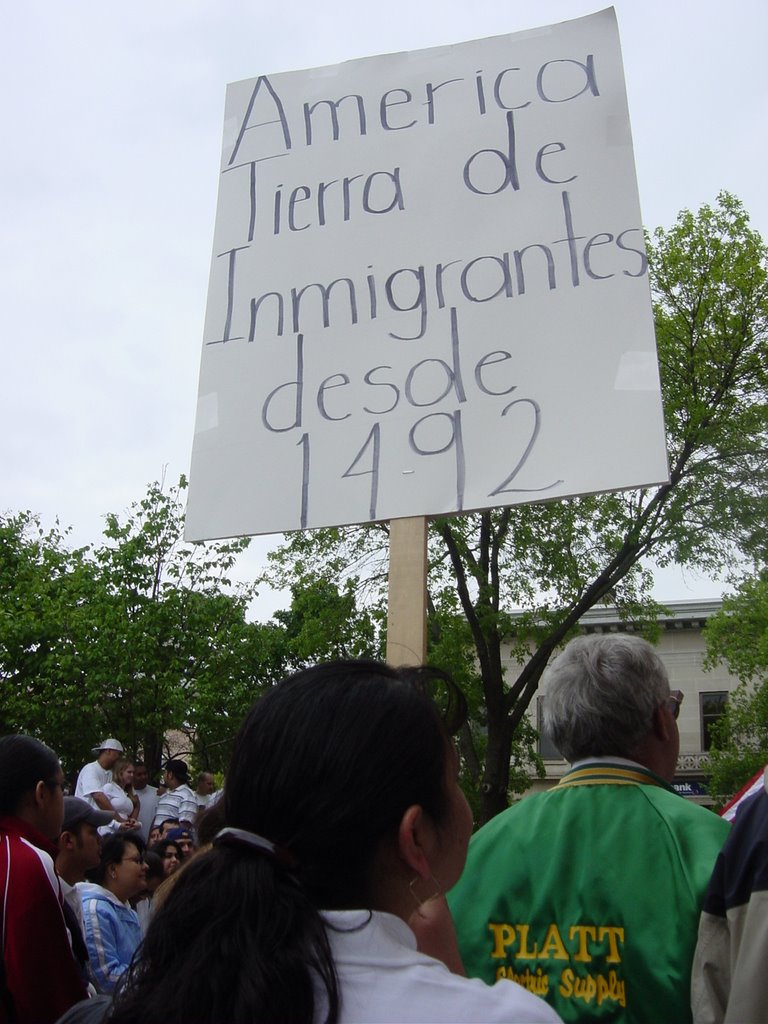
Amigos Del Inmigrantes in Iowa City

In support of nation-wide protests against U.S. immigration policies, and to call for solid reforms that are realistic and humane, Iowa City mobilized yesterday to march and demonstrate.

Here are some pictures of the noon-time rally.


For full images, click here.

Monday, May 01, 2006

Disagreement over Budget Shuts Down Puerto Rican Government


Puerto Rican Government Shuts Down, BBC News, 5/1/06
Puerto Rico Questions U.S. Ties By Jonathan Beale, BBC News, 3/28/06

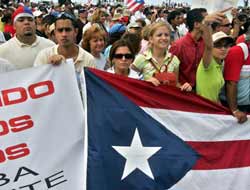
The U.S. territory of Puerto Rico, in the midst of a financial crisis, has temporarily shut down all state-operated schools and non-essential government offices. Approximately 95,000 government workers have been left without work and 40,000 students without classes. The government is the country’s biggest employer. Puerto Rico operates as a self-governing commonwealth, but President Bush is its head of state.

Governor Aníbal Acevedo Víla has blamed the crisis on “legislative inaction”. The Puerto Rican government is currently operating at an estimated $740 million dollar deficit, and has been unable to agree its budget. The government is currently using its 2004 budget because there has been no agreement with the Puerto Rican legislature since that year.

Last week, thousands of Puerto Ricans protested in the streets, demanding a solution. Governor Acevedo hopes to introduce a 7 percent sales tax to help pay off the island’s debt and allow the government to operate. The U.S. territory currently has no sales tax, but most legislators are opposed to any tax higher than 5.5 percent. Puerto Ricans do not pay U.S. income tax, but the island receives federal funds.

The financial crisis occurs on the brink of a recent White House report questioning the political status of Puerto Rico. The commonwealth is divided with some islanders demanding independence, others advocating that Puerto Rico become the U.S.’s 51st state, and others encouraging that the island retain its current status. In 1998, only 2.5 percent of the island population favored independence. However, there has been growing resentment that their country continues to deny them full voting rights.

Dubai Firm's Deal for Pentagon Supplier Is Cleared

By: Greg Hitt
April 29, 2006
http://online.wsj.com/article/SB114627255290939508.html?mod=economy_lead_story_lsc

Despite wide security concerns, President Bush approved a $1.2 billion deal that will give Dubai International Capital, a Dubai-owned firm, control of nine manufacturing plants in the U.S. that supply machine parts to the Pentagon for military vehicles and aircrafts; Dubai International is taking over for Doncasters Group Ltd., a United Kingdom company. President Bush defended his decision last Friday stating, "I signed off on it this morning because I'm convinced -- at the recommendation of the [Committee of Foreign Investment in the U.S.] as well as our military -- that it's a sale that should go through." The CFIUS committee conducted a 45-day investigation of the transaction, which thus far has provoked nowhere near the level of concern displayed over the ports deal.

The administration conducted a "careful, thoughtful" review of the Doncasters deal, which is very different from the ports transaction. "This is a product, not a service, and the opportunity to infiltrate and sabotage is both more difficult and more detectable," said Senator Charles Schumer, a New York Democrat. CFIUS is led by the Treasury Department and includes representatives of the State and Defense departments, which are deeply involved in the process.

Mr. Bush's press secretary said the review included an assessment of "potential threats to our national security" by the U.S. intelligence community, and as a condition of approval of the deal, the company signed an "assurances agreement" with the Pentagon, agreeing to provide a continuous supply of parts.

Asian, European Workers Demand Better Wages, Working Conditions

Associated Press
May 1, 2006
http://online.wsj.com/article_print/SB114648153656140313.html

Protests in Asia:

As people protest against the proposed immigration bill today in the United States, citizens of Asia and Europe take the day to protest unemployment, poor working conditions, and low wages. Although the protestors promise a friendly demonstration, police were on high alert in Asia with helicopters hovering overhead in Indonesia and riot police guarding the presidential palace in the Philippines. In the Philippines, government troops and police armed with batons and shields turned away hundreds of activists who marched to the Philippine presidential palace to demand a wage hike and President Gloria Macapagal Arroyo's ouster.

In Sri Lanka, “where violence between Tamil Tiger rebels and the military has sparked fears of a return to civil war, the government decided to cancel all May Day rallies in the capital.” Fifty thousand people in Jakarta chanted, “Don’t change the law,” in response to Indonesia’s plans to revise current labor laws by cutting severance packages and introducing more flexible contracts that would decrease worker security. In Cambodia, thousands of police brought the capital to a standstill during a government hold on an unauthorized May Day demonstrations. The government denied permission for the rally, allowing only one official May Day demonstration at Chenla Theater. Police armed with riot shields and batons physically prevented protesters from marching.

Protests in Europe:

“Meanwhile, in Moscow, official events set up by the ruling pro-United Russia party overshadowed traditional protest marches by the opposition Communists as 25,000 people gathered opposite the mayor's office in the central Tverskaya Street to hear speeches from trade union leaders and the mayor and listen to a concert.” In total, 1.5 million people participated in May Day rallies in Russia.

Labor unions in Germany protested the impact of globalization and the sacrifice of jobs of a quick profit. The labor unions also urged the government to introduce a minimum wage. Unfortunately for Germans, unemployment stands at 11.5 percent, “undermining government finances and the country's generous welfare state.” In Vienna, about 120,000 members of the opposition Social Democratic Party participated in a traditional march, which focused on Austria’s 8 percent unemployment rate.

Finally, in Bosnia the unemployed marched down the main street in Sarajevo, demanding new elections and the resignation of the government, which they claim is not doing enough to lower the unemployment rate, which has been above 40 percent for years.
Lamy calls for trade deal revival BBC (UK)

In the first quarter of 2006 the US economy grew at its fastest rate in two and a half years, according to the Commerce Department. Growth was boosted by government spending to deal with damage from last year's Gulf Coast hurricanes. Earlier this week, the Federal Reserve chairman said he expected growth to slow to a more sustainable level.

"With crude oil prices soaring and China investing in new export capacity at a breakneck pace, the trade deficit will continue to pull down U.S. growth," said Peter Morici, a University of Maryland economist. "Without a devaluation of the dollar against the Chinese yuan, U.S. growth will slow significantly in the second half of this year."

What does this mean for consumers? Brian Fabbri, chief economist at BNP Paribas in New York said "..consumers feel happy but they are beginning to become a little less happy about gasoline price increases. This is not a big move in confidence but it does say that confidence is probably levelling off and would probably continue to do so while gasoline prices go up."

Bolivia Nationalizes Gas Industry

Wall Street Journal
May 1, 2006
http://online.wsj.com/article/SB114650311422040582.html?mod=world_news_whats_news

Bolivia nationalized its natural gas industry on Monday, ordering all foreign energy companies to send their supplies to Yacimientos Petroliferos Fiscales Bolivianos, a state company responsible for sales and industrialization. President Evo Morales spoke from a facility owned by Brazil’s Petroleo Brasileiro SA (Petrobras) and Spanish-Argentine’s Repsol YPF, and stated: "The time has come, the awaited day, a historic day in which Bolivia retakes absolute control of our natural resources."

Mr. Morales further warned that companies which did not follow the decree would have to leave Bolivia within six months. The companies mostly affected by this nationalization of oil are Petrobras, Repsol, British Gas, Britain’s BP PLC, and France’s Total SA. In addition to natural gas companies, Bolivia also plans to retake control of hydrocarbons companies that were privatized in the 1990s by taking over shares that belong to foreign companies as well as semipublic Bolivian entities.

This decision is closely in line with Mr. Morale’s campaign platform “to wring greater profits from the gas producers doing business in Bolivia, which has South America’s second-largest reserves after Venezuela.” Last year, in efforts to speed the nationalization process, “Bolivia's congress passed a law that raised taxes and royalties on gas production and recognized the state as the sole owner of hydrocarbon resources.”

"El Boicot" Set to Test Employers in US

By: Edward Alden and Jenny Johnson in Washington and Christopher Parkesin Los Angeles
Financial Times
April 30 2006
http://news.ft.com/cms/s/cf3ba260-d879-11da-9715-0000779e2340.html

As Tanya posted earlier today, many Hispanic workers and people opposed to Congress’s efforts to crack down on illegal immigration, will protest today by walking out of work and demonstrating against the bill which would make illegal immigrants felons. Today, which is dubbed “El Boicot” or “A Day Without an Immigrant,” is aimed to show Americans what a day would be like in the United States without the work and consumption of immigrants.

Several industries like small retailers, meat packing plants, and restaurants heavily depend on immigrant labor and have prepared for possible shutdowns. For instance, “in Los Angeles, a fruit and vegetable market in the city center, employing 1,800 and serving 4,500 restaurants and 3,000 shops, will be closed today.” John Gay, Senior Vice President for the National Restaurant Association, states that the Association is on the same side as the immigrants from a policy standpoint; an ironic fact given that restaurants are likely to suffer the brint of closures due to the boycott.

There is however, some dispute, even among Immigrant groups, regarding whether or not the boycott should happen. Los Angeles’ Cardinal Roger Mahony, who was an avid supporter of the March 26th demonstration, which consisted of over 500,000 people jamming the streets of central LA, urged people to work and go to school normally during the day, and attend a major rally afterwards. A few union leaders have predicted that more than 2 million people will rally in Los Angeles and walkouts are expected at several educational institutions.

As a result of potential massive workouts, employers are faced with the task of disciplining those employees who chose to walk out. Since most employment is of the at-will variety, employers will have a huge leeway in deciding whether or not to terminate these workers. Employees are urged to ask for the day off, but “improper use of a sick leave [can be] construed as grounds for disciplinary action.” Angelo Amador, Director of Immigration Policy for the U.S. Chamber of Commerce warns that disciplinary action should be consistent: “You have to be careful if somebody takes off to go to a baseball game and you don’t fire them for that, then you cannot fire them because of this.”

Today is meant to be an eye-opening experience showing the impact that immigrants have on the economy of our country. So what will you do? Will you be one of the estimated millions of people to walk out today? Stay tuned for what I imagine will be increasing discussion on the matter.

Questions:
1) What do you think? Do you think that immigrants should protest today and walk out of their jobs, or do you agree with Cardinal Mahony?

2) What is that likely impact that this walkout will have on American commerce? Will anything change?

3) What, if any, impact will the “Day Without an Immigrant” have on Congress? Do the men and women in Washington care?

Europe Driven Lower by Auto and Oil Stocks

By: Neil Dennis
Financial Times
April 28, 2006
http://news.ft.com/cms/s/a3212632-d680-11da-b64c-0000779e2340.html

This week, European carmakers announced their quarterly results which indicate that the auto sector has risen more than 18 percent this year. There is hope in the industry that restructuring would reduce the large cost base faced by most European manufacturers. Renault reported higher than expected sales and investors were delighted with a 5.8 percent rise in first quarter sales. Renault’s CEO, Carlos Ghosn, plans to turn Renault into Europe’s most profitable volume car maker in a short four-year time span. Investment firms were very impressed with these results, which Merrill Lynch called “eye popping,” and marked the week’s biggest increase, up 7.4 percent.

On a poorer note, DaimlerChrysler’s shares fell 6.4 percent over the weekend, indicating a loss in profits at both its Chrysler and Mercedes divisions. Additionally, Europe’s largest manufacturer, Volkswagen fell 4.4 percent after failing to meet expectations due to restructuring costs and low quarterly earnings. As Stephen Pope of Cantor Fitzgerald said, “Volkswagen particularly, has to rid itself of its huge cost burden.” On the other hand, brands like Peugeot and Infineon had an increase in quarterly sales.

However, “oil stocks added [the] most downward pressure on the market as crude prices retreated from recent record highs.” Following China’s increase in interest rates last Thursday, interest rates rose “prompting fears that attempts to cool the economy could slow demand for oil.”

Immigrants Rallying Today

Immigrants set for massive ralliesBy Thomas Ferraro, Washington (Reuters)

"The Great May 1 Boycott, a day without immigrants," is a follow-up to the demonstrations attended by hundreds of thousands of immigrants and their supporters across the nation on April 10. Those rallies protested a get-tough bill passed by the Republican-led House of Representatives that would reclassify illegal immigrants as felons, punish those who help them and build a fence along much of the U.S.-Mexican border.

A bipartisan bill stalled in the U.S. Senate would bolster border security, but also provide illegal immigrants a path toward citizenship and a guest-worker program long favored by Bush.

Today's nationwide boycott may result in millions of immigrants will stay away from work, school and stores and rally in support of an overhaul of America's immigration laws. It will be interesting to see what effect, if any, this has on Iowa City.

Saturday, April 29, 2006

Global Bonds Suffer Amid Rate Uncertainty

By: Jennifer Hughes
Financial Times
April 28 2006
http://news.ft.com/cms/s/a75fd8fa-d6a4-11da-b64c-0000779e2340.html

Global bonds dropped 0.9 percent in March and 0.7 percent in April, thus yielding the worst returns in two years, when the markets were getting ready for the U.S. Federal Reserve to raise interest rates. A total of two thirds of all local and government bonds posted negative absolute returns this year. The decrease in interest rates was felt across the board: Lehman Brother’s U.S. Aggregate Bond index fell 1.2 percent year to date, Pan-Europe index fell 2.7 percent, and Asia-Pacific fell 1.3 percent year to date.

Recently, yields posted a series of four year highs in expectation of a quarter-point rate rise in May and another rise to 5.25 percent by June. Unfortunately, on Thursday, Fed chairman Ben Bernanke hinted at a looming pause in rate rises. Speculators argued about whether the pause in interest rate rises was truly a pause or an end; those arguing that interest rate rises were nearing an end were in fact correct. Some “traders are betting that rate-sensitive, short-dated yields will fall faster than longer-dated ones because they believe it will become clearer that the next move in rates will be down.”

Internationally, in Germany, Bund yields reached 4.033 percent, the first time in 18 months that it reached above 4 percent. “With eurozone inflation pushing back up and eurozone economic confidence surging, the ECB should, in theory, have all the ammunition they would need for a rate hike in May.” The UK market 10 year yields reached a high of 4.72 percent on Thursday, but went down to 4.645 percent on Friday. The fluctuation in interest rates has lead to incredible amounts of speculation regarding the future of international bond rates.

The Pirates of Asia

It is no news that the pirating business in Asia is strong and thriving. From Mariah Carey CDs to Northface jackets, Louis Vuitton bags to Sony memory chips, counterfeit products copying both brandnames and quality spread the Asian markets like wildfire.

Now foreign companies are seeing a new wave of fakes, with counterfeit enterprises competing in creativity of product line while still capitalizing on the brandname. Excerpt below.

Next step in pirating: Faking a company
By David Lague International Herald Tribune

FRIDAY, APRIL 28, 2006

At first it seemed to be nothing more than a routine, if damaging, case of counterfeiting in a country where faking it has become an industry.

Reports filtering back to the Tokyo headquarters of the Japanese electronics giant NEC in mid-2004 alerted managers that pirated keyboards and recordable CD and DVD discs bearing the company's brand were on sale in retail outlets in Beijing and Hong Kong.

The pirates were faking the entire company.

Evidence seized in raids on 18 factories and warehouses in China and Taiwan over the past year showed that the counterfeiters had set up what amounted to a parallel NEC brand with links to a network of more than 50 electronics factories in China, Hong Kong and Taiwan.

In the name of NEC, the pirates copied NEC products, and went as far as developing their own range of consumer electronic products - everything from home entertainment centers to MP3 players. They also coordinated manufacturing and distribution, collecting all the proceeds.

The Japanese company even received complaints about products - which were of generally good quality - that they did not make or provide with warranties.

NEC said it was unable to estimate the total value of the pirated goods from these factories, but the company believed the organizers had "profited substantially" from the operation.

"These entities are part of a sophisticated ring, coordinated by two key entities based in Taiwan and Japan, which has attempted to completely assume the NEC brand," said Fujio Okada, the NEC senior vice president and legal division general manager, in written answers to questions.

"Many of these entities are familiar with each other and cooperate with each other to develop, manufacture and sell products utilizing the NEC brand."

Some technology companies have been criticized for piecemeal and half-hearted attempts to protect their intellectual property, but Okada said NEC was prepared to take proactive measures to defend its brand.

NEC had not previously made public the piracy in order not to compromise its investigation.

Records showed that the counterfeiters carried NEC business cards, commissioned product research and development in the company's name and signed production and supply orders.

They also required factories to pay royalties for "licensed" products and issued official-looking warranty and service documents.

Some of the factories that were raided had erected bogus NEC signs and shipped their products packaged in authentic looking boxes and display cases.

NEC said about 50 products were counterfeited, including home entertainment systems, MP3 players, batteries, microphones and DVD players.

Many of these pirated items were not part of the genuine NEC product range.

The investigation also revealed that fake goods from these factories were on sale in Taiwan, mainland China, Hong Kong, Southeast Asia, North Africa, the Middle East and Europe.

In some cases, they were being sold alongside legitimate NEC products in retail outlets.

The counterfeiting attack on the NEC brand comes as the Chinese government is coming under intense international pressure to crack down on rampant intellectual property theft. The U.S. government and American businesses complain that the Chinese efforts to combat piracy have so far been ineffective.

Gregory Shea, president of the U.S. Information Technology Office in Beijing, which represents more than 6,000 technology companies, said it was clear that the top Chinese leaders understood that intellectual property rights contributed to economic growth.

In response to the losses suffered by Japanese companies, Tokyo has called on China to crack down on piracy.

But piracy experts say privately that strained Chinese-Japanese ties complicate Tokyo's efforts to support Japanese companies operating in China.

While intellectual property violations continue, there are clear signs that China is responding to international pressure.

************************************************************************
Governments, laws and businesses will have to deal with increasing sophistication of the counterfeiting enterprises with increasingly sophisticated countermeasures. What drugs are known to be in Latin America, counterfeiting will be the equivalent in China.

Friday, April 28, 2006

Asia Faces Jobs Crisis that Could Hit Growth

By: Jo Johnson in New Delhi
Financial Times
April 27 2006
http://news.ft.com/cms/s/33b345be-d617-11da-8b3a-0000779e2340.html

Asia is facing a potential unemployment crisis prompted by a slow-down in economic growth which doesn’t seem to be reaching an up-turn any time soon. The pace of job creation has left an unemployment rate of approximately 30 percent, or 500 million people in a region with a total labor force of 1.7 billion. This level of unemployment could lead to “social instability, political strife, policymaking paralysis and capital flight.” If these unemployment issues are not addressed, India, for example, could face a 3 to 4 percent growth within five to six years, as opposed to the current 7 to 8 percent growth.

Newly industrialized economies, such as Hong Kong, South Korea, and Singapore have succeeded in generating many new jobs which demand high skills but pay high wages. South Asia, on the other hand, has failed in attempts at creating similar new “good jobs.” Approximately 1.9 billion Asians live on less than $2 per day, despite the region’s progress in reducing poverty. In China it getting harder to create jobs, a problem which is not alleviated by the fact that it took an 8 percent growth rate to stimulate a 1 percent increase in employment, as opposed to the much smaller 3 percent growth rate required in the 1980s.
Employment growth rates are especially low in the formal sector, which is more capital intensive and where workers have more defined employment contracts and decent working conditions. Some analysts warn that “Asia’s success will sooner or later be eclipsed by the pressures of a huge ‘reserve army’ of unemployed and underemployed workers who are constantly driven to seek out employment at substandard wages in order to survive.”

Questions:
1) What effect, if any, does the increasing outsourcing of jobs to Asia have on employment rates?
2) Does the decreasing employment rate in Asia indicate that there is a slow-down in outsourcing in addition to a decrease in domestically-created jobs?

Microsoft Market Value Falls by More than $30 Billion

By: Richard Waters in San Francisco
Financial Times
April 28 2006

This Thursday Microsoft’s stock dropped 11 percent to $ 24.25. This fall in market value came shortly after Microsoft announced a new plan to reinvest some of its profits into new markets and into the continuing marketing of its online service search engine, MSN.com. Microsoft, which has been publicly trying to increase the market of MSN.com since last summer, wants to jumpstart its online business, which holds Google and Yahoo as its main competitors. Microsoft also plans to maintain a lead over Sony in the videogame business; Sony plans to introduce a new version of PlayStation later this year.

On a positive note, Microsoft seems to be emerging from a five year period of struggling, which followed a period of immense growth in the 1990s. Wall Street looked forward to a period of steadily rising profits as a result of the upcoming release of Windows Vista, a range of new products, and increasing sales. However, stock prices declined when Microsoft announced its plan to recycle of profits and new increase spending. Microsoft plans to add between $2 and $2.5 billion to its operating costs in the next fiscal year. The increase in spending will be spread across new products, but analysts see this increase as an attempt to catch up with Google and Yahoo in the online search engine business.

Microsoft forecasts an increase in earnings per share of only 8.5 percent, which is half the projected rise of 16 percent. This new change in direction, a.k.a., the increase in spending, was announced by Microsoft’s CFO, Chris Liddell, who added that details would not be available until an analyst’s meeting at the end of July. Overall, Microsoft’s earnings show that the MSN business overall was shrinking and its search advertising business was up only 7 percent, which is far below Google and Yahoo.

Questions:
1) What does the future hold for MSN.com, given that Google and Yahoo do not show any signs of slowing down in the future?
2) How, at all, will the new product releases, including Microsoft Vista, affect the market for MSN.com?

Remembering Chernobyl

Flowers, Tears in Memory of Chernobyl
CNN
April 27, 2006

This week, Ukraine memorialized the victims of the 20-year-old Chernobyl nuclear reactor disaster. The destruction of reactor Chernobyl-4 released 400 times more radiation than the Hiroshima atomic bomb, caused approximately 56 direct deaths, and forced the evacuation and resettlement of over 336,000 people. The reactor's explosion even registered as a weak seismic event in Ukraine.

Since the disaster, Ukraine has received almost $1 billion USD in Chernobyl-related aid. Currently, a $768 USD tomb to encapsulate and secure the remaining radiation is being constructed.

The anniversary sparks renewed debate about sustainable energy, the ability of aid programs to respond to disasters, and the prevention of such disasters through incentivizing alternative energy production means.

- UNICEF criticized the Chernobyl responders for not encouraging increased iodine intake for children to prevent thyroid cancer.
- Greenpeace urged relief organizations to admit that the human impact is broader than reported and to acknowledge the potential health-cost crisis.
- Belarussian protesters urged their government to more closely regulate food production to avoid contamination by Chernobyl-effected soil.

For a summary and links to relevant NGO reports, visit Wikipedia's Chernobyl website.

Wednesday, April 26, 2006

Oil for Terror


Shell Uses Nigerian Companies Linked to Rebels
By Dino Mahtani and Daniel Balint-Kurti
FT.com
April 26, 2006

Royal Dutch Shell admitted that it subcontracted work to companies run by Nigerian militant activists involved in a violent insurrection in 2003 that shut down 40 percent of the country’s oil output.

The militant activists are linked to the Movement for the Emancipation of the Niger Delta (Mend), a rebel group that attacked Shell oil facilities this year, closing down more than a fifth of the output of the world’s eighth largest exporter.

Subcontracting work to local militant groups is one method oil companies have used to “buy-off” militants and avoid attacks on their oil facilities. Contracts are worth an estimated $100,000 per year.

Shell used two companies, Shad-Ro Services and Integrate Production System Surveillance (IPSS), for waste disposal and pipeline security work. These companies have strong political ties to the Federated Niger Delta Ijaw Communities (FNDIC), a militant group that heavily targeted Chevron in 2003.

The Ijaw is the majority tribe in Nigeria’s oil producing Delta region. Many Ijaw leaders say their people have been cheated out of their oil wealth by the government and oil companies while they live in poverty among oil slicks and gas flares. FNDIC have been maintaining pressure on the government to give the Ijaw more political power and access to a greater share of the country’s oil revenue.

The Path Between Two Seas


Panama Plans Huge Canal Expansion
BBC News
April 25, 2006

This past Monday, Panama announced its $5.3 billion dollar plan to double the capacity of the Panama Canal. The widening project would allow the Canal to meet growing transit demands by increasing the waterway’s operating capacity and allowing ships of more than twice the present maximum size to use the waterway.

President Martin Torrijos described the project as a “formidable challenge” but necessary if the canal is to retain its place as a key route for global cargo. Due to the increase of exports from China and a new generation of ships that carry twice as much cargo as normal vessels, Panama’s canal has reached capacity.

The project will create several thousand jobs which may win much needed voter support for the initiative. The sentiment that ordinary people have not benefited from the Canal is widespread throughout the country.

The Canal opened in 1914 and was U.S. operated until it was handed over to the Panamanian government through the Torrijos-Carter Treaty of 1999. An estimated 5,609 lives were lost from disease and accidents during the American construction era (1904-1914), though that estimate increases by the thousands if deaths from the French construction era are added.

The Panama Canal is approximately 50 miles long between the Atlantic and Pacific Oceans. The Canal uses a system of locks-compartments with entrance and exit gates. An estimated 13,000 vessels use the Canal every year. Commercial transportation activities through the Canal represent approximately 5% of the world trade. The Canal has a workforce of approximately 9,000 employees and operates 24 hours a day.

"The creation of a water passage across Panama was one of the supreme human achievements of all time, the culmination of a heroic dream of over four hundred years and of more than twenty years of phenomenal effort and sacrifice. The fifty miles between the oceans were among the hardest ever won by human effort and ingenuity, and no statistics on tonnage or tolls can begin to convey the grandeur of what was accomplished. Primarily the canal is an expression of that old and noble desire to bridge the divide, to bring people together. It is a work of civilization.”
– Author David McCullough, A Path Between the Seas

For more information on the Canal, please visit the Panama Canal Authority website.

Friday, April 21, 2006

Tsunami Aid Investigation

Massive Fraud Hits Tsunami Aid
The Times (London)
April 16, 2006

The 2004 Indian Ocean tsunami sparked an outpouring of charitable giving to reestablish services in south and southeast Asia. Now, those funds are stalled while Oxfam and Save the Children investigate corruption claims. These two international aid organizations, based in the U.K., believe contractors hired to build new housing structures in Indonesia have misused funds and completed shoddy structures.

A preliminary investigation by an anticorruption organization reveals that 30-40% of aid funds may have been tainted. Other financial and governmental institutions, including the World Bank, have joined in condemning the small number of entrepreneurs who control these construction firms.

While the investigation continues, many of the projects commenced by these contractors will have to be destroyed and rebuilt properly. Prior to these fraud claims, the total cost of recovery was estimated at $5 billion USD.

Thursday, April 20, 2006

Seoul Says Won’t Rush Into U.S. Bilateral Trade Deal

By: Anna Fifield in Seoul
Financial Times
Published: April 17 2006
http://news.ft.com/cms/s/3bae0564-cdfd-11da-a032-0000779e2340.html

On Monday, April 17, 2006, South Korea’s trade minister, Kim Hyun-Chong, announced that Seoul and the United States would not enter in to a bilateral trade agreement, even though the two countries set a quick timetable from completing the deal. Perhaps this haste in completing the agreement by a specific deadline caused hesitation on the part of South Korea. Kim has said that he would be more comfortable If there was more time to reach an agreement before the formal negotiations begin on June 5, 2006. This agreement would likely require South Korea to open its car, pharmaceutical and part of its agricultural markets. This seems like a large requirement for South Korea, but Kim says that Seoul does have a minimum bottom line. In order for both countries to receive the necessary domestic approval for this bilateral trade agreement, the overall package much be balanced and consider the concerns of both countries.

On Saturday, 17,000 people protested the deal, arguing that it would increase South Korea’s economic reliance on the United States. South Korea is seeking to exclude rice from the deal, like it is excluded from multilateral trade agreements until 2015. The first part of negotiations begins on June 5th and will conclude in March 2007. The completed deal would then go through the U.S.’s Trade Promotion Authority (which has the power to negotiate trade deals without amendment procedures from the U.S. Congress). This process must be completed before the deal expires in June 2007.

The negotiations will likely be difficult because the U.S. will likely “to push for changes in “grey” areas of non-tariff trade barriers as well as on black-and-white tariffs issues.” Finally, there is friction over products manufactures at the Kaesong industrial park in North Korean because the U.S. is opposed that these products be considered “made in Korea.”

Questions:

1) Why would the U.S. be opposed to labeling the products made in the North Korean factory, “made in Korea”?

2) What is the likelihood that the United States and Seoul will reach an agreement in a timely fashion regarding the car, pharmaceutical, and agricultural markets?

3) What is the likely outcome of these negotiations? Will they be balanced? How will the South Korean population react to this agreement, if passed?

Wednesday, April 19, 2006

IMF Steps Up Pressure for Dollar Depreciation
By Krishna Guha and Scheherazade Daneshkhu
FT.com
April 19, 2006

On Wednesday, the International Monetary Fund (IMF) published its biannual World Economic Outlook (WEO). The WEO presents IMF staff analysis and projections of global economic development.

In the WEO, the IMF pressured for shifts in exchange rates, and called for a significant depreciation of the dollar over the medium term to resolve global economic imbalances. The IMF said it was also essential that currencies of Asian countries and that of oil exporters be allowed to appreciate as part of the “required realignment of exchange rates”. To address global imbalances, exchange rate shifts would need to be accompanied by “rebalancing demand across the world, with steps to increase savings in the U.S., raise consumption in China, and invest in the rest of Asia and boost productivity growth in the region.”

The IMF identified global imbalances as the biggest threat to an otherwise “favorable” economic environment where global growth has exceeded four percent for the fourth year in a row. The IMF sees the U.S. growing at 3.4 percent this year, and raised its forecasts for Japan, China, India, and oil exporters. The IMF also expects consumer price inflation in industrialized nations to remain at 2.3 percent this year.

The World Economic Outlook encouraged consumers to view the current high oil prices as permanent losses, rather than as temporary. The WEO attributed recent increases to the “deepening” fear of short- and long-term supply.

Click here to view the IMF World Economic Outlook: Globalization and Inflation April 2006

A Day Without Immigrants

Mexican Consumers Plan 'Great American Boycott'
By Adam Thompson
FT.com
April 19, 2006

What started out as an email grassroots initiative has spread from the U.S. to Mexico. Millions of Mexican citizens are threatening to boycott U.S. products and businesses in Mexico in “the Great American Boycott” on May 1st.

The May 1st U.S. protest entitled, “A Day without Immigrants” is aimed against House resolution 4437 and toward obtaining a more comprehensive immigration reform. U.S. protestors hope that a work stoppage will force Congress to recognize the millions of undocumented migrant workers who have become a vital source of cheap labor for the U.S. economy.

One Mexican government official said that Mexican nationals feel so strongly about U.S. immigration reform because of the increasing amount of remittances – money sent home by immigrants in U.S. According to Mexico’s central bank, at more than $20 billion per year, remittances are Mexico’s second-biggest source of foreign currency after oil.

“It is totally the wrong approach because the U.S. business community has been one of the most adamant supporters and lobbyists of a comprehensive immigration bill”– Larry Rubin, head of the American Chamber of Commerce in Mexico City

Singapore: Self Replicating
May 23, 2006


In what has to be considered an ingenious solution to its crisis of lack of land, Singapore has offered to "manage" one of Indonesia's 17,500 islands. While Indonesia has yet to officially consider the offer, according to the author it makes "good sense." Singapore is long considered one of Asia's most productive and efficient economies. Its brand of "Singapore operating system" - a high-quality administration has been exported to various Asian countries such as Malaysia, India and China. Such "mini-Singapores" were mostly very successful in the early 1990s in stimulating local economies, while enabling Singapore to make "juicy profits."

The author contends that such a 'deal' would make sense for Indonesia - many of its islands are short on foreign investment, and are currently struggling with high levels of unemployment. Singapore would supply the much-needed impetus to local economies while expanding both physically and financially profiting from Indonesia's abundant land and cheap labor.

Tuesday, April 18, 2006

Market Insight: Don't Cry for Argentina
By Benedict Mander
FT.com
April 17, 2006

Last month, Argentina made its first bond issue directly to international investors since 2001 for $500 million. The country anticipates another $500 million. Previously, Argentina relied on Venezuela and local investors for all of its financing. This year, Argentina has borrowed $1.5 billion at below market interest rates from Venezuela and now feels confident enough to issue at market prices.

Some market analysts believe that Argentina will suffer a "whiplash" when the market changes. “Hold-out” investors who did not enter the restructuring last year still own $20 billion of Argentina’s unpaid debt. These investors prevent Argentina from issuing debt in foreign countries without risking the seizure of the funds. Without a settlement for hold-out investors, Argentina must pay an extra 30-50 basis points on locally issued debt.

Argentina is optimistic that Gross Domestic Product warrants will re-establish its credibility in international capital markets. Argentina is half way to its $4 billion funding requirement for this year. The remainder will come from a World Bank loan and domestic pension funds.

I don’t think Argentina has ever paid a long-term or medium-term bond in accordance with its terms. It is at a decision point: does it want to be a part of the world economy or not? At the moment, Argentina is not a serious country. – Manager of New York hedge fund that owns Argentine sovereign debt
IMF Urged to Tackle Imbalances with Top Nations
By Krishna Guha
FT.com
April 18, 2006

As part of its eight-point agenda for economic reform, the Institute of International Finance (IIF), a lobbyist organization representing 345 international financial institutions, urged the International Monetary Fund (IMF) to meet with the world’s 11 most economically powerful countries to advocate for policy changes that will reduce global economic imbalance.

Some of the recommendations IIF made included setting target ranges for the most important global currencies, such as the dollar, euro, yen, and Chinese renminbi; exercising caution when these countries lend to emerging markets; and monitoring how each country’s economic policies affect the world’s financial system.

The IIF also organized a committee of experts on emerging market finance to “monitor developments in emerging market lending and its own principles for lender-borrower relations.” The committee is chaired by Jean-Claude Trichet, president of the European Central Bank; Henrique de Campos Meirelles, governor of the Central Bank of Brazil; and Toyoo Gyohten, former Vice-Minister for Finance of Japan.

The IMF’s governing body, the International Monetary and Financial Committee will meet this Saturday in Washington at the IMF’s annual spring meeting.

Fed: End of rising interest rates near

End of US rate hike cycle may be near WASHINGTON (Reuters)

Federal Reserve policy-makers meeting on March 27-28 felt the U.S. central bank was nearly done raising interest rates but remained worried about potential inflation risks.

"Most members thought the end of the tightening process was likely to be near, and some expressed concerns about the dangers of tightening too much, given the lags in the effects of policy," said the minutes from the policy-setting meeting, the first under new Chairman Ben Bernanke.

The minutes from the meeting, at which policy-makers raised interest rates for a 15th time since mid-2004, were released on Tuesday.

Monday, April 17, 2006

China in Latin America

Chinese Influence in Brazil Worries U.S.
By Humphrey Hawksley
BBC Newsnight, Sao Paulo
April 3, 2006

Earlier this month, assistant Secretary of State Thomas Shannon was dispatched to Beijing to inquire about China's growing influence in Latin America on everything from oil and gas, to defense projects. America has been "protective" of Latin America since 1823, when President James Monroe "decreed that no foreign power would have more influence there than the U.S. itself."

Of great concern are the recent elections in Latin America that have produced a number of leftist countries that are extremely critical of U.S. policy.

"We're concerned about the leftist countries that are dealing with China," says Congressman Dan Burton (R) Chairman of Sub-Committee on the Western Hemisphere, "It's extremely important that we don't let a potential enemy of the U.S. become a dominant force in this part of the world."

China-Brazil business began less than two years ago after a series of meetings between Brazilian President Luiz Inacio Lula Da Silva and Chinese President Hu Jintao. Since then, there has been a heavy influence of Chinese culture in Brazil, including the Mandarin language and other Chinese cultural habits. China asserts that it has much to teach Brazil regarding building economic development and decreasing poverty.

Leftwinger’s Lead Narrows in Mexican Contest

By: Adam Thomson in Mexico City
April 17, 2006
Article

Analysts in Mexico believe that the upcoming Presidential election will be the closest in Mexican history. The leading candidate, Andrés Manuel López Obrador (leftwing candidate for the Democratic Revolutionary Party (PRD)), who used to hold a large lead, now holds a lead of only four points against Felipe Calderón, candidate for the Center-Right National Action Party (PAN). Calderón holds 34% of the vote, which is a 2% increase from only a month ago. Roberto Madrazo, candidate for the Revolutionary Institutional party (PRI), is a distant third with 25% of the vote.

As López Obrador’s lead becomes smaller and smaller, Mexico’s business and community and investors are enthralled because they view Calderón as a much stronger candidate. Calderón promises to open Mexico’s energy sector to private investors, make labor laws more flexible, and crack down on crime. On the other hand, López Obrador promises to cut salaries and perks of top government officials in order to fund more comprehensive social spending.

Some pollsters believe that López Obrador’s quick fall is due in part to very effective negative campaigning by Calderón’s team. Some advertisements link López Obrador to economic chaos and to Hugo Chávez, the radical Venezuelan president. Other analysts believe that this fall is due to López Obrador’s derogatory comments about President Vincente Fox. Mexican citizens place great importance on institutions, and therefore they reject attacks on the presidency.

On a positive note for López Obrador, his opponents have done the worst they can in terms of negative campaigning. As pollster Dan Lund stated, “López Obrador should be bleeding and on the floor but he is not. An independent poll confirms that he continues to be in the lead.”

Sunday, April 16, 2006

Will India Free the Rupee?

Business Week
In recent times, Indian politicians have expressed a desire to make remove any encumberances from India's currency, the Rupee. While the Rupee can be coverted freely for trade in goods and services, restrictions are placed on international asset acquisition. India's economy is in great shape for such a transition. Economic growth has averaged a very healthy 7-8% over the past five years, while inflation has remained steady at approximately 4-5%. India's foreign reserves currently stand at 144 billion dollars which would cover approximately 13 months of imports. Furthermore, short term debt as a percentage of total debt is also steadily declining.

Freeing its currency has many advantages for India. To begin with, a free currency would give emerging Indian companies access to foreign debt markets, in addition to decreasing delays in foreign exchange trades. The abolishment of capital controls would allow foreign investors greater access to India's banks and debt markets and might boost foreign investment, which despite substantial improvements, lags far behind China. To sustain its current rate of growth, India's Prime Minister has estimated that India would require approximately 70 billion dollars of foreign investment, something that could be realized with the help of a free currency. Moreover, a freely floating currency would remove the last remaining obstacle to India's integration with global markets, and would be "a reflection of the nation's increased self-confidence."
Exports and Lending Push China's GDP growth to 10%
Richard McGregor
Financial Times

China's economy grew 10.2% the first quarter of 2006 buoyed by strong export growth and resurgent bank lending. China had a trade surplus of 23 billion dollars in the first quarter and its foreign reserves rose by 56 billion dollars. This rapid pace of growth because of increasing export demand is likely to lead to further calls from the United States for China to appreciate its currency. Last year China de-pegged its currency, the Renminbi from the US dollar allowing a one-time appreciation of 2.1 per cent. The currency has since appreciated by approximately 1.1 per cent against the US dollar.

The robust growth is not impressing many however. In fact, critics point that China continues to rely heavily on foreign investment and heavy industrialization, which is considered undesirable and unsustainable by many. In response to these critics, the Chinese Government is clearly recognizing objectives other than rapid economic growth. In its next 5 year plan, the Government has envisaged a growth rate of 'just' 7.5%, with the focus being on energy efficiency and environmental awareness during this time.

Chad Government Threatens Oil Production Against World Bank Policies


Revenue from oil is providing the fertile ground for dispute between the government in Chad and the World Bank.

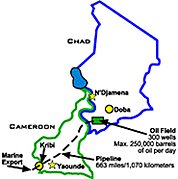
Chad is one of the poorest in the world. About 80 percent of its 7 million people live on less than $1 a day in this landlocked country in Central Africa. Like many others in the continent, Chad is trading on oil to increase GDP growth and development. The current project causing the dispute is the pipeline from Chad through Cameroon, built to transport the oil for export at the Atlantic Coast.

Total project costs were estimated at $4.1 billion. While the private sector sponsored most of the costs in this project, the World Bank has provided loans of $39.5 million to Chad as well. The condition of this World Bank loan is poverty reduction, to be monitored by Chad's churches, trade unions and non-governmental organisations.

Last December the Chadian government changed a law that carefully controlled how oil revenues were spent. Chad wanted to use $36m of revenues held in a fund that is meant to tackle poverty to deal instead with the country's financial problems, against the World Bank's warning. In response, the Bank froze all payments of oil revenues to the government, amounting to $100m. Failing negotiations, the Chadian government is issuing an ultimatum now, threatening that if the Bank does not turn over the revenue by noon on Tuesday next week, the pipeline will be shut down.

If the flow of oil is stopped, profits enjoyed by oil companies in the United States, namely Exxon Mobil, will dry up along with the pipeline.

The Chadian government accuses the World Bank of colonizing the country by imposing policy goals on money earned with the country's own natural resources. This controversy illustrates a classic problem in development economics, that in receipt of aid from the developed world, developing countries have to give up significant control over its national policies, implicating national sovereignty.

Thursday, April 13, 2006

New EBRD Loan to Azerbaijan

EBRD Loan to Boost Private Sector
AzerNews
April 13, 2006

European Bank for Reconstruction and Development:
http://www.ebrd.com/

The U.K.-based European Bank for Reconstruction and Development ("EBRD") provides financing to former Soviet States to encourage new investment and full transition to market economies. The EBRD, founded in 1991, operates in twenty-seven countries and has a capital base of 20 billion Euro.

This week, the EBRD, working cooperatively with AzeriGazBank, agreed to loan $2 million for the promotion of small and mid-size businesses in Azerbaijan. One goal of the EBRD loan is to stimulate job growth in the country. As of 2002, 49% of Azerbaijan citizens lived below the poverty line. As of 2005, the country's unemployment rate hovered at 1.2% for a labor force of 5.45 million people. Refer to the CIA Factbook for more information about Azerbaijan's chief industries.

The EBRD is often subject to the same criticisms as other large international lenders. Critics often request that the Bank reconsider certain policy initiatives and better ensure the effective use of money offered on credit. For a summary of some of these general concerns, review the UICIFD E-Book, Part II, Section 2.
The Importance of Sex
April 12, 2006
The Economist

The author discusses how women are the "world's most under-utilized resource" and a key to economic development and growth. In support of his argument, the author states that women consistently get better grades than men, are more likely to go to university and financially savvier than men. Thus, according to the author, women are better equipped to excel in the workforce than men.

The author exhorts governments to "exploit" women’s abilities. In the author's opinion, investing in female education in developing countries would deliver enormous economic and social returns for two reasons. First, educated women are likelier to be more productive than men, and second, they are likelier to raise well-educated and healthier children. The author suggests that increased representation of women in government will probably lead to a shift in priorities away from "tanks and bombs" to issues such as improving health, education and infrastructure.

Trying to Keep Doha Alive

African Union Nations Must Speak Up at WTO: US
Reuters
April 12, 2006

AU Ministers in Nairobi for WTO Talks
Kenya Times
April 12, 2006

In an effort to keep the WTO Doha trade talks moving, in light of a looming 2007 deadline, the U.S. Trade Representative has appealed to African countries to unite and more aggressively lobby for their preferred trade outcome. Negotiations between the U.S., E.U., and Brazil over agricultural and manufacturing trade provisions have led to a stalemate. This tactic may be an attempt to revitalize the discussion.

"[Deputy U.S.T.R.] Bhatia said African nations needed to appreciate what they stood to gain from a successful conclusion to the Doha round -- greater market access, greater security of access to the developed country market and most importantly, greater access between developing country markets, where tariffs are highest."

African Union members are in Nairobi discussing numerous trade related issues, including a bilateral agreement with China, the progress of WTO negotiations, and pending aid agreements.

Some critics argue that the bilateral agreements, like the one referenced above, will continue to be utilized even if the Doha negotiations successfully lead to a global trade agreement. To force an outcome would be unnecessary or counterproductive.

"[I]t does not follow that the U.S. appetite for bilaterals will be appeased if developing countries hasten to capitulate to terms of a Doha round from which only very few are expected to benefit, once the costs of tariff revenue loss and market entry facilitation are taken into account. The U.S. has negotiated and will continue to negotiate bilaterals with or without the conclusion of the Doha round. . . . Doha is in the doldrums because the Doha agenda is too large for WTO members to agree on in a way that can be implemented fairly, thoroughly and transparently."

Refer to "Forced Conclusion of Doha Agenda Is No Way to Go" for the full critique.

Wednesday, April 12, 2006

What Does Economics Have to Do with the Taiwan Issue?

Taiwan independence (or reunification, depending on which side is speaking) may seem like an issue of international law and politics, but what is often left out of the polemics is the fact that business and development ties between China and Taiwan are strong--and growing.

Excerpt from: Taipei calls for tourism and flights deals with Beijing
Financial Times, April 12, 2006

Taiwan on Wednesday called for a deal with China within six months on tourism and non-stop charter flights as its independence-minded government sought to pre-empt weekend talks between the opposition Kuomintang and the Chinese Communist leadership.

“We demand China complete negotiations with us within six months on admitting Chinese tourists to Taiwan and on regular passenger and cargo charter flights,” said Joseph Wu, the head of the cabinet-level China policy body.

Mr Wu added that Taipei’s move was aimed at clearing up “the misunderstanding that China is handing out goodwill all the time and we are blocking all the time.”

Delegates mandated by the government have been in contact with Chinese counterparts over potential deals on tourism and regular direct flights since last summer.

Taiwan had committed itself last year to letting up to 1,000 Chinese citizens in once it and Beijing have readied a regulatory framework. Taiwan also proposed a long time ago that regular cross-Strait charter flights for passengers and cargo should be established, with up to one flight a day on the cargo side.

China is more eager to see frequent passenger flights because it believes that increased contacts will make the Taiwanese people feel more positive about eventual unification, while Taiwan views cargo flights as more important because they are commercially attractive to its transport industry.

Officials said it is likely that charter flights will start this year, with more frequent one-off deals, and will then be gradually expanded into scheduled charter flights.

Chinese and Taiwanese airlines have offered one-off non-stop charter flights over Chinese New Year before. Such events are likely to occur more often now over the Dragonboat Festival and the Mid-Autumn festival, officials said. Separately, one-off cargo charter flights could be organized.

Taipei also hopes to expand the scope of cargo flights under any eventual agreement to nearly double the level of its earlier proposal.
**************************************************

It is known that Taiwan investment in China accounts for as much as half of all FDI in China. The economic gains from trade with China is something that the pro-independence camp in Taiwan have not overlooked at all. As the above report shows, there are times when Taiwan officials would like to claim credits for fostering stronger economic ties with China--as it is generally believed in Taiwan that it will help growth in domestic economy.

Tuesday, April 11, 2006

Wal-Bank

Regulators hear Wal-Mart critics By Kristin Roberts, Washington(Reuters)
UPDATE 3-Wal-Mart defends bank bid, draws fire from critics By Kristin Roberts, Washington(Reuters)
Wal-Mart Bank Opposed by Bankers, Consumer Groups (Update5) By Lauren Coleman-Lochner, New York

Wal-Mart has applied to the Federal Deposit Insurance Corporation (FDIC) for insurance for a proposed bank in Utah, one of the few states that allows commercial firms to operate banks.

Meanwhile, Utah is reviewing Wal-Mart's application for a bank charter. A coalition of labor unions, community groups, small bankers and other Wal-Mart critics has been urging the FDIC to hold hearings around the country before deciding the merits of Wal-Mart's application, and to compel Wal-Mart to disclose more information on how its new enterprise would affect local economies.

The small bankers also worry that the Wal-Mart bank, though based in Utah, could begin operating chapters in other states, threatening local lending institutions nationwide. And they worry about mixing commerce and banking.

The hearings in Arlington, Virginia, are the first the agency has ever held on an application. More than two dozen consumer groups and bankers are testifying that the company's reputation for wiping out competitors and its poor track record as a corporate citizen should convince the FDIC to reject Wal-Mart. The company's past attempts to operate banks in California, Oklahoma and Toronto have all been rejected by government regulators.

Labor and community groups have pointed out that given Wal-Mart's history of breaking labor and sex discrimination laws, there is little reason to think that Wal-Mart would obey banking laws.

Community advocates like ACORN are particularly troubled that Wal-Mart is trying to exempt its Utah bank from the Community Reinvestment Act, which requires financial institutions to make credit available in the low- and moderate-income communities in which they operate, and has sometimes been a genuine impetus to economic development in poor neighborhoods.

Global Trade, World Financial Markets Strong ...For Now

Financial system strong but challenges emerging: IMF By Katie Allen and Fiona Shaikh, London(Reuters)

WTO Sees Global Trade Growth Quickening in 2006 Geneva(Reuters)

Earlier this week the World Trade Organization (WTO) said that global trade may grow 7 percent in 2006, up slightly from 6 percent last year, but warned the outlook was uncertain.

Among downside risks is the possibility that U.S. economic growth could slow more than expected because of higher real interest rates and energy costs, it warned.

The International Monetary Fund voiced similar warnings this week. In its latest Global Financial Stability Report the IMF said that major cyclical risks that lay ahead for financial markets stemmed from higher interest rates and/or higher inflation, worsening credit quality of various debtors and a sudden unwinding of global imbalances. On house prices, it said U.S. housing market activity appeared to have slowed recently in response to higher interest rates in the world's largest economy, where the Federal Reserve raised borrowing costs for the 15th straight time last month.

But while there were concerns higher rates would raise households' debt servicing burdens and softer prices could curb consumption, the Fund noted "prospects of a soft landing" judging from trends in Britain and Australia's housing markets.

Wednesday, April 05, 2006

The Africa-China Nexus

It's not uncommon to hear the prediction that China will become a world power within the 21st Century. Rapid development and economic success since the reforms 28 years ago seem to confirm that observation. While news reports on China mostly focus on its love-hate relationship with the United States, many other countries and regions in the world have built significant business relationships, diplomatic ties, and even rivalries with China.

So what's the nexus between the African countries and China?

The oil.

Energy resources have become a viable trade item in the continent. Sudan, Nigeria, Angola, and Congo have traded with China on oil. Equatorial Guinea and Gabon are also oil traders. Africa currently contributes 12 percent of the world's liquid hydrocarbon production, and one in four barrels of oil discovered outside of the U.S. and Canada between 2000 and 2004 came from Africa.

Indeed, it has been reported that Angola has surpassed Saudi Arabia as the number one supplier of oil to China. Angola shipped 456,000 barrels a day to China in the first two months of the year.

If readers remember the CNOOC bid for UNOCAL last year that caused outcries in the United States--well, now CNOOC and other Chinese oil companies have found new courtships with African countries. Sinopec agreed last week to help build a $3bn refinery in Angola. In January, CNOOC agreed to pay $2,27bn for a stake in a Nigerian oil field. Companies from the U.S and India have also made significant investments in the region, hoping to assuage the current oil shortage and diversify reliance on suppliers in the Middle East.

In return for oil, China often offers development aid to its oil trading partners. A report by the Council of Foreign Relation has noted that, "In Angola, which currently exports 25 percent of its oil production to China, Beijing has secured a major stake in future oil production with a $2 billion package of loans and aid that includes funds for Chinese companies to build railroads, schools, roads, hospitals, bridges, and offices; lay a fiber-optic network; and train Angolan telecommunications workers."

Fifteen percent of U.S. oil imports come from Africa; by 2010 this could reach 20 percent.

Investment in Africa does not go without risks. Conflict situations, political instability, organized crimes and terrorism complicate the flow of free trade. Factors external to the African countries may also affect foreign policies. China's continuous courtship with the oil countries in Africa presents larger issues such as China's general tolerance toward authoritarian regimes, the involvement of arms trade as exchange for oil, and human rights violations that China often ignores.

Monday, April 03, 2006

Canadian Western Bank's secret of success

EXCLUSIVE-Canadian Western Bank rides oil boom to profit boom By Cameron French
Long merely a blip on Canada's financial services scene, Canadian Western Bank is bearing the fruit of close ties to the Alberta oil boom, and showing the Toronto-based big boys how to leverage low-risk growth from a strong economy.

Based in Edmonton, Alberta, CWB was once a stock market laggard. But it now commands a far better valuation than Canada's most profitable lenders, and plans to use its newfound wealth to add to its small but lucrative insurance business.

The bank, Canada's eighth-largest, makes its home far from the traditional banking centers of Toronto and Montreal. But its location has been crucial to success and has brought a lucrative franchise providing commercial loans to small-to-mid sized companies in Alberta, the new sweet spot of Canada's economy. "We serve the construction industry, the forestry industry, oil and gas, transportation, all those sorts of things that most of the other banks really ignore," Chief Executive Larry Pollock, said in a recent interview.

The bank's growth has prompted some analysts to reconsider the stock. "I've been wrong on the story now for quite a long time, and it was because when you take a look at Canadian Western Bank as a bank, its valuation does not make any sense whatsoever," said National Bank Financial analyst John Aiken, who rates the bank sector perform with a target of C$43 a share. "The problem is that we as Canadian investors are not used to seeing a bank growing at the same rate that CWB has been growing at on an extended period of time."

Intel's computer for developing nations.

Intel eyes PCs for developing nations

Intel is working on a durable, low-cost personal computer aimed at developing nations. The plan is to connect the computers to the internet using wireless protocols. The computers are specialized to withstand dust and heat, and to operate on a fluctuating power supply.

"Based on several pilot projects conducted throughout India, Intel sees the Community PC as most attractive to villagers seeking a registry for government paperwork they would otherwise have to travel extensively to retrieve and file."