Wednesday, April 19, 2006

Singapore: Self Replicating
May 23, 2006


In what has to be considered an ingenious solution to its crisis of lack of land, Singapore has offered to "manage" one of Indonesia's 17,500 islands. While Indonesia has yet to officially consider the offer, according to the author it makes "good sense." Singapore is long considered one of Asia's most productive and efficient economies. Its brand of "Singapore operating system" - a high-quality administration has been exported to various Asian countries such as Malaysia, India and China. Such "mini-Singapores" were mostly very successful in the early 1990s in stimulating local economies, while enabling Singapore to make "juicy profits."

The author contends that such a 'deal' would make sense for Indonesia - many of its islands are short on foreign investment, and are currently struggling with high levels of unemployment. Singapore would supply the much-needed impetus to local economies while expanding both physically and financially profiting from Indonesia's abundant land and cheap labor.

Tuesday, April 18, 2006

Market Insight: Don't Cry for Argentina
By Benedict Mander
FT.com
April 17, 2006

Last month, Argentina made its first bond issue directly to international investors since 2001 for $500 million. The country anticipates another $500 million. Previously, Argentina relied on Venezuela and local investors for all of its financing. This year, Argentina has borrowed $1.5 billion at below market interest rates from Venezuela and now feels confident enough to issue at market prices.

Some market analysts believe that Argentina will suffer a "whiplash" when the market changes. “Hold-out” investors who did not enter the restructuring last year still own $20 billion of Argentina’s unpaid debt. These investors prevent Argentina from issuing debt in foreign countries without risking the seizure of the funds. Without a settlement for hold-out investors, Argentina must pay an extra 30-50 basis points on locally issued debt.

Argentina is optimistic that Gross Domestic Product warrants will re-establish its credibility in international capital markets. Argentina is half way to its $4 billion funding requirement for this year. The remainder will come from a World Bank loan and domestic pension funds.

I don’t think Argentina has ever paid a long-term or medium-term bond in accordance with its terms. It is at a decision point: does it want to be a part of the world economy or not? At the moment, Argentina is not a serious country. – Manager of New York hedge fund that owns Argentine sovereign debt
IMF Urged to Tackle Imbalances with Top Nations
By Krishna Guha
FT.com
April 18, 2006

As part of its eight-point agenda for economic reform, the Institute of International Finance (IIF), a lobbyist organization representing 345 international financial institutions, urged the International Monetary Fund (IMF) to meet with the world’s 11 most economically powerful countries to advocate for policy changes that will reduce global economic imbalance.

Some of the recommendations IIF made included setting target ranges for the most important global currencies, such as the dollar, euro, yen, and Chinese renminbi; exercising caution when these countries lend to emerging markets; and monitoring how each country’s economic policies affect the world’s financial system.

The IIF also organized a committee of experts on emerging market finance to “monitor developments in emerging market lending and its own principles for lender-borrower relations.” The committee is chaired by Jean-Claude Trichet, president of the European Central Bank; Henrique de Campos Meirelles, governor of the Central Bank of Brazil; and Toyoo Gyohten, former Vice-Minister for Finance of Japan.

The IMF’s governing body, the International Monetary and Financial Committee will meet this Saturday in Washington at the IMF’s annual spring meeting.

Fed: End of rising interest rates near

End of US rate hike cycle may be near WASHINGTON (Reuters)

Federal Reserve policy-makers meeting on March 27-28 felt the U.S. central bank was nearly done raising interest rates but remained worried about potential inflation risks.

"Most members thought the end of the tightening process was likely to be near, and some expressed concerns about the dangers of tightening too much, given the lags in the effects of policy," said the minutes from the policy-setting meeting, the first under new Chairman Ben Bernanke.

The minutes from the meeting, at which policy-makers raised interest rates for a 15th time since mid-2004, were released on Tuesday.

Monday, April 17, 2006

China in Latin America

Chinese Influence in Brazil Worries U.S.
By Humphrey Hawksley
BBC Newsnight, Sao Paulo
April 3, 2006

Earlier this month, assistant Secretary of State Thomas Shannon was dispatched to Beijing to inquire about China's growing influence in Latin America on everything from oil and gas, to defense projects. America has been "protective" of Latin America since 1823, when President James Monroe "decreed that no foreign power would have more influence there than the U.S. itself."

Of great concern are the recent elections in Latin America that have produced a number of leftist countries that are extremely critical of U.S. policy.

"We're concerned about the leftist countries that are dealing with China," says Congressman Dan Burton (R) Chairman of Sub-Committee on the Western Hemisphere, "It's extremely important that we don't let a potential enemy of the U.S. become a dominant force in this part of the world."

China-Brazil business began less than two years ago after a series of meetings between Brazilian President Luiz Inacio Lula Da Silva and Chinese President Hu Jintao. Since then, there has been a heavy influence of Chinese culture in Brazil, including the Mandarin language and other Chinese cultural habits. China asserts that it has much to teach Brazil regarding building economic development and decreasing poverty.

Leftwinger’s Lead Narrows in Mexican Contest

By: Adam Thomson in Mexico City
April 17, 2006
Article

Analysts in Mexico believe that the upcoming Presidential election will be the closest in Mexican history. The leading candidate, Andrés Manuel López Obrador (leftwing candidate for the Democratic Revolutionary Party (PRD)), who used to hold a large lead, now holds a lead of only four points against Felipe Calderón, candidate for the Center-Right National Action Party (PAN). Calderón holds 34% of the vote, which is a 2% increase from only a month ago. Roberto Madrazo, candidate for the Revolutionary Institutional party (PRI), is a distant third with 25% of the vote.

As López Obrador’s lead becomes smaller and smaller, Mexico’s business and community and investors are enthralled because they view Calderón as a much stronger candidate. Calderón promises to open Mexico’s energy sector to private investors, make labor laws more flexible, and crack down on crime. On the other hand, López Obrador promises to cut salaries and perks of top government officials in order to fund more comprehensive social spending.

Some pollsters believe that López Obrador’s quick fall is due in part to very effective negative campaigning by Calderón’s team. Some advertisements link López Obrador to economic chaos and to Hugo Chávez, the radical Venezuelan president. Other analysts believe that this fall is due to López Obrador’s derogatory comments about President Vincente Fox. Mexican citizens place great importance on institutions, and therefore they reject attacks on the presidency.

On a positive note for López Obrador, his opponents have done the worst they can in terms of negative campaigning. As pollster Dan Lund stated, “López Obrador should be bleeding and on the floor but he is not. An independent poll confirms that he continues to be in the lead.”

Sunday, April 16, 2006

Will India Free the Rupee?

Business Week
In recent times, Indian politicians have expressed a desire to make remove any encumberances from India's currency, the Rupee. While the Rupee can be coverted freely for trade in goods and services, restrictions are placed on international asset acquisition. India's economy is in great shape for such a transition. Economic growth has averaged a very healthy 7-8% over the past five years, while inflation has remained steady at approximately 4-5%. India's foreign reserves currently stand at 144 billion dollars which would cover approximately 13 months of imports. Furthermore, short term debt as a percentage of total debt is also steadily declining.

Freeing its currency has many advantages for India. To begin with, a free currency would give emerging Indian companies access to foreign debt markets, in addition to decreasing delays in foreign exchange trades. The abolishment of capital controls would allow foreign investors greater access to India's banks and debt markets and might boost foreign investment, which despite substantial improvements, lags far behind China. To sustain its current rate of growth, India's Prime Minister has estimated that India would require approximately 70 billion dollars of foreign investment, something that could be realized with the help of a free currency. Moreover, a freely floating currency would remove the last remaining obstacle to India's integration with global markets, and would be "a reflection of the nation's increased self-confidence."
Exports and Lending Push China's GDP growth to 10%
Richard McGregor
Financial Times

China's economy grew 10.2% the first quarter of 2006 buoyed by strong export growth and resurgent bank lending. China had a trade surplus of 23 billion dollars in the first quarter and its foreign reserves rose by 56 billion dollars. This rapid pace of growth because of increasing export demand is likely to lead to further calls from the United States for China to appreciate its currency. Last year China de-pegged its currency, the Renminbi from the US dollar allowing a one-time appreciation of 2.1 per cent. The currency has since appreciated by approximately 1.1 per cent against the US dollar.

The robust growth is not impressing many however. In fact, critics point that China continues to rely heavily on foreign investment and heavy industrialization, which is considered undesirable and unsustainable by many. In response to these critics, the Chinese Government is clearly recognizing objectives other than rapid economic growth. In its next 5 year plan, the Government has envisaged a growth rate of 'just' 7.5%, with the focus being on energy efficiency and environmental awareness during this time.

Chad Government Threatens Oil Production Against World Bank Policies


Revenue from oil is providing the fertile ground for dispute between the government in Chad and the World Bank.

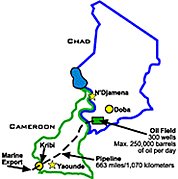
Chad is one of the poorest in the world. About 80 percent of its 7 million people live on less than $1 a day in this landlocked country in Central Africa. Like many others in the continent, Chad is trading on oil to increase GDP growth and development. The current project causing the dispute is the pipeline from Chad through Cameroon, built to transport the oil for export at the Atlantic Coast.

Total project costs were estimated at $4.1 billion. While the private sector sponsored most of the costs in this project, the World Bank has provided loans of $39.5 million to Chad as well. The condition of this World Bank loan is poverty reduction, to be monitored by Chad's churches, trade unions and non-governmental organisations.

Last December the Chadian government changed a law that carefully controlled how oil revenues were spent. Chad wanted to use $36m of revenues held in a fund that is meant to tackle poverty to deal instead with the country's financial problems, against the World Bank's warning. In response, the Bank froze all payments of oil revenues to the government, amounting to $100m. Failing negotiations, the Chadian government is issuing an ultimatum now, threatening that if the Bank does not turn over the revenue by noon on Tuesday next week, the pipeline will be shut down.

If the flow of oil is stopped, profits enjoyed by oil companies in the United States, namely Exxon Mobil, will dry up along with the pipeline.

The Chadian government accuses the World Bank of colonizing the country by imposing policy goals on money earned with the country's own natural resources. This controversy illustrates a classic problem in development economics, that in receipt of aid from the developed world, developing countries have to give up significant control over its national policies, implicating national sovereignty.

Thursday, April 13, 2006

New EBRD Loan to Azerbaijan

EBRD Loan to Boost Private Sector
AzerNews
April 13, 2006

European Bank for Reconstruction and Development:
http://www.ebrd.com/

The U.K.-based European Bank for Reconstruction and Development ("EBRD") provides financing to former Soviet States to encourage new investment and full transition to market economies. The EBRD, founded in 1991, operates in twenty-seven countries and has a capital base of 20 billion Euro.

This week, the EBRD, working cooperatively with AzeriGazBank, agreed to loan $2 million for the promotion of small and mid-size businesses in Azerbaijan. One goal of the EBRD loan is to stimulate job growth in the country. As of 2002, 49% of Azerbaijan citizens lived below the poverty line. As of 2005, the country's unemployment rate hovered at 1.2% for a labor force of 5.45 million people. Refer to the CIA Factbook for more information about Azerbaijan's chief industries.

The EBRD is often subject to the same criticisms as other large international lenders. Critics often request that the Bank reconsider certain policy initiatives and better ensure the effective use of money offered on credit. For a summary of some of these general concerns, review the UICIFD E-Book, Part II, Section 2.
The Importance of Sex
April 12, 2006
The Economist

The author discusses how women are the "world's most under-utilized resource" and a key to economic development and growth. In support of his argument, the author states that women consistently get better grades than men, are more likely to go to university and financially savvier than men. Thus, according to the author, women are better equipped to excel in the workforce than men.

The author exhorts governments to "exploit" women’s abilities. In the author's opinion, investing in female education in developing countries would deliver enormous economic and social returns for two reasons. First, educated women are likelier to be more productive than men, and second, they are likelier to raise well-educated and healthier children. The author suggests that increased representation of women in government will probably lead to a shift in priorities away from "tanks and bombs" to issues such as improving health, education and infrastructure.

Trying to Keep Doha Alive

African Union Nations Must Speak Up at WTO: US
Reuters
April 12, 2006

AU Ministers in Nairobi for WTO Talks
Kenya Times
April 12, 2006

In an effort to keep the WTO Doha trade talks moving, in light of a looming 2007 deadline, the U.S. Trade Representative has appealed to African countries to unite and more aggressively lobby for their preferred trade outcome. Negotiations between the U.S., E.U., and Brazil over agricultural and manufacturing trade provisions have led to a stalemate. This tactic may be an attempt to revitalize the discussion.

"[Deputy U.S.T.R.] Bhatia said African nations needed to appreciate what they stood to gain from a successful conclusion to the Doha round -- greater market access, greater security of access to the developed country market and most importantly, greater access between developing country markets, where tariffs are highest."

African Union members are in Nairobi discussing numerous trade related issues, including a bilateral agreement with China, the progress of WTO negotiations, and pending aid agreements.

Some critics argue that the bilateral agreements, like the one referenced above, will continue to be utilized even if the Doha negotiations successfully lead to a global trade agreement. To force an outcome would be unnecessary or counterproductive.

"[I]t does not follow that the U.S. appetite for bilaterals will be appeased if developing countries hasten to capitulate to terms of a Doha round from which only very few are expected to benefit, once the costs of tariff revenue loss and market entry facilitation are taken into account. The U.S. has negotiated and will continue to negotiate bilaterals with or without the conclusion of the Doha round. . . . Doha is in the doldrums because the Doha agenda is too large for WTO members to agree on in a way that can be implemented fairly, thoroughly and transparently."

Refer to "Forced Conclusion of Doha Agenda Is No Way to Go" for the full critique.

Wednesday, April 12, 2006

What Does Economics Have to Do with the Taiwan Issue?

Taiwan independence (or reunification, depending on which side is speaking) may seem like an issue of international law and politics, but what is often left out of the polemics is the fact that business and development ties between China and Taiwan are strong--and growing.

Excerpt from: Taipei calls for tourism and flights deals with Beijing
Financial Times, April 12, 2006

Taiwan on Wednesday called for a deal with China within six months on tourism and non-stop charter flights as its independence-minded government sought to pre-empt weekend talks between the opposition Kuomintang and the Chinese Communist leadership.

“We demand China complete negotiations with us within six months on admitting Chinese tourists to Taiwan and on regular passenger and cargo charter flights,” said Joseph Wu, the head of the cabinet-level China policy body.

Mr Wu added that Taipei’s move was aimed at clearing up “the misunderstanding that China is handing out goodwill all the time and we are blocking all the time.”

Delegates mandated by the government have been in contact with Chinese counterparts over potential deals on tourism and regular direct flights since last summer.

Taiwan had committed itself last year to letting up to 1,000 Chinese citizens in once it and Beijing have readied a regulatory framework. Taiwan also proposed a long time ago that regular cross-Strait charter flights for passengers and cargo should be established, with up to one flight a day on the cargo side.

China is more eager to see frequent passenger flights because it believes that increased contacts will make the Taiwanese people feel more positive about eventual unification, while Taiwan views cargo flights as more important because they are commercially attractive to its transport industry.

Officials said it is likely that charter flights will start this year, with more frequent one-off deals, and will then be gradually expanded into scheduled charter flights.

Chinese and Taiwanese airlines have offered one-off non-stop charter flights over Chinese New Year before. Such events are likely to occur more often now over the Dragonboat Festival and the Mid-Autumn festival, officials said. Separately, one-off cargo charter flights could be organized.

Taipei also hopes to expand the scope of cargo flights under any eventual agreement to nearly double the level of its earlier proposal.
**************************************************

It is known that Taiwan investment in China accounts for as much as half of all FDI in China. The economic gains from trade with China is something that the pro-independence camp in Taiwan have not overlooked at all. As the above report shows, there are times when Taiwan officials would like to claim credits for fostering stronger economic ties with China--as it is generally believed in Taiwan that it will help growth in domestic economy.
Tuesday, April 11, 2006

Wal-Bank

Regulators hear Wal-Mart critics By Kristin Roberts, Washington(Reuters)
UPDATE 3-Wal-Mart defends bank bid, draws fire from critics By Kristin Roberts, Washington(Reuters)
Wal-Mart Bank Opposed by Bankers, Consumer Groups (Update5) By Lauren Coleman-Lochner, New York

Wal-Mart has applied to the Federal Deposit Insurance Corporation (FDIC) for insurance for a proposed bank in Utah, one of the few states that allows commercial firms to operate banks.

Meanwhile, Utah is reviewing Wal-Mart's application for a bank charter. A coalition of labor unions, community groups, small bankers and other Wal-Mart critics has been urging the FDIC to hold hearings around the country before deciding the merits of Wal-Mart's application, and to compel Wal-Mart to disclose more information on how its new enterprise would affect local economies.

The small bankers also worry that the Wal-Mart bank, though based in Utah, could begin operating chapters in other states, threatening local lending institutions nationwide. And they worry about mixing commerce and banking.

The hearings in Arlington, Virginia, are the first the agency has ever held on an application. More than two dozen consumer groups and bankers are testifying that the company's reputation for wiping out competitors and its poor track record as a corporate citizen should convince the FDIC to reject Wal-Mart. The company's past attempts to operate banks in California, Oklahoma and Toronto have all been rejected by government regulators.

Labor and community groups have pointed out that given Wal-Mart's history of breaking labor and sex discrimination laws, there is little reason to think that Wal-Mart would obey banking laws.

Community advocates like ACORN are particularly troubled that Wal-Mart is trying to exempt its Utah bank from the Community Reinvestment Act, which requires financial institutions to make credit available in the low- and moderate-income communities in which they operate, and has sometimes been a genuine impetus to economic development in poor neighborhoods.

Global Trade, World Financial Markets Strong ...For Now

Financial system strong but challenges emerging: IMF By Katie Allen and Fiona Shaikh, London(Reuters)

WTO Sees Global Trade Growth Quickening in 2006 Geneva(Reuters)

Earlier this week the World Trade Organization (WTO) said that global trade may grow 7 percent in 2006, up slightly from 6 percent last year, but warned the outlook was uncertain.

Among downside risks is the possibility that U.S. economic growth could slow more than expected because of higher real interest rates and energy costs, it warned.

The International Monetary Fund voiced similar warnings this week. In its latest Global Financial Stability Report the IMF said that major cyclical risks that lay ahead for financial markets stemmed from higher interest rates and/or higher inflation, worsening credit quality of various debtors and a sudden unwinding of global imbalances. On house prices, it said U.S. housing market activity appeared to have slowed recently in response to higher interest rates in the world's largest economy, where the Federal Reserve raised borrowing costs for the 15th straight time last month.

But while there were concerns higher rates would raise households' debt servicing burdens and softer prices could curb consumption, the Fund noted "prospects of a soft landing" judging from trends in Britain and Australia's housing markets.

Wednesday, April 05, 2006

The Africa-China Nexus

It's not uncommon to hear the prediction that China will become a world power within the 21st Century. Rapid development and economic success since the reforms 28 years ago seem to confirm that observation. While news reports on China mostly focus on its love-hate relationship with the United States, many other countries and regions in the world have built significant business relationships, diplomatic ties, and even rivalries with China.

So what's the nexus between the African countries and China?

The oil.

Energy resources have become a viable trade item in the continent. Sudan, Nigeria, Angola, and Congo have traded with China on oil. Equatorial Guinea and Gabon are also oil traders. Africa currently contributes 12 percent of the world's liquid hydrocarbon production, and one in four barrels of oil discovered outside of the U.S. and Canada between 2000 and 2004 came from Africa.

Indeed, it has been reported that Angola has surpassed Saudi Arabia as the number one supplier of oil to China. Angola shipped 456,000 barrels a day to China in the first two months of the year.

If readers remember the CNOOC bid for UNOCAL last year that caused outcries in the United States--well, now CNOOC and other Chinese oil companies have found new courtships with African countries. Sinopec agreed last week to help build a $3bn refinery in Angola. In January, CNOOC agreed to pay $2,27bn for a stake in a Nigerian oil field. Companies from the U.S and India have also made significant investments in the region, hoping to assuage the current oil shortage and diversify reliance on suppliers in the Middle East.

In return for oil, China often offers development aid to its oil trading partners. A report by the Council of Foreign Relation has noted that, "In Angola, which currently exports 25 percent of its oil production to China, Beijing has secured a major stake in future oil production with a $2 billion package of loans and aid that includes funds for Chinese companies to build railroads, schools, roads, hospitals, bridges, and offices; lay a fiber-optic network; and train Angolan telecommunications workers."

Fifteen percent of U.S. oil imports come from Africa; by 2010 this could reach 20 percent.

Investment in Africa does not go without risks. Conflict situations, political instability, organized crimes and terrorism complicate the flow of free trade. Factors external to the African countries may also affect foreign policies. China's continuous courtship with the oil countries in Africa presents larger issues such as China's general tolerance toward authoritarian regimes, the involvement of arms trade as exchange for oil, and human rights violations that China often ignores.

Monday, April 03, 2006

Canadian Western Bank's secret of success

EXCLUSIVE-Canadian Western Bank rides oil boom to profit boom By Cameron French
Long merely a blip on Canada's financial services scene, Canadian Western Bank is bearing the fruit of close ties to the Alberta oil boom, and showing the Toronto-based big boys how to leverage low-risk growth from a strong economy.

Based in Edmonton, Alberta, CWB was once a stock market laggard. But it now commands a far better valuation than Canada's most profitable lenders, and plans to use its newfound wealth to add to its small but lucrative insurance business.

The bank, Canada's eighth-largest, makes its home far from the traditional banking centers of Toronto and Montreal. But its location has been crucial to success and has brought a lucrative franchise providing commercial loans to small-to-mid sized companies in Alberta, the new sweet spot of Canada's economy. "We serve the construction industry, the forestry industry, oil and gas, transportation, all those sorts of things that most of the other banks really ignore," Chief Executive Larry Pollock, said in a recent interview.

The bank's growth has prompted some analysts to reconsider the stock. "I've been wrong on the story now for quite a long time, and it was because when you take a look at Canadian Western Bank as a bank, its valuation does not make any sense whatsoever," said National Bank Financial analyst John Aiken, who rates the bank sector perform with a target of C$43 a share. "The problem is that we as Canadian investors are not used to seeing a bank growing at the same rate that CWB has been growing at on an extended period of time."

Intel's computer for developing nations.

Intel eyes PCs for developing nations

Intel is working on a durable, low-cost personal computer aimed at developing nations. The plan is to connect the computers to the internet using wireless protocols. The computers are specialized to withstand dust and heat, and to operate on a fluctuating power supply.

"Based on several pilot projects conducted throughout India, Intel sees the Community PC as most attractive to villagers seeking a registry for government paperwork they would otherwise have to travel extensively to retrieve and file."

Thursday, March 30, 2006

Pollution Tax in China

One of the major items discussed at the current National People's Congress sessions is pollution. Effective this past weekend, China has started imposing a tax on luxury cars in an effort to reduce air pollution. Cars like SUVs (Sports Utility Vehicles) or Mercedes Benz will be taxed at 3 percent to 20 percent, depending on engine size.

Yet analysts are not confident that these new measures will help reduce pollution level or even affect car sales in China. The luxury car market, although developing, still consists a small share in China's total car sales. Also, consumer demand for luxury cars may not be affected too much, because those who can afford to buy luxury cars in the first place probably will not be overly concerned with the tax increase. Other commentators suggested that a better way to tax luxury car is to take account of a vehicle's fuel efficiency, not just the size of the engine.

Another alternative is to impose an across-the-board fuel tax. State administrative officials said that the fuel tax is not in place because of concerns of general high oil prices in the world.

Other unlikely items to be taxed include disposable wooden chopsticks, planks for wood floors, luxury watches, golf clubs, yachts, golf balls and certain oil products. These new taxes are intended to reduce pollution and conserve energy. China has been criticized for consuming large amount of wood from Southeast Asia to produce its disposal chopsticks. The luxury goods tax targets the political and business elites who have reaped huge profits from the booming economy.

It is no news that pollution problems have global consequences. Developed countries have long realized that their efforts to reduce pollution may well be futile in face of the ever intensifying rate of industrial production in countries like China and India. Yet how can the West make the case to developing countries that, a century after the industrial revolution and the subsequent material wealth and environmental degradation it caused, it is now not right for the developing countries to do the same?

Sources:
Xinhua.net, Combating Pollution Has Priority, Feb. 14, 2006
ABC News Online, Latest Import from China: Filthy Air, Mar. 27, 2006
Associated Press, Analysts: China Pollution Tax Ineffective, Mar. 25, 2006
New York Times, China Aims Taxes at Cars and the Rich, Mar. 22, 2006

Wednesday, March 29, 2006

The World's Biggest Forex Reserves

New data reports show that China currently holds the world's biggest foreign exchange reserves, surpassing that of Japan's. Beijing said, however, that this will not change its gradualist approach to currency reform.

At the end of Feruary, China's reserves reached U.S. $853.7 billion, and Japan's was U.S. $850 billion. On the other hand, the United States has a much smaller foreign currency reserve of approximately $38.9 billion.

There had been reports a few months ago stating that China had planned on shifting some of its foreign reserve holdings from the American dollar to some other foreign currencies. Some economists in the U.S. has warned that such actions by the Chinese government could induce fluctuations in the value of the greenback. Not all economists, however, anticipate negative repercussions for the U.S. economy. Were China and Japan to engineer a significant fall in the dollar, those nations also would suffer the consequences -- sharply diminished exports as Americans lose spending power, plus a drop in the value of their dollar assets. This could be an incentive for China to hold on to its American dollars.

Currency exchange rate can have considerable bearing on trade balance sheets. While it has been speculated that, with the unpegging of the yuan, the U.S. trade deficit with China would be reduced, data has shown that it has not happened as expected. Some economists have noted that the reduction of trade imabalance between the U.S. and China is a collaborative effort. While China was to float the exchange rate, the United States should also look into structural issues such as savings rate and active reduction of its deficits.

Chinese policymakers have justified the increased foreign exchange reserves with a few observations. The high reserves held by China, Japan and other Asian economies was a result of the Asian financial crisis in 1998. It is also noteworthy that Asian economies have saving regimes that favor savings much more so than consumption. While some of the increased reserves came from trade imabalance with the United States, some of them also came from increased foreign direct investment from American companies. Finally, on balance, the reserves on a per capita level are not all that high.

With the U.S. Congress aiming to pass policies to reduce the trade deficits, this news comes as yet another incentive for politicians to consider drastic measures against a free market solution to China's continuous rise.

Sources:
Financial Times, China Forex Reserves World's Biggest, Report Says, March 28, 2006.
Washington Post, China Set To Reduce Exposure To Dollar, Move Would Probably Push Currency Down, January 10, 2006.
International Monetary Fund, Data Template on International Reserves and Foreign Currency Liquidity (U.S. data)