Tuesday, May 02, 2006

Amigos Del Inmigrantes in Iowa City

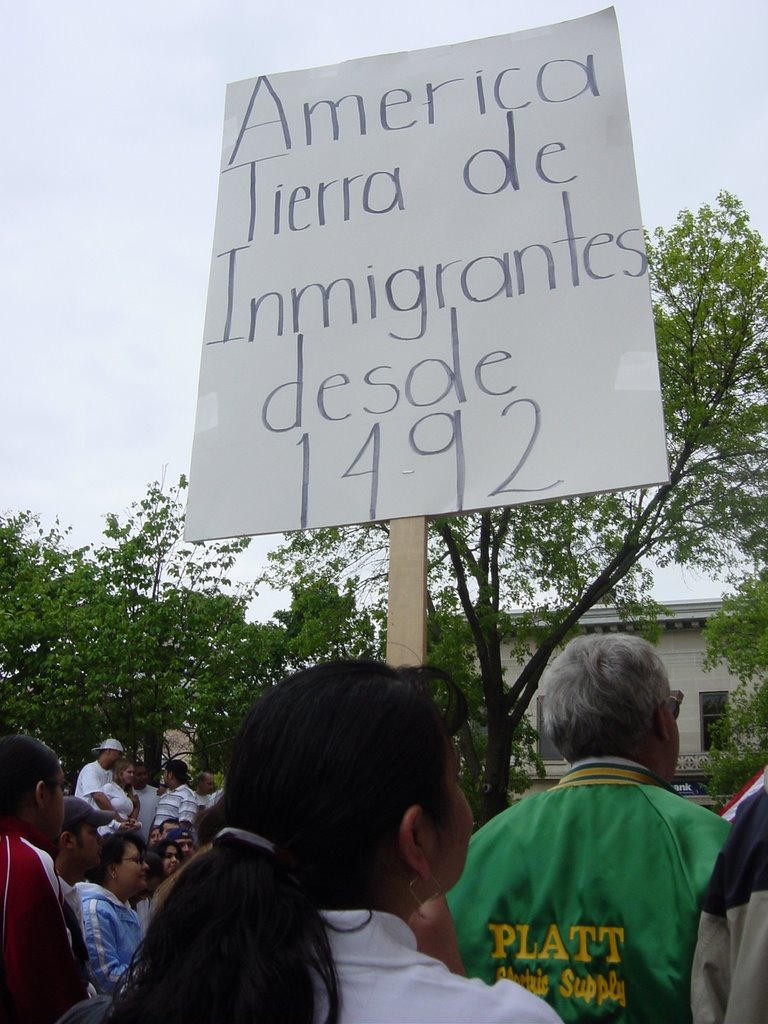
In support of nation-wide protests against U.S. immigration policies, and to call for solid reforms that are realistic and humane, Iowa City mobilized yesterday to march and demonstrate.

Here are some pictures of the noon-time rally.


For full images, click here.

Monday, May 01, 2006

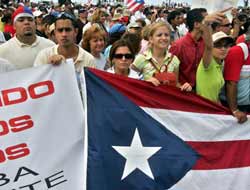
Disagreement over Budget Shuts Down Puerto Rican Government


Puerto Rican Government Shuts Down, BBC News, 5/1/06
Puerto Rico Questions U.S. Ties By Jonathan Beale, BBC News, 3/28/06

The U.S. territory of Puerto Rico, in the midst of a financial crisis, has temporarily shut down all state-operated schools and non-essential government offices. Approximately 95,000 government workers have been left without work and 40,000 students without classes. The government is the country’s biggest employer. Puerto Rico operates as a self-governing commonwealth, but President Bush is its head of state.

Governor Aníbal Acevedo Víla has blamed the crisis on “legislative inaction”. The Puerto Rican government is currently operating at an estimated $740 million dollar deficit, and has been unable to agree its budget. The government is currently using its 2004 budget because there has been no agreement with the Puerto Rican legislature since that year.

Last week, thousands of Puerto Ricans protested in the streets, demanding a solution. Governor Acevedo hopes to introduce a 7 percent sales tax to help pay off the island’s debt and allow the government to operate. The U.S. territory currently has no sales tax, but most legislators are opposed to any tax higher than 5.5 percent. Puerto Ricans do not pay U.S. income tax, but the island receives federal funds.

The financial crisis occurs on the brink of a recent White House report questioning the political status of Puerto Rico. The commonwealth is divided with some islanders demanding independence, others advocating that Puerto Rico become the U.S.’s 51st state, and others encouraging that the island retain its current status. In 1998, only 2.5 percent of the island population favored independence. However, there has been growing resentment that their country continues to deny them full voting rights.

Dubai Firm's Deal for Pentagon Supplier Is Cleared

By: Greg Hitt
April 29, 2006
http://online.wsj.com/article/SB114627255290939508.html?mod=economy_lead_story_lsc

Despite wide security concerns, President Bush approved a $1.2 billion deal that will give Dubai International Capital, a Dubai-owned firm, control of nine manufacturing plants in the U.S. that supply machine parts to the Pentagon for military vehicles and aircrafts; Dubai International is taking over for Doncasters Group Ltd., a United Kingdom company. President Bush defended his decision last Friday stating, "I signed off on it this morning because I'm convinced -- at the recommendation of the [Committee of Foreign Investment in the U.S.] as well as our military -- that it's a sale that should go through." The CFIUS committee conducted a 45-day investigation of the transaction, which thus far has provoked nowhere near the level of concern displayed over the ports deal.

The administration conducted a "careful, thoughtful" review of the Doncasters deal, which is very different from the ports transaction. "This is a product, not a service, and the opportunity to infiltrate and sabotage is both more difficult and more detectable," said Senator Charles Schumer, a New York Democrat. CFIUS is led by the Treasury Department and includes representatives of the State and Defense departments, which are deeply involved in the process.

Mr. Bush's press secretary said the review included an assessment of "potential threats to our national security" by the U.S. intelligence community, and as a condition of approval of the deal, the company signed an "assurances agreement" with the Pentagon, agreeing to provide a continuous supply of parts.

Asian, European Workers Demand Better Wages, Working Conditions

Associated Press
May 1, 2006
http://online.wsj.com/article_print/SB114648153656140313.html

Protests in Asia:

As people protest against the proposed immigration bill today in the United States, citizens of Asia and Europe take the day to protest unemployment, poor working conditions, and low wages. Although the protestors promise a friendly demonstration, police were on high alert in Asia with helicopters hovering overhead in Indonesia and riot police guarding the presidential palace in the Philippines. In the Philippines, government troops and police armed with batons and shields turned away hundreds of activists who marched to the Philippine presidential palace to demand a wage hike and President Gloria Macapagal Arroyo's ouster.

In Sri Lanka, “where violence between Tamil Tiger rebels and the military has sparked fears of a return to civil war, the government decided to cancel all May Day rallies in the capital.” Fifty thousand people in Jakarta chanted, “Don’t change the law,” in response to Indonesia’s plans to revise current labor laws by cutting severance packages and introducing more flexible contracts that would decrease worker security. In Cambodia, thousands of police brought the capital to a standstill during a government hold on an unauthorized May Day demonstrations. The government denied permission for the rally, allowing only one official May Day demonstration at Chenla Theater. Police armed with riot shields and batons physically prevented protesters from marching.

Protests in Europe:

“Meanwhile, in Moscow, official events set up by the ruling pro-United Russia party overshadowed traditional protest marches by the opposition Communists as 25,000 people gathered opposite the mayor's office in the central Tverskaya Street to hear speeches from trade union leaders and the mayor and listen to a concert.” In total, 1.5 million people participated in May Day rallies in Russia.

Labor unions in Germany protested the impact of globalization and the sacrifice of jobs of a quick profit. The labor unions also urged the government to introduce a minimum wage. Unfortunately for Germans, unemployment stands at 11.5 percent, “undermining government finances and the country's generous welfare state.” In Vienna, about 120,000 members of the opposition Social Democratic Party participated in a traditional march, which focused on Austria’s 8 percent unemployment rate.

Finally, in Bosnia the unemployed marched down the main street in Sarajevo, demanding new elections and the resignation of the government, which they claim is not doing enough to lower the unemployment rate, which has been above 40 percent for years.
Lamy calls for trade deal revival BBC (UK)

In the first quarter of 2006 the US economy grew at its fastest rate in two and a half years, according to the Commerce Department. Growth was boosted by government spending to deal with damage from last year's Gulf Coast hurricanes. Earlier this week, the Federal Reserve chairman said he expected growth to slow to a more sustainable level.

"With crude oil prices soaring and China investing in new export capacity at a breakneck pace, the trade deficit will continue to pull down U.S. growth," said Peter Morici, a University of Maryland economist. "Without a devaluation of the dollar against the Chinese yuan, U.S. growth will slow significantly in the second half of this year."

What does this mean for consumers? Brian Fabbri, chief economist at BNP Paribas in New York said "..consumers feel happy but they are beginning to become a little less happy about gasoline price increases. This is not a big move in confidence but it does say that confidence is probably levelling off and would probably continue to do so while gasoline prices go up."

Bolivia Nationalizes Gas Industry

Wall Street Journal
May 1, 2006
http://online.wsj.com/article/SB114650311422040582.html?mod=world_news_whats_news

Bolivia nationalized its natural gas industry on Monday, ordering all foreign energy companies to send their supplies to Yacimientos Petroliferos Fiscales Bolivianos, a state company responsible for sales and industrialization. President Evo Morales spoke from a facility owned by Brazil’s Petroleo Brasileiro SA (Petrobras) and Spanish-Argentine’s Repsol YPF, and stated: "The time has come, the awaited day, a historic day in which Bolivia retakes absolute control of our natural resources."

Mr. Morales further warned that companies which did not follow the decree would have to leave Bolivia within six months. The companies mostly affected by this nationalization of oil are Petrobras, Repsol, British Gas, Britain’s BP PLC, and France’s Total SA. In addition to natural gas companies, Bolivia also plans to retake control of hydrocarbons companies that were privatized in the 1990s by taking over shares that belong to foreign companies as well as semipublic Bolivian entities.

This decision is closely in line with Mr. Morale’s campaign platform “to wring greater profits from the gas producers doing business in Bolivia, which has South America’s second-largest reserves after Venezuela.” Last year, in efforts to speed the nationalization process, “Bolivia's congress passed a law that raised taxes and royalties on gas production and recognized the state as the sole owner of hydrocarbon resources.”

"El Boicot" Set to Test Employers in US

By: Edward Alden and Jenny Johnson in Washington and Christopher Parkesin Los Angeles
Financial Times
April 30 2006
http://news.ft.com/cms/s/cf3ba260-d879-11da-9715-0000779e2340.html

As Tanya posted earlier today, many Hispanic workers and people opposed to Congress’s efforts to crack down on illegal immigration, will protest today by walking out of work and demonstrating against the bill which would make illegal immigrants felons. Today, which is dubbed “El Boicot” or “A Day Without an Immigrant,” is aimed to show Americans what a day would be like in the United States without the work and consumption of immigrants.

Several industries like small retailers, meat packing plants, and restaurants heavily depend on immigrant labor and have prepared for possible shutdowns. For instance, “in Los Angeles, a fruit and vegetable market in the city center, employing 1,800 and serving 4,500 restaurants and 3,000 shops, will be closed today.” John Gay, Senior Vice President for the National Restaurant Association, states that the Association is on the same side as the immigrants from a policy standpoint; an ironic fact given that restaurants are likely to suffer the brint of closures due to the boycott.

There is however, some dispute, even among Immigrant groups, regarding whether or not the boycott should happen. Los Angeles’ Cardinal Roger Mahony, who was an avid supporter of the March 26th demonstration, which consisted of over 500,000 people jamming the streets of central LA, urged people to work and go to school normally during the day, and attend a major rally afterwards. A few union leaders have predicted that more than 2 million people will rally in Los Angeles and walkouts are expected at several educational institutions.

As a result of potential massive workouts, employers are faced with the task of disciplining those employees who chose to walk out. Since most employment is of the at-will variety, employers will have a huge leeway in deciding whether or not to terminate these workers. Employees are urged to ask for the day off, but “improper use of a sick leave [can be] construed as grounds for disciplinary action.” Angelo Amador, Director of Immigration Policy for the U.S. Chamber of Commerce warns that disciplinary action should be consistent: “You have to be careful if somebody takes off to go to a baseball game and you don’t fire them for that, then you cannot fire them because of this.”

Today is meant to be an eye-opening experience showing the impact that immigrants have on the economy of our country. So what will you do? Will you be one of the estimated millions of people to walk out today? Stay tuned for what I imagine will be increasing discussion on the matter.

Questions:
1) What do you think? Do you think that immigrants should protest today and walk out of their jobs, or do you agree with Cardinal Mahony?

2) What is that likely impact that this walkout will have on American commerce? Will anything change?

3) What, if any, impact will the “Day Without an Immigrant” have on Congress? Do the men and women in Washington care?

Europe Driven Lower by Auto and Oil Stocks

By: Neil Dennis
Financial Times
April 28, 2006
http://news.ft.com/cms/s/a3212632-d680-11da-b64c-0000779e2340.html

This week, European carmakers announced their quarterly results which indicate that the auto sector has risen more than 18 percent this year. There is hope in the industry that restructuring would reduce the large cost base faced by most European manufacturers. Renault reported higher than expected sales and investors were delighted with a 5.8 percent rise in first quarter sales. Renault’s CEO, Carlos Ghosn, plans to turn Renault into Europe’s most profitable volume car maker in a short four-year time span. Investment firms were very impressed with these results, which Merrill Lynch called “eye popping,” and marked the week’s biggest increase, up 7.4 percent.

On a poorer note, DaimlerChrysler’s shares fell 6.4 percent over the weekend, indicating a loss in profits at both its Chrysler and Mercedes divisions. Additionally, Europe’s largest manufacturer, Volkswagen fell 4.4 percent after failing to meet expectations due to restructuring costs and low quarterly earnings. As Stephen Pope of Cantor Fitzgerald said, “Volkswagen particularly, has to rid itself of its huge cost burden.” On the other hand, brands like Peugeot and Infineon had an increase in quarterly sales.

However, “oil stocks added [the] most downward pressure on the market as crude prices retreated from recent record highs.” Following China’s increase in interest rates last Thursday, interest rates rose “prompting fears that attempts to cool the economy could slow demand for oil.”

Immigrants Rallying Today

Immigrants set for massive ralliesBy Thomas Ferraro, Washington (Reuters)

"The Great May 1 Boycott, a day without immigrants," is a follow-up to the demonstrations attended by hundreds of thousands of immigrants and their supporters across the nation on April 10. Those rallies protested a get-tough bill passed by the Republican-led House of Representatives that would reclassify illegal immigrants as felons, punish those who help them and build a fence along much of the U.S.-Mexican border.

A bipartisan bill stalled in the U.S. Senate would bolster border security, but also provide illegal immigrants a path toward citizenship and a guest-worker program long favored by Bush.

Today's nationwide boycott may result in millions of immigrants will stay away from work, school and stores and rally in support of an overhaul of America's immigration laws. It will be interesting to see what effect, if any, this has on Iowa City.

Saturday, April 29, 2006

Global Bonds Suffer Amid Rate Uncertainty

By: Jennifer Hughes
Financial Times
April 28 2006
http://news.ft.com/cms/s/a75fd8fa-d6a4-11da-b64c-0000779e2340.html

Global bonds dropped 0.9 percent in March and 0.7 percent in April, thus yielding the worst returns in two years, when the markets were getting ready for the U.S. Federal Reserve to raise interest rates. A total of two thirds of all local and government bonds posted negative absolute returns this year. The decrease in interest rates was felt across the board: Lehman Brother’s U.S. Aggregate Bond index fell 1.2 percent year to date, Pan-Europe index fell 2.7 percent, and Asia-Pacific fell 1.3 percent year to date.

Recently, yields posted a series of four year highs in expectation of a quarter-point rate rise in May and another rise to 5.25 percent by June. Unfortunately, on Thursday, Fed chairman Ben Bernanke hinted at a looming pause in rate rises. Speculators argued about whether the pause in interest rate rises was truly a pause or an end; those arguing that interest rate rises were nearing an end were in fact correct. Some “traders are betting that rate-sensitive, short-dated yields will fall faster than longer-dated ones because they believe it will become clearer that the next move in rates will be down.”

Internationally, in Germany, Bund yields reached 4.033 percent, the first time in 18 months that it reached above 4 percent. “With eurozone inflation pushing back up and eurozone economic confidence surging, the ECB should, in theory, have all the ammunition they would need for a rate hike in May.” The UK market 10 year yields reached a high of 4.72 percent on Thursday, but went down to 4.645 percent on Friday. The fluctuation in interest rates has lead to incredible amounts of speculation regarding the future of international bond rates.

The Pirates of Asia

It is no news that the pirating business in Asia is strong and thriving. From Mariah Carey CDs to Northface jackets, Louis Vuitton bags to Sony memory chips, counterfeit products copying both brandnames and quality spread the Asian markets like wildfire.

Now foreign companies are seeing a new wave of fakes, with counterfeit enterprises competing in creativity of product line while still capitalizing on the brandname. Excerpt below.

Next step in pirating: Faking a company
By David Lague International Herald Tribune

FRIDAY, APRIL 28, 2006

At first it seemed to be nothing more than a routine, if damaging, case of counterfeiting in a country where faking it has become an industry.

Reports filtering back to the Tokyo headquarters of the Japanese electronics giant NEC in mid-2004 alerted managers that pirated keyboards and recordable CD and DVD discs bearing the company's brand were on sale in retail outlets in Beijing and Hong Kong.

The pirates were faking the entire company.

Evidence seized in raids on 18 factories and warehouses in China and Taiwan over the past year showed that the counterfeiters had set up what amounted to a parallel NEC brand with links to a network of more than 50 electronics factories in China, Hong Kong and Taiwan.

In the name of NEC, the pirates copied NEC products, and went as far as developing their own range of consumer electronic products - everything from home entertainment centers to MP3 players. They also coordinated manufacturing and distribution, collecting all the proceeds.

The Japanese company even received complaints about products - which were of generally good quality - that they did not make or provide with warranties.

NEC said it was unable to estimate the total value of the pirated goods from these factories, but the company believed the organizers had "profited substantially" from the operation.

"These entities are part of a sophisticated ring, coordinated by two key entities based in Taiwan and Japan, which has attempted to completely assume the NEC brand," said Fujio Okada, the NEC senior vice president and legal division general manager, in written answers to questions.

"Many of these entities are familiar with each other and cooperate with each other to develop, manufacture and sell products utilizing the NEC brand."

Some technology companies have been criticized for piecemeal and half-hearted attempts to protect their intellectual property, but Okada said NEC was prepared to take proactive measures to defend its brand.

NEC had not previously made public the piracy in order not to compromise its investigation.

Records showed that the counterfeiters carried NEC business cards, commissioned product research and development in the company's name and signed production and supply orders.

They also required factories to pay royalties for "licensed" products and issued official-looking warranty and service documents.

Some of the factories that were raided had erected bogus NEC signs and shipped their products packaged in authentic looking boxes and display cases.

NEC said about 50 products were counterfeited, including home entertainment systems, MP3 players, batteries, microphones and DVD players.

Many of these pirated items were not part of the genuine NEC product range.

The investigation also revealed that fake goods from these factories were on sale in Taiwan, mainland China, Hong Kong, Southeast Asia, North Africa, the Middle East and Europe.

In some cases, they were being sold alongside legitimate NEC products in retail outlets.

The counterfeiting attack on the NEC brand comes as the Chinese government is coming under intense international pressure to crack down on rampant intellectual property theft. The U.S. government and American businesses complain that the Chinese efforts to combat piracy have so far been ineffective.

Gregory Shea, president of the U.S. Information Technology Office in Beijing, which represents more than 6,000 technology companies, said it was clear that the top Chinese leaders understood that intellectual property rights contributed to economic growth.

In response to the losses suffered by Japanese companies, Tokyo has called on China to crack down on piracy.

But piracy experts say privately that strained Chinese-Japanese ties complicate Tokyo's efforts to support Japanese companies operating in China.

While intellectual property violations continue, there are clear signs that China is responding to international pressure.

************************************************************************
Governments, laws and businesses will have to deal with increasing sophistication of the counterfeiting enterprises with increasingly sophisticated countermeasures. What drugs are known to be in Latin America, counterfeiting will be the equivalent in China.


Friday, April 28, 2006

Asia Faces Jobs Crisis that Could Hit Growth

By: Jo Johnson in New Delhi
Financial Times
April 27 2006
http://news.ft.com/cms/s/33b345be-d617-11da-8b3a-0000779e2340.html

Asia is facing a potential unemployment crisis prompted by a slow-down in economic growth which doesn’t seem to be reaching an up-turn any time soon. The pace of job creation has left an unemployment rate of approximately 30 percent, or 500 million people in a region with a total labor force of 1.7 billion. This level of unemployment could lead to “social instability, political strife, policymaking paralysis and capital flight.” If these unemployment issues are not addressed, India, for example, could face a 3 to 4 percent growth within five to six years, as opposed to the current 7 to 8 percent growth.

Newly industrialized economies, such as Hong Kong, South Korea, and Singapore have succeeded in generating many new jobs which demand high skills but pay high wages. South Asia, on the other hand, has failed in attempts at creating similar new “good jobs.” Approximately 1.9 billion Asians live on less than $2 per day, despite the region’s progress in reducing poverty. In China it getting harder to create jobs, a problem which is not alleviated by the fact that it took an 8 percent growth rate to stimulate a 1 percent increase in employment, as opposed to the much smaller 3 percent growth rate required in the 1980s.
Employment growth rates are especially low in the formal sector, which is more capital intensive and where workers have more defined employment contracts and decent working conditions. Some analysts warn that “Asia’s success will sooner or later be eclipsed by the pressures of a huge ‘reserve army’ of unemployed and underemployed workers who are constantly driven to seek out employment at substandard wages in order to survive.”

Questions:
1) What effect, if any, does the increasing outsourcing of jobs to Asia have on employment rates?
2) Does the decreasing employment rate in Asia indicate that there is a slow-down in outsourcing in addition to a decrease in domestically-created jobs?

Microsoft Market Value Falls by More than $30 Billion

By: Richard Waters in San Francisco
Financial Times
April 28 2006

This Thursday Microsoft’s stock dropped 11 percent to $ 24.25. This fall in market value came shortly after Microsoft announced a new plan to reinvest some of its profits into new markets and into the continuing marketing of its online service search engine, MSN.com. Microsoft, which has been publicly trying to increase the market of MSN.com since last summer, wants to jumpstart its online business, which holds Google and Yahoo as its main competitors. Microsoft also plans to maintain a lead over Sony in the videogame business; Sony plans to introduce a new version of PlayStation later this year.

On a positive note, Microsoft seems to be emerging from a five year period of struggling, which followed a period of immense growth in the 1990s. Wall Street looked forward to a period of steadily rising profits as a result of the upcoming release of Windows Vista, a range of new products, and increasing sales. However, stock prices declined when Microsoft announced its plan to recycle of profits and new increase spending. Microsoft plans to add between $2 and $2.5 billion to its operating costs in the next fiscal year. The increase in spending will be spread across new products, but analysts see this increase as an attempt to catch up with Google and Yahoo in the online search engine business.

Microsoft forecasts an increase in earnings per share of only 8.5 percent, which is half the projected rise of 16 percent. This new change in direction, a.k.a., the increase in spending, was announced by Microsoft’s CFO, Chris Liddell, who added that details would not be available until an analyst’s meeting at the end of July. Overall, Microsoft’s earnings show that the MSN business overall was shrinking and its search advertising business was up only 7 percent, which is far below Google and Yahoo.

Questions:
1) What does the future hold for MSN.com, given that Google and Yahoo do not show any signs of slowing down in the future?
2) How, at all, will the new product releases, including Microsoft Vista, affect the market for MSN.com?

Remembering Chernobyl

Flowers, Tears in Memory of Chernobyl
CNN
April 27, 2006

This week, Ukraine memorialized the victims of the 20-year-old Chernobyl nuclear reactor disaster. The destruction of reactor Chernobyl-4 released 400 times more radiation than the Hiroshima atomic bomb, caused approximately 56 direct deaths, and forced the evacuation and resettlement of over 336,000 people. The reactor's explosion even registered as a weak seismic event in Ukraine.

Since the disaster, Ukraine has received almost $1 billion USD in Chernobyl-related aid. Currently, a $768 USD tomb to encapsulate and secure the remaining radiation is being constructed.

The anniversary sparks renewed debate about sustainable energy, the ability of aid programs to respond to disasters, and the prevention of such disasters through incentivizing alternative energy production means.

- UNICEF criticized the Chernobyl responders for not encouraging increased iodine intake for children to prevent thyroid cancer.
- Greenpeace urged relief organizations to admit that the human impact is broader than reported and to acknowledge the potential health-cost crisis.
- Belarussian protesters urged their government to more closely regulate food production to avoid contamination by Chernobyl-effected soil.

For a summary and links to relevant NGO reports, visit Wikipedia's Chernobyl website.

Wednesday, April 26, 2006

Oil for Terror


Shell Uses Nigerian Companies Linked to Rebels
By Dino Mahtani and Daniel Balint-Kurti
FT.com
April 26, 2006

Royal Dutch Shell admitted that it subcontracted work to companies run by Nigerian militant activists involved in a violent insurrection in 2003 that shut down 40 percent of the country’s oil output.

The militant activists are linked to the Movement for the Emancipation of the Niger Delta (Mend), a rebel group that attacked Shell oil facilities this year, closing down more than a fifth of the output of the world’s eighth largest exporter.

Subcontracting work to local militant groups is one method oil companies have used to “buy-off” militants and avoid attacks on their oil facilities. Contracts are worth an estimated $100,000 per year.

Shell used two companies, Shad-Ro Services and Integrate Production System Surveillance (IPSS), for waste disposal and pipeline security work. These companies have strong political ties to the Federated Niger Delta Ijaw Communities (FNDIC), a militant group that heavily targeted Chevron in 2003.

The Ijaw is the majority tribe in Nigeria’s oil producing Delta region. Many Ijaw leaders say their people have been cheated out of their oil wealth by the government and oil companies while they live in poverty among oil slicks and gas flares. FNDIC have been maintaining pressure on the government to give the Ijaw more political power and access to a greater share of the country’s oil revenue.

The Path Between Two Seas


Panama Plans Huge Canal Expansion
BBC News
April 25, 2006

This past Monday, Panama announced its $5.3 billion dollar plan to double the capacity of the Panama Canal. The widening project would allow the Canal to meet growing transit demands by increasing the waterway’s operating capacity and allowing ships of more than twice the present maximum size to use the waterway.

President Martin Torrijos described the project as a “formidable challenge” but necessary if the canal is to retain its place as a key route for global cargo. Due to the increase of exports from China and a new generation of ships that carry twice as much cargo as normal vessels, Panama’s canal has reached capacity.

The project will create several thousand jobs which may win much needed voter support for the initiative. The sentiment that ordinary people have not benefited from the Canal is widespread throughout the country.

The Canal opened in 1914 and was U.S. operated until it was handed over to the Panamanian government through the Torrijos-Carter Treaty of 1999. An estimated 5,609 lives were lost from disease and accidents during the American construction era (1904-1914), though that estimate increases by the thousands if deaths from the French construction era are added.

The Panama Canal is approximately 50 miles long between the Atlantic and Pacific Oceans. The Canal uses a system of locks-compartments with entrance and exit gates. An estimated 13,000 vessels use the Canal every year. Commercial transportation activities through the Canal represent approximately 5% of the world trade. The Canal has a workforce of approximately 9,000 employees and operates 24 hours a day.

"The creation of a water passage across Panama was one of the supreme human achievements of all time, the culmination of a heroic dream of over four hundred years and of more than twenty years of phenomenal effort and sacrifice. The fifty miles between the oceans were among the hardest ever won by human effort and ingenuity, and no statistics on tonnage or tolls can begin to convey the grandeur of what was accomplished. Primarily the canal is an expression of that old and noble desire to bridge the divide, to bring people together. It is a work of civilization.”
– Author David McCullough, A Path Between the Seas

For more information on the Canal, please visit the Panama Canal Authority website.

Friday, April 21, 2006

Tsunami Aid Investigation

Massive Fraud Hits Tsunami Aid
The Times (London)
April 16, 2006

The 2004 Indian Ocean tsunami sparked an outpouring of charitable giving to reestablish services in south and southeast Asia. Now, those funds are stalled while Oxfam and Save the Children investigate corruption claims. These two international aid organizations, based in the U.K., believe contractors hired to build new housing structures in Indonesia have misused funds and completed shoddy structures.

A preliminary investigation by an anticorruption organization reveals that 30-40% of aid funds may have been tainted. Other financial and governmental institutions, including the World Bank, have joined in condemning the small number of entrepreneurs who control these construction firms.

While the investigation continues, many of the projects commenced by these contractors will have to be destroyed and rebuilt properly. Prior to these fraud claims, the total cost of recovery was estimated at $5 billion USD.

Thursday, April 20, 2006

Seoul Says Won’t Rush Into U.S. Bilateral Trade Deal

By: Anna Fifield in Seoul
Financial Times
Published: April 17 2006
http://news.ft.com/cms/s/3bae0564-cdfd-11da-a032-0000779e2340.html

On Monday, April 17, 2006, South Korea’s trade minister, Kim Hyun-Chong, announced that Seoul and the United States would not enter in to a bilateral trade agreement, even though the two countries set a quick timetable from completing the deal. Perhaps this haste in completing the agreement by a specific deadline caused hesitation on the part of South Korea. Kim has said that he would be more comfortable If there was more time to reach an agreement before the formal negotiations begin on June 5, 2006. This agreement would likely require South Korea to open its car, pharmaceutical and part of its agricultural markets. This seems like a large requirement for South Korea, but Kim says that Seoul does have a minimum bottom line. In order for both countries to receive the necessary domestic approval for this bilateral trade agreement, the overall package much be balanced and consider the concerns of both countries.

On Saturday, 17,000 people protested the deal, arguing that it would increase South Korea’s economic reliance on the United States. South Korea is seeking to exclude rice from the deal, like it is excluded from multilateral trade agreements until 2015. The first part of negotiations begins on June 5th and will conclude in March 2007. The completed deal would then go through the U.S.’s Trade Promotion Authority (which has the power to negotiate trade deals without amendment procedures from the U.S. Congress). This process must be completed before the deal expires in June 2007.

The negotiations will likely be difficult because the U.S. will likely “to push for changes in “grey” areas of non-tariff trade barriers as well as on black-and-white tariffs issues.” Finally, there is friction over products manufactures at the Kaesong industrial park in North Korean because the U.S. is opposed that these products be considered “made in Korea.”

Questions:

1) Why would the U.S. be opposed to labeling the products made in the North Korean factory, “made in Korea”?

2) What is the likelihood that the United States and Seoul will reach an agreement in a timely fashion regarding the car, pharmaceutical, and agricultural markets?

3) What is the likely outcome of these negotiations? Will they be balanced? How will the South Korean population react to this agreement, if passed?

Wednesday, April 19, 2006

IMF Steps Up Pressure for Dollar Depreciation
By Krishna Guha and Scheherazade Daneshkhu
FT.com
April 19, 2006

On Wednesday, the International Monetary Fund (IMF) published its biannual World Economic Outlook (WEO). The WEO presents IMF staff analysis and projections of global economic development.

In the WEO, the IMF pressured for shifts in exchange rates, and called for a significant depreciation of the dollar over the medium term to resolve global economic imbalances. The IMF said it was also essential that currencies of Asian countries and that of oil exporters be allowed to appreciate as part of the “required realignment of exchange rates”. To address global imbalances, exchange rate shifts would need to be accompanied by “rebalancing demand across the world, with steps to increase savings in the U.S., raise consumption in China, and invest in the rest of Asia and boost productivity growth in the region.”

The IMF identified global imbalances as the biggest threat to an otherwise “favorable” economic environment where global growth has exceeded four percent for the fourth year in a row. The IMF sees the U.S. growing at 3.4 percent this year, and raised its forecasts for Japan, China, India, and oil exporters. The IMF also expects consumer price inflation in industrialized nations to remain at 2.3 percent this year.

The World Economic Outlook encouraged consumers to view the current high oil prices as permanent losses, rather than as temporary. The WEO attributed recent increases to the “deepening” fear of short- and long-term supply.

Click here to view the IMF World Economic Outlook: Globalization and Inflation April 2006

A Day Without Immigrants

Mexican Consumers Plan 'Great American Boycott'
By Adam Thompson
FT.com
April 19, 2006

What started out as an email grassroots initiative has spread from the U.S. to Mexico. Millions of Mexican citizens are threatening to boycott U.S. products and businesses in Mexico in “the Great American Boycott” on May 1st.

The May 1st U.S. protest entitled, “A Day without Immigrants” is aimed against House resolution 4437 and toward obtaining a more comprehensive immigration reform. U.S. protestors hope that a work stoppage will force Congress to recognize the millions of undocumented migrant workers who have become a vital source of cheap labor for the U.S. economy.

One Mexican government official said that Mexican nationals feel so strongly about U.S. immigration reform because of the increasing amount of remittances – money sent home by immigrants in U.S. According to Mexico’s central bank, at more than $20 billion per year, remittances are Mexico’s second-biggest source of foreign currency after oil.

“It is totally the wrong approach because the U.S. business community has been one of the most adamant supporters and lobbyists of a comprehensive immigration bill”– Larry Rubin, head of the American Chamber of Commerce in Mexico City