By: Anna Fifield in Seoul
Financial Times
Published: April 17 2006
http://news.ft.com/cms/s/3bae0564-cdfd-11da-a032-0000779e2340.html
On Monday, April 17, 2006, South Korea’s trade minister, Kim Hyun-Chong, announced that Seoul and the United States would not enter in to a bilateral trade agreement, even though the two countries set a quick timetable from completing the deal. Perhaps this haste in completing the agreement by a specific deadline caused hesitation on the part of South Korea. Kim has said that he would be more comfortable If there was more time to reach an agreement before the formal negotiations begin on June 5, 2006. This agreement would likely require South Korea to open its car, pharmaceutical and part of its agricultural markets. This seems like a large requirement for South Korea, but Kim says that Seoul does have a minimum bottom line. In order for both countries to receive the necessary domestic approval for this bilateral trade agreement, the overall package much be balanced and consider the concerns of both countries.
On Saturday, 17,000 people protested the deal, arguing that it would increase South Korea’s economic reliance on the United States. South Korea is seeking to exclude rice from the deal, like it is excluded from multilateral trade agreements until 2015. The first part of negotiations begins on June 5th and will conclude in March 2007. The completed deal would then go through the U.S.’s Trade Promotion Authority (which has the power to negotiate trade deals without amendment procedures from the U.S. Congress). This process must be completed before the deal expires in June 2007.
The negotiations will likely be difficult because the U.S. will likely “to push for changes in “grey” areas of non-tariff trade barriers as well as on black-and-white tariffs issues.” Finally, there is friction over products manufactures at the Kaesong industrial park in North Korean because the U.S. is opposed that these products be considered “made in Korea.”
Questions:
1) Why would the U.S. be opposed to labeling the products made in the North Korean factory, “made in Korea”?
2) What is the likelihood that the United States and Seoul will reach an agreement in a timely fashion regarding the car, pharmaceutical, and agricultural markets?
3) What is the likely outcome of these negotiations? Will they be balanced? How will the South Korean population react to this agreement, if passed?
Thursday, April 20, 2006

Wednesday, April 19, 2006
IMF Steps Up Pressure for Dollar Depreciation
By Krishna Guha and Scheherazade Daneshkhu
FT.com
April 19, 2006
On Wednesday, the International Monetary Fund (IMF) published its biannual World Economic Outlook (WEO). The WEO presents IMF staff analysis and projections of global economic development.
In the WEO, the IMF pressured for shifts in exchange rates, and called for a significant depreciation of the dollar over the medium term to resolve global economic imbalances. The IMF said it was also essential that currencies of Asian countries and that of oil exporters be allowed to appreciate as part of the “required realignment of exchange rates”. To address global imbalances, exchange rate shifts would need to be accompanied by “rebalancing demand across the world, with steps to increase savings in the U.S., raise consumption in China, and invest in the rest of Asia and boost productivity growth in the region.”
The IMF identified global imbalances as the biggest threat to an otherwise “favorable” economic environment where global growth has exceeded four percent for the fourth year in a row. The IMF sees the U.S. growing at 3.4 percent this year, and raised its forecasts for Japan, China, India, and oil exporters. The IMF also expects consumer price inflation in industrialized nations to remain at 2.3 percent this year.
The World Economic Outlook encouraged consumers to view the current high oil prices as permanent losses, rather than as temporary. The WEO attributed recent increases to the “deepening” fear of short- and long-term supply.
Click here to view the IMF World Economic Outlook: Globalization and Inflation April 2006
By Krishna Guha and Scheherazade Daneshkhu
FT.com
April 19, 2006
On Wednesday, the International Monetary Fund (IMF) published its biannual World Economic Outlook (WEO). The WEO presents IMF staff analysis and projections of global economic development.
In the WEO, the IMF pressured for shifts in exchange rates, and called for a significant depreciation of the dollar over the medium term to resolve global economic imbalances. The IMF said it was also essential that currencies of Asian countries and that of oil exporters be allowed to appreciate as part of the “required realignment of exchange rates”. To address global imbalances, exchange rate shifts would need to be accompanied by “rebalancing demand across the world, with steps to increase savings in the U.S., raise consumption in China, and invest in the rest of Asia and boost productivity growth in the region.”
The IMF identified global imbalances as the biggest threat to an otherwise “favorable” economic environment where global growth has exceeded four percent for the fourth year in a row. The IMF sees the U.S. growing at 3.4 percent this year, and raised its forecasts for Japan, China, India, and oil exporters. The IMF also expects consumer price inflation in industrialized nations to remain at 2.3 percent this year.
The World Economic Outlook encouraged consumers to view the current high oil prices as permanent losses, rather than as temporary. The WEO attributed recent increases to the “deepening” fear of short- and long-term supply.
Click here to view the IMF World Economic Outlook: Globalization and Inflation April 2006
A Day Without Immigrants
Mexican Consumers Plan 'Great American Boycott'
By Adam Thompson
FT.com
April 19, 2006
What started out as an email grassroots initiative has spread from the U.S. to Mexico. Millions of Mexican citizens are threatening to boycott U.S. products and businesses in Mexico in “the Great American Boycott” on May 1st.
The May 1st U.S. protest entitled, “A Day without Immigrants” is aimed against House resolution 4437 and toward obtaining a more comprehensive immigration reform. U.S. protestors hope that a work stoppage will force Congress to recognize the millions of undocumented migrant workers who have become a vital source of cheap labor for the U.S. economy.
One Mexican government official said that Mexican nationals feel so strongly about U.S. immigration reform because of the increasing amount of remittances – money sent home by immigrants in U.S. According to Mexico’s central bank, at more than $20 billion per year, remittances are Mexico’s second-biggest source of foreign currency after oil.
By Adam Thompson
FT.com
April 19, 2006
What started out as an email grassroots initiative has spread from the U.S. to Mexico. Millions of Mexican citizens are threatening to boycott U.S. products and businesses in Mexico in “the Great American Boycott” on May 1st.
The May 1st U.S. protest entitled, “A Day without Immigrants” is aimed against House resolution 4437 and toward obtaining a more comprehensive immigration reform. U.S. protestors hope that a work stoppage will force Congress to recognize the millions of undocumented migrant workers who have become a vital source of cheap labor for the U.S. economy.
One Mexican government official said that Mexican nationals feel so strongly about U.S. immigration reform because of the increasing amount of remittances – money sent home by immigrants in U.S. According to Mexico’s central bank, at more than $20 billion per year, remittances are Mexico’s second-biggest source of foreign currency after oil.
“It is totally the wrong approach because the U.S. business community has been one of the most adamant supporters and lobbyists of a comprehensive immigration bill”– Larry Rubin, head of the American Chamber of Commerce in Mexico City
Singapore: Self Replicating
May 23, 2006
In what has to be considered an ingenious solution to its crisis of lack of land,
The author contends that such a 'deal' would make sense for
Tuesday, April 18, 2006
Market Insight: Don't Cry for Argentina
By Benedict Mander
FT.com
April 17, 2006
Last month, Argentina made its first bond issue directly to international investors since 2001 for $500 million. The country anticipates another $500 million. Previously, Argentina relied on Venezuela and local investors for all of its financing. This year, Argentina has borrowed $1.5 billion at below market interest rates from Venezuela and now feels confident enough to issue at market prices.
Some market analysts believe that Argentina will suffer a "whiplash" when the market changes. “Hold-out” investors who did not enter the restructuring last year still own $20 billion of Argentina’s unpaid debt. These investors prevent Argentina from issuing debt in foreign countries without risking the seizure of the funds. Without a settlement for hold-out investors, Argentina must pay an extra 30-50 basis points on locally issued debt.
Argentina is optimistic that Gross Domestic Product warrants will re-establish its credibility in international capital markets. Argentina is half way to its $4 billion funding requirement for this year. The remainder will come from a World Bank loan and domestic pension funds.
By Benedict Mander
FT.com
April 17, 2006
Last month, Argentina made its first bond issue directly to international investors since 2001 for $500 million. The country anticipates another $500 million. Previously, Argentina relied on Venezuela and local investors for all of its financing. This year, Argentina has borrowed $1.5 billion at below market interest rates from Venezuela and now feels confident enough to issue at market prices.
Some market analysts believe that Argentina will suffer a "whiplash" when the market changes. “Hold-out” investors who did not enter the restructuring last year still own $20 billion of Argentina’s unpaid debt. These investors prevent Argentina from issuing debt in foreign countries without risking the seizure of the funds. Without a settlement for hold-out investors, Argentina must pay an extra 30-50 basis points on locally issued debt.
Argentina is optimistic that Gross Domestic Product warrants will re-establish its credibility in international capital markets. Argentina is half way to its $4 billion funding requirement for this year. The remainder will come from a World Bank loan and domestic pension funds.
I don’t think Argentina has ever paid a long-term or medium-term bond in accordance with its terms. It is at a decision point: does it want to be a part of the world economy or not? At the moment, Argentina is not a serious country. – Manager of New York hedge fund that owns Argentine sovereign debt
IMF Urged to Tackle Imbalances with Top Nations
By Krishna Guha
FT.com
April 18, 2006
As part of its eight-point agenda for economic reform, the Institute of International Finance (IIF), a lobbyist organization representing 345 international financial institutions, urged the International Monetary Fund (IMF) to meet with the world’s 11 most economically powerful countries to advocate for policy changes that will reduce global economic imbalance.
Some of the recommendations IIF made included setting target ranges for the most important global currencies, such as the dollar, euro, yen, and Chinese renminbi; exercising caution when these countries lend to emerging markets; and monitoring how each country’s economic policies affect the world’s financial system.
The IIF also organized a committee of experts on emerging market finance to “monitor developments in emerging market lending and its own principles for lender-borrower relations.” The committee is chaired by Jean-Claude Trichet, president of the European Central Bank; Henrique de Campos Meirelles, governor of the Central Bank of Brazil; and Toyoo Gyohten, former Vice-Minister for Finance of Japan.
The IMF’s governing body, the International Monetary and Financial Committee will meet this Saturday in Washington at the IMF’s annual spring meeting.
By Krishna Guha
FT.com
April 18, 2006
As part of its eight-point agenda for economic reform, the Institute of International Finance (IIF), a lobbyist organization representing 345 international financial institutions, urged the International Monetary Fund (IMF) to meet with the world’s 11 most economically powerful countries to advocate for policy changes that will reduce global economic imbalance.
Some of the recommendations IIF made included setting target ranges for the most important global currencies, such as the dollar, euro, yen, and Chinese renminbi; exercising caution when these countries lend to emerging markets; and monitoring how each country’s economic policies affect the world’s financial system.
The IIF also organized a committee of experts on emerging market finance to “monitor developments in emerging market lending and its own principles for lender-borrower relations.” The committee is chaired by Jean-Claude Trichet, president of the European Central Bank; Henrique de Campos Meirelles, governor of the Central Bank of Brazil; and Toyoo Gyohten, former Vice-Minister for Finance of Japan.
The IMF’s governing body, the International Monetary and Financial Committee will meet this Saturday in Washington at the IMF’s annual spring meeting.
Fed: End of rising interest rates near
End of US rate hike cycle may be near WASHINGTON (Reuters)
Federal Reserve policy-makers meeting on March 27-28 felt the U.S. central bank was nearly done raising interest rates but remained worried about potential inflation risks.
"Most members thought the end of the tightening process was likely to be near, and some expressed concerns about the dangers of tightening too much, given the lags in the effects of policy," said the minutes from the policy-setting meeting, the first under new Chairman Ben Bernanke.
The minutes from the meeting, at which policy-makers raised interest rates for a 15th time since mid-2004, were released on Tuesday.
Federal Reserve policy-makers meeting on March 27-28 felt the U.S. central bank was nearly done raising interest rates but remained worried about potential inflation risks.
"Most members thought the end of the tightening process was likely to be near, and some expressed concerns about the dangers of tightening too much, given the lags in the effects of policy," said the minutes from the policy-setting meeting, the first under new Chairman Ben Bernanke.
The minutes from the meeting, at which policy-makers raised interest rates for a 15th time since mid-2004, were released on Tuesday.
Monday, April 17, 2006
China in Latin America
Chinese Influence in Brazil Worries U.S.
By Humphrey Hawksley
BBC Newsnight, Sao Paulo
April 3, 2006
Earlier this month, assistant Secretary of State Thomas Shannon was dispatched to Beijing to inquire about China's growing influence in Latin America on everything from oil and gas, to defense projects. America has been "protective" of Latin America since 1823, when President James Monroe "decreed that no foreign power would have more influence there than the U.S. itself."
Of great concern are the recent elections in Latin America that have produced a number of leftist countries that are extremely critical of U.S. policy.
China-Brazil business began less than two years ago after a series of meetings between Brazilian President Luiz Inacio Lula Da Silva and Chinese President Hu Jintao. Since then, there has been a heavy influence of Chinese culture in Brazil, including the Mandarin language and other Chinese cultural habits. China asserts that it has much to teach Brazil regarding building economic development and decreasing poverty.
By Humphrey Hawksley
BBC Newsnight, Sao Paulo
April 3, 2006
Earlier this month, assistant Secretary of State Thomas Shannon was dispatched to Beijing to inquire about China's growing influence in Latin America on everything from oil and gas, to defense projects. America has been "protective" of Latin America since 1823, when President James Monroe "decreed that no foreign power would have more influence there than the U.S. itself."
Of great concern are the recent elections in Latin America that have produced a number of leftist countries that are extremely critical of U.S. policy.
"We're concerned about the leftist countries that are dealing with China," says Congressman Dan Burton (R) Chairman of Sub-Committee on the Western Hemisphere, "It's extremely important that we don't let a potential enemy of the U.S. become a dominant force in this part of the world."
China-Brazil business began less than two years ago after a series of meetings between Brazilian President Luiz Inacio Lula Da Silva and Chinese President Hu Jintao. Since then, there has been a heavy influence of Chinese culture in Brazil, including the Mandarin language and other Chinese cultural habits. China asserts that it has much to teach Brazil regarding building economic development and decreasing poverty.
Leftwinger’s Lead Narrows in Mexican Contest
By: Adam Thomson in Mexico City
April 17, 2006
Article
Analysts in Mexico believe that the upcoming Presidential election will be the closest in Mexican history. The leading candidate, Andrés Manuel López Obrador (leftwing candidate for the Democratic Revolutionary Party (PRD)), who used to hold a large lead, now holds a lead of only four points against Felipe Calderón, candidate for the Center-Right National Action Party (PAN). Calderón holds 34% of the vote, which is a 2% increase from only a month ago. Roberto Madrazo, candidate for the Revolutionary Institutional party (PRI), is a distant third with 25% of the vote.
As López Obrador’s lead becomes smaller and smaller, Mexico’s business and community and investors are enthralled because they view Calderón as a much stronger candidate. Calderón promises to open Mexico’s energy sector to private investors, make labor laws more flexible, and crack down on crime. On the other hand, López Obrador promises to cut salaries and perks of top government officials in order to fund more comprehensive social spending.
Some pollsters believe that López Obrador’s quick fall is due in part to very effective negative campaigning by Calderón’s team. Some advertisements link López Obrador to economic chaos and to Hugo Chávez, the radical Venezuelan president. Other analysts believe that this fall is due to López Obrador’s derogatory comments about President Vincente Fox. Mexican citizens place great importance on institutions, and therefore they reject attacks on the presidency.
On a positive note for López Obrador, his opponents have done the worst they can in terms of negative campaigning. As pollster Dan Lund stated, “López Obrador should be bleeding and on the floor but he is not. An independent poll confirms that he continues to be in the lead.”
April 17, 2006
Article
Analysts in Mexico believe that the upcoming Presidential election will be the closest in Mexican history. The leading candidate, Andrés Manuel López Obrador (leftwing candidate for the Democratic Revolutionary Party (PRD)), who used to hold a large lead, now holds a lead of only four points against Felipe Calderón, candidate for the Center-Right National Action Party (PAN). Calderón holds 34% of the vote, which is a 2% increase from only a month ago. Roberto Madrazo, candidate for the Revolutionary Institutional party (PRI), is a distant third with 25% of the vote.
As López Obrador’s lead becomes smaller and smaller, Mexico’s business and community and investors are enthralled because they view Calderón as a much stronger candidate. Calderón promises to open Mexico’s energy sector to private investors, make labor laws more flexible, and crack down on crime. On the other hand, López Obrador promises to cut salaries and perks of top government officials in order to fund more comprehensive social spending.
Some pollsters believe that López Obrador’s quick fall is due in part to very effective negative campaigning by Calderón’s team. Some advertisements link López Obrador to economic chaos and to Hugo Chávez, the radical Venezuelan president. Other analysts believe that this fall is due to López Obrador’s derogatory comments about President Vincente Fox. Mexican citizens place great importance on institutions, and therefore they reject attacks on the presidency.
On a positive note for López Obrador, his opponents have done the worst they can in terms of negative campaigning. As pollster Dan Lund stated, “López Obrador should be bleeding and on the floor but he is not. An independent poll confirms that he continues to be in the lead.”
Sunday, April 16, 2006
Will India Free the Rupee?
Business Week
In recent times, Indian politicians have expressed a desire to make remove any encumberances from India's currency, the Rupee. While the Rupee can be coverted freely for trade in goods and services, restrictions are placed on international asset acquisition. India's economy is in great shape for such a transition. Economic growth has averaged a very healthy 7-8% over the past five years, while inflation has remained steady at approximately 4-5%. India's foreign reserves currently stand at 144 billion dollars which would cover approximately 13 months of imports. Furthermore, short term debt as a percentage of total debt is also steadily declining.
Freeing its currency has many advantages for India. To begin with, a free currency would give emerging Indian companies access to foreign debt markets, in addition to decreasing delays in foreign exchange trades. The abolishment of capital controls would allow foreign investors greater access to India's banks and debt markets and might boost foreign investment, which despite substantial improvements, lags far behind China. To sustain its current rate of growth, India's Prime Minister has estimated that India would require approximately 70 billion dollars of foreign investment, something that could be realized with the help of a free currency. Moreover, a freely floating currency would remove the last remaining obstacle to India's integration with global markets, and would be "a reflection of the nation's increased self-confidence."
Business Week
In recent times, Indian politicians have expressed a desire to make remove any encumberances from India's currency, the Rupee. While the Rupee can be coverted freely for trade in goods and services, restrictions are placed on international asset acquisition. India's economy is in great shape for such a transition. Economic growth has averaged a very healthy 7-8% over the past five years, while inflation has remained steady at approximately 4-5%. India's foreign reserves currently stand at 144 billion dollars which would cover approximately 13 months of imports. Furthermore, short term debt as a percentage of total debt is also steadily declining.
Freeing its currency has many advantages for India. To begin with, a free currency would give emerging Indian companies access to foreign debt markets, in addition to decreasing delays in foreign exchange trades. The abolishment of capital controls would allow foreign investors greater access to India's banks and debt markets and might boost foreign investment, which despite substantial improvements, lags far behind China. To sustain its current rate of growth, India's Prime Minister has estimated that India would require approximately 70 billion dollars of foreign investment, something that could be realized with the help of a free currency. Moreover, a freely floating currency would remove the last remaining obstacle to India's integration with global markets, and would be "a reflection of the nation's increased self-confidence."
Exports and Lending Push China's GDP growth to 10%
Richard McGregor
Financial Times
China's economy grew 10.2% the first quarter of 2006 buoyed by strong export growth and resurgent bank lending. China had a trade surplus of 23 billion dollars in the first quarter and its foreign reserves rose by 56 billion dollars. This rapid pace of growth because of increasing export demand is likely to lead to further calls from the United States for China to appreciate its currency. Last year China de-pegged its currency, the Renminbi from the US dollar allowing a one-time appreciation of 2.1 per cent. The currency has since appreciated by approximately 1.1 per cent against the US dollar.
The robust growth is not impressing many however. In fact, critics point that China continues to rely heavily on foreign investment and heavy industrialization, which is considered undesirable and unsustainable by many. In response to these critics, the Chinese Government is clearly recognizing objectives other than rapid economic growth. In its next 5 year plan, the Government has envisaged a growth rate of 'just' 7.5%, with the focus being on energy efficiency and environmental awareness during this time.
Richard McGregor
Financial Times
China's economy grew 10.2% the first quarter of 2006 buoyed by strong export growth and resurgent bank lending. China had a trade surplus of 23 billion dollars in the first quarter and its foreign reserves rose by 56 billion dollars. This rapid pace of growth because of increasing export demand is likely to lead to further calls from the United States for China to appreciate its currency. Last year China de-pegged its currency, the Renminbi from the US dollar allowing a one-time appreciation of 2.1 per cent. The currency has since appreciated by approximately 1.1 per cent against the US dollar.
The robust growth is not impressing many however. In fact, critics point that China continues to rely heavily on foreign investment and heavy industrialization, which is considered undesirable and unsustainable by many. In response to these critics, the Chinese Government is clearly recognizing objectives other than rapid economic growth. In its next 5 year plan, the Government has envisaged a growth rate of 'just' 7.5%, with the focus being on energy efficiency and environmental awareness during this time.
Chad Government Threatens Oil Production Against World Bank Policies
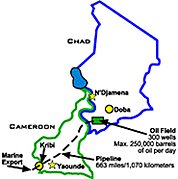
Revenue from oil is providing the fertile ground for dispute between the government in Chad and the World Bank.
Chad is one of the poorest in the world. About 80 percent of its 7 million people live on less than $1 a day in this landlocked country in Central Africa. Like many others in the continent, Chad is trading on oil to increase GDP growth and development. The current project causing the dispute is the pipeline from Chad through Cameroon, built to transport the oil for export at the Atlantic Coast.
Total project costs were estimated at $4.1 billion. While the private sector sponsored most of the costs in this project, the World Bank has provided loans of $39.5 million to Chad as well. The condition of this World Bank loan is poverty reduction, to be monitored by Chad's churches, trade unions and non-governmental organisations.
Last December the Chadian government changed a law that carefully controlled how oil revenues were spent. Chad wanted to use $36m of revenues held in a fund that is meant to tackle poverty to deal instead with the country's financial problems, against the World Bank's warning. In response, the Bank froze all payments of oil revenues to the government, amounting to $100m. Failing negotiations, the Chadian government is issuing an ultimatum now, threatening that if the Bank does not turn over the revenue by noon on Tuesday next week, the pipeline will be shut down.
If the flow of oil is stopped, profits enjoyed by oil companies in the United States, namely Exxon Mobil, will dry up along with the pipeline.
The Chadian government accuses the World Bank of colonizing the country by imposing policy goals on money earned with the country's own natural resources. This controversy illustrates a classic problem in development economics, that in receipt of aid from the developed world, developing countries have to give up significant control over its national policies, implicating national sovereignty.
Thursday, April 13, 2006
New EBRD Loan to Azerbaijan
EBRD Loan to Boost Private Sector
AzerNews
April 13, 2006
European Bank for Reconstruction and Development:
http://www.ebrd.com/
The U.K.-based European Bank for Reconstruction and Development ("EBRD") provides financing to former Soviet States to encourage new investment and full transition to market economies. The EBRD, founded in 1991, operates in twenty-seven countries and has a capital base of 20 billion Euro.
This week, the EBRD, working cooperatively with AzeriGazBank, agreed to loan $2 million for the promotion of small and mid-size businesses in Azerbaijan. One goal of the EBRD loan is to stimulate job growth in the country. As of 2002, 49% of Azerbaijan citizens lived below the poverty line. As of 2005, the country's unemployment rate hovered at 1.2% for a labor force of 5.45 million people. Refer to the CIA Factbook for more information about Azerbaijan's chief industries.
The EBRD is often subject to the same criticisms as other large international lenders. Critics often request that the Bank reconsider certain policy initiatives and better ensure the effective use of money offered on credit. For a summary of some of these general concerns, review the UICIFD E-Book, Part II, Section 2.
AzerNews
April 13, 2006
European Bank for Reconstruction and Development:
http://www.ebrd.com/
The U.K.-based European Bank for Reconstruction and Development ("EBRD") provides financing to former Soviet States to encourage new investment and full transition to market economies. The EBRD, founded in 1991, operates in twenty-seven countries and has a capital base of 20 billion Euro.
This week, the EBRD, working cooperatively with AzeriGazBank, agreed to loan $2 million for the promotion of small and mid-size businesses in Azerbaijan. One goal of the EBRD loan is to stimulate job growth in the country. As of 2002, 49% of Azerbaijan citizens lived below the poverty line. As of 2005, the country's unemployment rate hovered at 1.2% for a labor force of 5.45 million people. Refer to the CIA Factbook for more information about Azerbaijan's chief industries.
The EBRD is often subject to the same criticisms as other large international lenders. Critics often request that the Bank reconsider certain policy initiatives and better ensure the effective use of money offered on credit. For a summary of some of these general concerns, review the UICIFD E-Book, Part II, Section 2.
The Importance of Sex
April 12, 2006
The Economist
The author discusses how women are the "world's most under-utilized resource" and a key to economic development and growth. In support of his argument, the author states that women consistently get better grades than men, are more likely to go to university and financially savvier than men. Thus, according to the author, women are better equipped to excel in the workforce than men.
The author exhorts governments to "exploit" women’s abilities. In the author's opinion, investing in female education in developing countries would deliver enormous economic and social returns for two reasons. First, educated women are likelier to be more productive than men, and second, they are likelier to raise well-educated and healthier children. The author suggests that increased representation of women in government will probably lead to a shift in priorities away from "tanks and bombs" to issues such as improving health, education and infrastructure.
April 12, 2006
The Economist
The author discusses how women are the "world's most under-utilized resource" and a key to economic development and growth. In support of his argument, the author states that women consistently get better grades than men, are more likely to go to university and financially savvier than men. Thus, according to the author, women are better equipped to excel in the workforce than men.
The author exhorts governments to "exploit" women’s abilities. In the author's opinion, investing in female education in developing countries would deliver enormous economic and social returns for two reasons. First, educated women are likelier to be more productive than men, and second, they are likelier to raise well-educated and healthier children. The author suggests that increased representation of women in government will probably lead to a shift in priorities away from "tanks and bombs" to issues such as improving health, education and infrastructure.
Trying to Keep Doha Alive
African Union Nations Must Speak Up at WTO: US
Reuters
April 12, 2006
AU Ministers in Nairobi for WTO Talks
Kenya Times
April 12, 2006
In an effort to keep the WTO Doha trade talks moving, in light of a looming 2007 deadline, the U.S. Trade Representative has appealed to African countries to unite and more aggressively lobby for their preferred trade outcome. Negotiations between the U.S., E.U., and Brazil over agricultural and manufacturing trade provisions have led to a stalemate. This tactic may be an attempt to revitalize the discussion.
"[Deputy U.S.T.R.] Bhatia said African nations needed to appreciate what they stood to gain from a successful conclusion to the Doha round -- greater market access, greater security of access to the developed country market and most importantly, greater access between developing country markets, where tariffs are highest."
African Union members are in Nairobi discussing numerous trade related issues, including a bilateral agreement with China, the progress of WTO negotiations, and pending aid agreements.
Some critics argue that the bilateral agreements, like the one referenced above, will continue to be utilized even if the Doha negotiations successfully lead to a global trade agreement. To force an outcome would be unnecessary or counterproductive.
"[I]t does not follow that the U.S. appetite for bilaterals will be appeased if developing countries hasten to capitulate to terms of a Doha round from which only very few are expected to benefit, once the costs of tariff revenue loss and market entry facilitation are taken into account. The U.S. has negotiated and will continue to negotiate bilaterals with or without the conclusion of the Doha round. . . . Doha is in the doldrums because the Doha agenda is too large for WTO members to agree on in a way that can be implemented fairly, thoroughly and transparently."
Refer to "Forced Conclusion of Doha Agenda Is No Way to Go" for the full critique.
Reuters
April 12, 2006
AU Ministers in Nairobi for WTO Talks
Kenya Times
April 12, 2006
In an effort to keep the WTO Doha trade talks moving, in light of a looming 2007 deadline, the U.S. Trade Representative has appealed to African countries to unite and more aggressively lobby for their preferred trade outcome. Negotiations between the U.S., E.U., and Brazil over agricultural and manufacturing trade provisions have led to a stalemate. This tactic may be an attempt to revitalize the discussion.
"[Deputy U.S.T.R.] Bhatia said African nations needed to appreciate what they stood to gain from a successful conclusion to the Doha round -- greater market access, greater security of access to the developed country market and most importantly, greater access between developing country markets, where tariffs are highest."
African Union members are in Nairobi discussing numerous trade related issues, including a bilateral agreement with China, the progress of WTO negotiations, and pending aid agreements.
Some critics argue that the bilateral agreements, like the one referenced above, will continue to be utilized even if the Doha negotiations successfully lead to a global trade agreement. To force an outcome would be unnecessary or counterproductive.
"[I]t does not follow that the U.S. appetite for bilaterals will be appeased if developing countries hasten to capitulate to terms of a Doha round from which only very few are expected to benefit, once the costs of tariff revenue loss and market entry facilitation are taken into account. The U.S. has negotiated and will continue to negotiate bilaterals with or without the conclusion of the Doha round. . . . Doha is in the doldrums because the Doha agenda is too large for WTO members to agree on in a way that can be implemented fairly, thoroughly and transparently."
Refer to "Forced Conclusion of Doha Agenda Is No Way to Go" for the full critique.
Wednesday, April 12, 2006
What Does Economics Have to Do with the Taiwan Issue?
Taiwan independence (or reunification, depending on which side is speaking) may seem like an issue of international law and politics, but what is often left out of the polemics is the fact that business and development ties between China and Taiwan are strong--and growing.
Excerpt from: Taipei calls for tourism and flights deals with Beijing
Financial Times, April 12, 2006
Taiwan on Wednesday called for a deal with China within six months on tourism and non-stop charter flights as its independence-minded government sought to pre-empt weekend talks between the opposition Kuomintang and the Chinese Communist leadership.
“We demand China complete negotiations with us within six months on admitting Chinese tourists to Taiwan and on regular passenger and cargo charter flights,” said Joseph Wu, the head of the cabinet-level China policy body.
Mr Wu added that Taipei’s move was aimed at clearing up “the misunderstanding that China is handing out goodwill all the time and we are blocking all the time.”
Delegates mandated by the government have been in contact with Chinese counterparts over potential deals on tourism and regular direct flights since last summer.
Taiwan had committed itself last year to letting up to 1,000 Chinese citizens in once it and Beijing have readied a regulatory framework. Taiwan also proposed a long time ago that regular cross-Strait charter flights for passengers and cargo should be established, with up to one flight a day on the cargo side.
China is more eager to see frequent passenger flights because it believes that increased contacts will make the Taiwanese people feel more positive about eventual unification, while Taiwan views cargo flights as more important because they are commercially attractive to its transport industry.
Officials said it is likely that charter flights will start this year, with more frequent one-off deals, and will then be gradually expanded into scheduled charter flights.
Chinese and Taiwanese airlines have offered one-off non-stop charter flights over Chinese New Year before. Such events are likely to occur more often now over the Dragonboat Festival and the Mid-Autumn festival, officials said. Separately, one-off cargo charter flights could be organized.
Taipei also hopes to expand the scope of cargo flights under any eventual agreement to nearly double the level of its earlier proposal.
**************************************************
It is known that Taiwan investment in China accounts for as much as half of all FDI in China. The economic gains from trade with China is something that the pro-independence camp in Taiwan have not overlooked at all. As the above report shows, there are times when Taiwan officials would like to claim credits for fostering stronger economic ties with China--as it is generally believed in Taiwan that it will help growth in domestic economy.
Excerpt from: Taipei calls for tourism and flights deals with Beijing
Financial Times, April 12, 2006
Taiwan on Wednesday called for a deal with China within six months on tourism and non-stop charter flights as its independence-minded government sought to pre-empt weekend talks between the opposition Kuomintang and the Chinese Communist leadership.
“We demand China complete negotiations with us within six months on admitting Chinese tourists to Taiwan and on regular passenger and cargo charter flights,” said Joseph Wu, the head of the cabinet-level China policy body.
Mr Wu added that Taipei’s move was aimed at clearing up “the misunderstanding that China is handing out goodwill all the time and we are blocking all the time.”
Delegates mandated by the government have been in contact with Chinese counterparts over potential deals on tourism and regular direct flights since last summer.
Taiwan had committed itself last year to letting up to 1,000 Chinese citizens in once it and Beijing have readied a regulatory framework. Taiwan also proposed a long time ago that regular cross-Strait charter flights for passengers and cargo should be established, with up to one flight a day on the cargo side.
China is more eager to see frequent passenger flights because it believes that increased contacts will make the Taiwanese people feel more positive about eventual unification, while Taiwan views cargo flights as more important because they are commercially attractive to its transport industry.
Officials said it is likely that charter flights will start this year, with more frequent one-off deals, and will then be gradually expanded into scheduled charter flights.
Chinese and Taiwanese airlines have offered one-off non-stop charter flights over Chinese New Year before. Such events are likely to occur more often now over the Dragonboat Festival and the Mid-Autumn festival, officials said. Separately, one-off cargo charter flights could be organized.
Taipei also hopes to expand the scope of cargo flights under any eventual agreement to nearly double the level of its earlier proposal.
**************************************************
It is known that Taiwan investment in China accounts for as much as half of all FDI in China. The economic gains from trade with China is something that the pro-independence camp in Taiwan have not overlooked at all. As the above report shows, there are times when Taiwan officials would like to claim credits for fostering stronger economic ties with China--as it is generally believed in Taiwan that it will help growth in domestic economy.
Tuesday, April 11, 2006
Wal-Bank
Regulators hear Wal-Mart critics By Kristin Roberts, Washington(Reuters)
UPDATE 3-Wal-Mart defends bank bid, draws fire from critics By Kristin Roberts, Washington(Reuters)
Wal-Mart Bank Opposed by Bankers, Consumer Groups (Update5) By Lauren Coleman-Lochner, New York
Wal-Mart has applied to the Federal Deposit Insurance Corporation (FDIC) for insurance for a proposed bank in Utah, one of the few states that allows commercial firms to operate banks.
Meanwhile, Utah is reviewing Wal-Mart's application for a bank charter. A coalition of labor unions, community groups, small bankers and other Wal-Mart critics has been urging the FDIC to hold hearings around the country before deciding the merits of Wal-Mart's application, and to compel Wal-Mart to disclose more information on how its new enterprise would affect local economies.
The small bankers also worry that the Wal-Mart bank, though based in Utah, could begin operating chapters in other states, threatening local lending institutions nationwide. And they worry about mixing commerce and banking.
The hearings in Arlington, Virginia, are the first the agency has ever held on an application. More than two dozen consumer groups and bankers are testifying that the company's reputation for wiping out competitors and its poor track record as a corporate citizen should convince the FDIC to reject Wal-Mart. The company's past attempts to operate banks in California, Oklahoma and Toronto have all been rejected by government regulators.
Labor and community groups have pointed out that given Wal-Mart's history of breaking labor and sex discrimination laws, there is little reason to think that Wal-Mart would obey banking laws.
Community advocates like ACORN are particularly troubled that Wal-Mart is trying to exempt its Utah bank from the Community Reinvestment Act, which requires financial institutions to make credit available in the low- and moderate-income communities in which they operate, and has sometimes been a genuine impetus to economic development in poor neighborhoods.
UPDATE 3-Wal-Mart defends bank bid, draws fire from critics By Kristin Roberts, Washington(Reuters)
Wal-Mart Bank Opposed by Bankers, Consumer Groups (Update5) By Lauren Coleman-Lochner, New York
Wal-Mart has applied to the Federal Deposit Insurance Corporation (FDIC) for insurance for a proposed bank in Utah, one of the few states that allows commercial firms to operate banks.
Meanwhile, Utah is reviewing Wal-Mart's application for a bank charter. A coalition of labor unions, community groups, small bankers and other Wal-Mart critics has been urging the FDIC to hold hearings around the country before deciding the merits of Wal-Mart's application, and to compel Wal-Mart to disclose more information on how its new enterprise would affect local economies.
The small bankers also worry that the Wal-Mart bank, though based in Utah, could begin operating chapters in other states, threatening local lending institutions nationwide. And they worry about mixing commerce and banking.
The hearings in Arlington, Virginia, are the first the agency has ever held on an application. More than two dozen consumer groups and bankers are testifying that the company's reputation for wiping out competitors and its poor track record as a corporate citizen should convince the FDIC to reject Wal-Mart. The company's past attempts to operate banks in California, Oklahoma and Toronto have all been rejected by government regulators.
Labor and community groups have pointed out that given Wal-Mart's history of breaking labor and sex discrimination laws, there is little reason to think that Wal-Mart would obey banking laws.
Community advocates like ACORN are particularly troubled that Wal-Mart is trying to exempt its Utah bank from the Community Reinvestment Act, which requires financial institutions to make credit available in the low- and moderate-income communities in which they operate, and has sometimes been a genuine impetus to economic development in poor neighborhoods.
Global Trade, World Financial Markets Strong ...For Now
Financial system strong but challenges emerging: IMF By Katie Allen and Fiona Shaikh, London(Reuters)
WTO Sees Global Trade Growth Quickening in 2006 Geneva(Reuters)
Earlier this week the World Trade Organization (WTO) said that global trade may grow 7 percent in 2006, up slightly from 6 percent last year, but warned the outlook was uncertain.
Among downside risks is the possibility that U.S. economic growth could slow more than expected because of higher real interest rates and energy costs, it warned.
The International Monetary Fund voiced similar warnings this week. In its latest Global Financial Stability Report the IMF said that major cyclical risks that lay ahead for financial markets stemmed from higher interest rates and/or higher inflation, worsening credit quality of various debtors and a sudden unwinding of global imbalances. On house prices, it said U.S. housing market activity appeared to have slowed recently in response to higher interest rates in the world's largest economy, where the Federal Reserve raised borrowing costs for the 15th straight time last month.
But while there were concerns higher rates would raise households' debt servicing burdens and softer prices could curb consumption, the Fund noted "prospects of a soft landing" judging from trends in Britain and Australia's housing markets.
WTO Sees Global Trade Growth Quickening in 2006 Geneva(Reuters)
Earlier this week the World Trade Organization (WTO) said that global trade may grow 7 percent in 2006, up slightly from 6 percent last year, but warned the outlook was uncertain.
Among downside risks is the possibility that U.S. economic growth could slow more than expected because of higher real interest rates and energy costs, it warned.
The International Monetary Fund voiced similar warnings this week. In its latest Global Financial Stability Report the IMF said that major cyclical risks that lay ahead for financial markets stemmed from higher interest rates and/or higher inflation, worsening credit quality of various debtors and a sudden unwinding of global imbalances. On house prices, it said U.S. housing market activity appeared to have slowed recently in response to higher interest rates in the world's largest economy, where the Federal Reserve raised borrowing costs for the 15th straight time last month.
But while there were concerns higher rates would raise households' debt servicing burdens and softer prices could curb consumption, the Fund noted "prospects of a soft landing" judging from trends in Britain and Australia's housing markets.
Wednesday, April 05, 2006
The Africa-China Nexus
It's not uncommon to hear the prediction that China will become a world power within the 21st Century. Rapid development and economic success since the reforms 28 years ago seem to confirm that observation. While news reports on China mostly focus on its love-hate relationship with the United States, many other countries and regions in the world have built significant business relationships, diplomatic ties, and even rivalries with China.
So what's the nexus between the African countries and China?
The oil.
Energy resources have become a viable trade item in the continent. Sudan, Nigeria, Angola, and Congo have traded with China on oil. Equatorial Guinea and Gabon are also oil traders. Africa currently contributes 12 percent of the world's liquid hydrocarbon production, and one in four barrels of oil discovered outside of the U.S. and Canada between 2000 and 2004 came from Africa.
Indeed, it has been reported that Angola has surpassed Saudi Arabia as the number one supplier of oil to China. Angola shipped 456,000 barrels a day to China in the first two months of the year.
If readers remember the CNOOC bid for UNOCAL last year that caused outcries in the United States--well, now CNOOC and other Chinese oil companies have found new courtships with African countries. Sinopec agreed last week to help build a $3bn refinery in Angola. In January, CNOOC agreed to pay $2,27bn for a stake in a Nigerian oil field. Companies from the U.S and India have also made significant investments in the region, hoping to assuage the current oil shortage and diversify reliance on suppliers in the Middle East.
In return for oil, China often offers development aid to its oil trading partners. A report by the Council of Foreign Relation has noted that, "In Angola, which currently exports 25 percent of its oil production to China, Beijing has secured a major stake in future oil production with a $2 billion package of loans and aid that includes funds for Chinese companies to build railroads, schools, roads, hospitals, bridges, and offices; lay a fiber-optic network; and train Angolan telecommunications workers."
Fifteen percent of U.S. oil imports come from Africa; by 2010 this could reach 20 percent.
Investment in Africa does not go without risks. Conflict situations, political instability, organized crimes and terrorism complicate the flow of free trade. Factors external to the African countries may also affect foreign policies. China's continuous courtship with the oil countries in Africa presents larger issues such as China's general tolerance toward authoritarian regimes, the involvement of arms trade as exchange for oil, and human rights violations that China often ignores.
So what's the nexus between the African countries and China?
The oil.
Energy resources have become a viable trade item in the continent. Sudan, Nigeria, Angola, and Congo have traded with China on oil. Equatorial Guinea and Gabon are also oil traders. Africa currently contributes 12 percent of the world's liquid hydrocarbon production, and one in four barrels of oil discovered outside of the U.S. and Canada between 2000 and 2004 came from Africa.
Indeed, it has been reported that Angola has surpassed Saudi Arabia as the number one supplier of oil to China. Angola shipped 456,000 barrels a day to China in the first two months of the year.
If readers remember the CNOOC bid for UNOCAL last year that caused outcries in the United States--well, now CNOOC and other Chinese oil companies have found new courtships with African countries. Sinopec agreed last week to help build a $3bn refinery in Angola. In January, CNOOC agreed to pay $2,27bn for a stake in a Nigerian oil field. Companies from the U.S and India have also made significant investments in the region, hoping to assuage the current oil shortage and diversify reliance on suppliers in the Middle East.
In return for oil, China often offers development aid to its oil trading partners. A report by the Council of Foreign Relation has noted that, "In Angola, which currently exports 25 percent of its oil production to China, Beijing has secured a major stake in future oil production with a $2 billion package of loans and aid that includes funds for Chinese companies to build railroads, schools, roads, hospitals, bridges, and offices; lay a fiber-optic network; and train Angolan telecommunications workers."
Fifteen percent of U.S. oil imports come from Africa; by 2010 this could reach 20 percent.
Investment in Africa does not go without risks. Conflict situations, political instability, organized crimes and terrorism complicate the flow of free trade. Factors external to the African countries may also affect foreign policies. China's continuous courtship with the oil countries in Africa presents larger issues such as China's general tolerance toward authoritarian regimes, the involvement of arms trade as exchange for oil, and human rights violations that China often ignores.
Monday, April 03, 2006
Canadian Western Bank's secret of success
EXCLUSIVE-Canadian Western Bank rides oil boom to profit boom By Cameron French
Based in Edmonton, Alberta, CWB was once a stock market laggard. But it now commands a far better valuation than Canada's most profitable lenders, and plans to use its newfound wealth to add to its small but lucrative insurance business.
The bank, Canada's eighth-largest, makes its home far from the traditional banking centers of Toronto and Montreal. But its location has been crucial to success and has brought a lucrative franchise providing commercial loans to small-to-mid sized companies in Alberta, the new sweet spot of Canada's economy. "We serve the construction industry, the forestry industry, oil and gas, transportation, all those sorts of things that most of the other banks really ignore," Chief Executive Larry Pollock, said in a recent interview.
The bank's growth has prompted some analysts to reconsider the stock. "I've been wrong on the story now for quite a long time, and it was because when you take a look at Canadian Western Bank as a bank, its valuation does not make any sense whatsoever," said National Bank Financial analyst John Aiken, who rates the bank sector perform with a target of C$43 a share. "The problem is that we as Canadian investors are not used to seeing a bank growing at the same rate that CWB has been growing at on an extended period of time."
Long merely a blip on Canada's financial services scene, Canadian Western Bank is bearing the fruit of close ties to the Alberta oil boom, and showing the Toronto-based big boys how to leverage low-risk growth from a strong economy.
Based in Edmonton, Alberta, CWB was once a stock market laggard. But it now commands a far better valuation than Canada's most profitable lenders, and plans to use its newfound wealth to add to its small but lucrative insurance business.
The bank, Canada's eighth-largest, makes its home far from the traditional banking centers of Toronto and Montreal. But its location has been crucial to success and has brought a lucrative franchise providing commercial loans to small-to-mid sized companies in Alberta, the new sweet spot of Canada's economy. "We serve the construction industry, the forestry industry, oil and gas, transportation, all those sorts of things that most of the other banks really ignore," Chief Executive Larry Pollock, said in a recent interview.
The bank's growth has prompted some analysts to reconsider the stock. "I've been wrong on the story now for quite a long time, and it was because when you take a look at Canadian Western Bank as a bank, its valuation does not make any sense whatsoever," said National Bank Financial analyst John Aiken, who rates the bank sector perform with a target of C$43 a share. "The problem is that we as Canadian investors are not used to seeing a bank growing at the same rate that CWB has been growing at on an extended period of time."
Intel's computer for developing nations.
Intel eyes PCs for developing nations
Intel is working on a durable, low-cost personal computer aimed at developing nations. The plan is to connect the computers to the internet using wireless protocols. The computers are specialized to withstand dust and heat, and to operate on a fluctuating power supply.
"Based on several pilot projects conducted throughout India, Intel sees the Community PC as most attractive to villagers seeking a registry for government paperwork they would otherwise have to travel extensively to retrieve and file."
Intel is working on a durable, low-cost personal computer aimed at developing nations. The plan is to connect the computers to the internet using wireless protocols. The computers are specialized to withstand dust and heat, and to operate on a fluctuating power supply.
"Based on several pilot projects conducted throughout India, Intel sees the Community PC as most attractive to villagers seeking a registry for government paperwork they would otherwise have to travel extensively to retrieve and file."
Thursday, March 30, 2006
Pollution Tax in China
One of the major items discussed at the current National People's Congress sessions is pollution. Effective this past weekend, China has started imposing a tax on luxury cars in an effort to reduce air pollution. Cars like SUVs (Sports Utility Vehicles) or Mercedes Benz will be taxed at 3 percent to 20 percent, depending on engine size.
Yet analysts are not confident that these new measures will help reduce pollution level or even affect car sales in China. The luxury car market, although developing, still consists a small share in China's total car sales. Also, consumer demand for luxury cars may not be affected too much, because those who can afford to buy luxury cars in the first place probably will not be overly concerned with the tax increase. Other commentators suggested that a better way to tax luxury car is to take account of a vehicle's fuel efficiency, not just the size of the engine.
Another alternative is to impose an across-the-board fuel tax. State administrative officials said that the fuel tax is not in place because of concerns of general high oil prices in the world.
Other unlikely items to be taxed include disposable wooden chopsticks, planks for wood floors, luxury watches, golf clubs, yachts, golf balls and certain oil products. These new taxes are intended to reduce pollution and conserve energy. China has been criticized for consuming large amount of wood from Southeast Asia to produce its disposal chopsticks. The luxury goods tax targets the political and business elites who have reaped huge profits from the booming economy.
It is no news that pollution problems have global consequences. Developed countries have long realized that their efforts to reduce pollution may well be futile in face of the ever intensifying rate of industrial production in countries like China and India. Yet how can the West make the case to developing countries that, a century after the industrial revolution and the subsequent material wealth and environmental degradation it caused, it is now not right for the developing countries to do the same?
Sources:
Xinhua.net, Combating Pollution Has Priority, Feb. 14, 2006
ABC News Online, Latest Import from China: Filthy Air, Mar. 27, 2006
Associated Press, Analysts: China Pollution Tax Ineffective, Mar. 25, 2006
New York Times, China Aims Taxes at Cars and the Rich, Mar. 22, 2006
Yet analysts are not confident that these new measures will help reduce pollution level or even affect car sales in China. The luxury car market, although developing, still consists a small share in China's total car sales. Also, consumer demand for luxury cars may not be affected too much, because those who can afford to buy luxury cars in the first place probably will not be overly concerned with the tax increase. Other commentators suggested that a better way to tax luxury car is to take account of a vehicle's fuel efficiency, not just the size of the engine.
Another alternative is to impose an across-the-board fuel tax. State administrative officials said that the fuel tax is not in place because of concerns of general high oil prices in the world.
Other unlikely items to be taxed include disposable wooden chopsticks, planks for wood floors, luxury watches, golf clubs, yachts, golf balls and certain oil products. These new taxes are intended to reduce pollution and conserve energy. China has been criticized for consuming large amount of wood from Southeast Asia to produce its disposal chopsticks. The luxury goods tax targets the political and business elites who have reaped huge profits from the booming economy.
It is no news that pollution problems have global consequences. Developed countries have long realized that their efforts to reduce pollution may well be futile in face of the ever intensifying rate of industrial production in countries like China and India. Yet how can the West make the case to developing countries that, a century after the industrial revolution and the subsequent material wealth and environmental degradation it caused, it is now not right for the developing countries to do the same?
Sources:
Xinhua.net, Combating Pollution Has Priority, Feb. 14, 2006
ABC News Online, Latest Import from China: Filthy Air, Mar. 27, 2006
Associated Press, Analysts: China Pollution Tax Ineffective, Mar. 25, 2006
New York Times, China Aims Taxes at Cars and the Rich, Mar. 22, 2006
Wednesday, March 29, 2006
The World's Biggest Forex Reserves
New data reports show that China currently holds the world's biggest foreign exchange reserves, surpassing that of Japan's. Beijing said, however, that this will not change its gradualist approach to currency reform.
At the end of Feruary, China's reserves reached U.S. $853.7 billion, and Japan's was U.S. $850 billion. On the other hand, the United States has a much smaller foreign currency reserve of approximately $38.9 billion.
There had been reports a few months ago stating that China had planned on shifting some of its foreign reserve holdings from the American dollar to some other foreign currencies. Some economists in the U.S. has warned that such actions by the Chinese government could induce fluctuations in the value of the greenback. Not all economists, however, anticipate negative repercussions for the U.S. economy. Were China and Japan to engineer a significant fall in the dollar, those nations also would suffer the consequences -- sharply diminished exports as Americans lose spending power, plus a drop in the value of their dollar assets. This could be an incentive for China to hold on to its American dollars.
Currency exchange rate can have considerable bearing on trade balance sheets. While it has been speculated that, with the unpegging of the yuan, the U.S. trade deficit with China would be reduced, data has shown that it has not happened as expected. Some economists have noted that the reduction of trade imabalance between the U.S. and China is a collaborative effort. While China was to float the exchange rate, the United States should also look into structural issues such as savings rate and active reduction of its deficits.
Chinese policymakers have justified the increased foreign exchange reserves with a few observations. The high reserves held by China, Japan and other Asian economies was a result of the Asian financial crisis in 1998. It is also noteworthy that Asian economies have saving regimes that favor savings much more so than consumption. While some of the increased reserves came from trade imabalance with the United States, some of them also came from increased foreign direct investment from American companies. Finally, on balance, the reserves on a per capita level are not all that high.
With the U.S. Congress aiming to pass policies to reduce the trade deficits, this news comes as yet another incentive for politicians to consider drastic measures against a free market solution to China's continuous rise.
Sources:
Financial Times, China Forex Reserves World's Biggest, Report Says, March 28, 2006.
Washington Post, China Set To Reduce Exposure To Dollar, Move Would Probably Push Currency Down, January 10, 2006.
International Monetary Fund, Data Template on International Reserves and Foreign Currency Liquidity (U.S. data)
At the end of Feruary, China's reserves reached U.S. $853.7 billion, and Japan's was U.S. $850 billion. On the other hand, the United States has a much smaller foreign currency reserve of approximately $38.9 billion.
There had been reports a few months ago stating that China had planned on shifting some of its foreign reserve holdings from the American dollar to some other foreign currencies. Some economists in the U.S. has warned that such actions by the Chinese government could induce fluctuations in the value of the greenback. Not all economists, however, anticipate negative repercussions for the U.S. economy. Were China and Japan to engineer a significant fall in the dollar, those nations also would suffer the consequences -- sharply diminished exports as Americans lose spending power, plus a drop in the value of their dollar assets. This could be an incentive for China to hold on to its American dollars.
Currency exchange rate can have considerable bearing on trade balance sheets. While it has been speculated that, with the unpegging of the yuan, the U.S. trade deficit with China would be reduced, data has shown that it has not happened as expected. Some economists have noted that the reduction of trade imabalance between the U.S. and China is a collaborative effort. While China was to float the exchange rate, the United States should also look into structural issues such as savings rate and active reduction of its deficits.
Chinese policymakers have justified the increased foreign exchange reserves with a few observations. The high reserves held by China, Japan and other Asian economies was a result of the Asian financial crisis in 1998. It is also noteworthy that Asian economies have saving regimes that favor savings much more so than consumption. While some of the increased reserves came from trade imabalance with the United States, some of them also came from increased foreign direct investment from American companies. Finally, on balance, the reserves on a per capita level are not all that high.
With the U.S. Congress aiming to pass policies to reduce the trade deficits, this news comes as yet another incentive for politicians to consider drastic measures against a free market solution to China's continuous rise.
Sources:
Financial Times, China Forex Reserves World's Biggest, Report Says, March 28, 2006.
Washington Post, China Set To Reduce Exposure To Dollar, Move Would Probably Push Currency Down, January 10, 2006.
International Monetary Fund, Data Template on International Reserves and Foreign Currency Liquidity (U.S. data)
Bernanke shows his hand
UPDATE 4-Fed raises U.S. rates, says more may come
By Tim Ahmann (Reuters)
In their first meeting under new chief Ben Bernanke, Federal Reserve officials lifted a key U.S. interest rate a 15th straight time to 4.75 percent and said credit costs may have to go higher still, given inflation risks.
Some analysts had thought policy-makers would suggest that the string of rate hikes dating to June 30, 2004, might be near an end. Instead Bernanke, who took over from Alan Greenspan on Feb. 1, was seen as taking a clear stand against inflation.
"Economic growth has rebounded strongly in the current quarter, but appears likely to moderate to a more sustainable pace," the Fed said. The language offered a bit more information on the outlook than statements had under Greenspan, and some analysts said it suggested a shift under Bernanke toward greater transparency.
By Tim Ahmann (Reuters)
"The message from Bernanke is simple -- that nothing has changed, that the Fed takes inflation just as seriously as under the 'maestro.'"Chris Low, chief economist at FTN Financial in New York, referring to Bernanke's storied predecessor.
In their first meeting under new chief Ben Bernanke, Federal Reserve officials lifted a key U.S. interest rate a 15th straight time to 4.75 percent and said credit costs may have to go higher still, given inflation risks.
Some analysts had thought policy-makers would suggest that the string of rate hikes dating to June 30, 2004, might be near an end. Instead Bernanke, who took over from Alan Greenspan on Feb. 1, was seen as taking a clear stand against inflation.
"Economic growth has rebounded strongly in the current quarter, but appears likely to moderate to a more sustainable pace," the Fed said. The language offered a bit more information on the outlook than statements had under Greenspan, and some analysts said it suggested a shift under Bernanke toward greater transparency.
Tuesday, March 28, 2006
America's Favorite Whipping Boy
--Referring to China here. China seems to have become the target of many potential congressional actions lately. The SNOOC controversy didn't take place too long ago.
Word has it that Senator Charles Schumer (D-N.Y.) and Senator Lindsey Graham (R-S.C.) are hoping to introduce a new bill calling for a retaliatory 27.5% tariff on all Chinese imports if the Yuan is not revalued 180 days after the trade talks. Working in the background are concerns that trade deficits haven't alleviated since the Yuan was unpegged last year. According to the report, imports from China account for nearly a quarter of the record $723 billion U.S. trade deficit. The failure to prevent widespread intellectual property violation is also a major concern to politicians, especially when reelection pressure sinks in for many.
The bill has been brewing for more than a year, as it won support in a Senate test vote a year ago. Now it has become a rather urgent issue for the introducers of this bill, as they would like to press for a vote in the Senate soon, even as soon as March 31. Yet things are probably not happening until the two senators come back from their China trip, hopefully with new perspectives that are conducive to dialogue and collaboration, rather than retaliatory measures.
An issue that comes to mind immediately is the implication for the two countries' respective WTO obligations. Disputes may arise in the WTO if the U.S. passes this tariff, and it can be years to come before the trade relation can normalize.
Word has it that Senator Charles Schumer (D-N.Y.) and Senator Lindsey Graham (R-S.C.) are hoping to introduce a new bill calling for a retaliatory 27.5% tariff on all Chinese imports if the Yuan is not revalued 180 days after the trade talks. Working in the background are concerns that trade deficits haven't alleviated since the Yuan was unpegged last year. According to the report, imports from China account for nearly a quarter of the record $723 billion U.S. trade deficit. The failure to prevent widespread intellectual property violation is also a major concern to politicians, especially when reelection pressure sinks in for many.
The bill has been brewing for more than a year, as it won support in a Senate test vote a year ago. Now it has become a rather urgent issue for the introducers of this bill, as they would like to press for a vote in the Senate soon, even as soon as March 31. Yet things are probably not happening until the two senators come back from their China trip, hopefully with new perspectives that are conducive to dialogue and collaboration, rather than retaliatory measures.
An issue that comes to mind immediately is the implication for the two countries' respective WTO obligations. Disputes may arise in the WTO if the U.S. passes this tariff, and it can be years to come before the trade relation can normalize.
Bush: Migrant workers do the jobs Americans don't want to do
Bush defends role of migrant workers
By Caroline Daniel and Edward Alden in Washington (FT)
Immigration dominates southern US politics
By Matthew Wells in Carlsbad, Southern California (BBC)
The debate on illegal immigration has intensified after protests in a number of cities against a bill passed in the House of Representatives making it a felony for immigrants to remain in the country illegally. Bush has proposed tightening border security alongside a guest worker program to address the problem of the 12 million illegal immigrants in the US. The House last year approved a bill that would crack down on illegal immigration without offering new channels for legal workers.
The Senate judiciary committee on Monday night approved legislation, by a 12-8 vote, that will be debated by the full Senate this week. But the committee also pledged to beef up enforcement by hiring as many as 14,000 additional border patrol agents over the next five years and increasing detention facilities for those caught in the country illegally.
Immigration reform was initially put on the agenda by Mr Bush’s advisers as a way of attracting Hispanic voters, helping to forge a permanent Republican majority. It is estimated that approximately 12 million people are living in the US illegally.
By Caroline Daniel and Edward Alden in Washington (FT)
Immigration dominates southern US politics
By Matthew Wells in Carlsbad, Southern California (BBC)
The debate on illegal immigration has intensified after protests in a number of cities against a bill passed in the House of Representatives making it a felony for immigrants to remain in the country illegally. Bush has proposed tightening border security alongside a guest worker program to address the problem of the 12 million illegal immigrants in the US. The House last year approved a bill that would crack down on illegal immigration without offering new channels for legal workers.
The Senate judiciary committee on Monday night approved legislation, by a 12-8 vote, that will be debated by the full Senate this week. But the committee also pledged to beef up enforcement by hiring as many as 14,000 additional border patrol agents over the next five years and increasing detention facilities for those caught in the country illegally.
Immigration reform was initially put on the agenda by Mr Bush’s advisers as a way of attracting Hispanic voters, helping to forge a permanent Republican majority. It is estimated that approximately 12 million people are living in the US illegally.
Wall Street firms ride leveraged loan wave
Leveraged loans are similar to hedge funds, in that they provide financing to companies with credit ratings below investment grade. But there are some several distinctions.
Companies which don't want a long term commitment can pay off leveraged loans ahead of maturity without penalty, and there tend to be fewer rules attached to the money. Investors like them because they have a higher priority over bonds for companies in bankruptcy and they offer attractive yields that float with market rates.
Demand for leveraged loans has also been driven by investors hungry for yield, allowing issuers to "flex up" the size of offerings and pay smaller coupons. That has made the loans very popular among leveraged buyout firms.
According to Reuters Loan Pricing Corp., U.S. LBO financing volumes rose by half to $78 billion last year. Business is likely to remain strong this year, bankers said, with interest rates expected to remain low and buyout funds amassing cash and prowling for increasingly big deals. Leveraged loans have also emerged as an alternative to junk bonds.
Bankers say these are the best times ever for leveraged lending, with U.S. and European demand more than doubling over the past five years. Rampant M&A activity, cheap money and the growing ease of trading loans has turned leveraged lending into a global securities business rivaling junk bonds, bankers said. Many of the bankers, though, cautioned that the current bull market could turn sour quickly if funding costs and unusually low default rates were to rise. Junk bonds, bankers added, will regain popularity as issuers lock in low rates for the long term.
For now, though, Wall Street expects the leveraged lending business to remain a major contributor this year and going forward.
CORRECTED: Wall Street firms ride leveraged loan wave
By Joseph A. Giannone
NEW YORK (Reuters)
Companies which don't want a long term commitment can pay off leveraged loans ahead of maturity without penalty, and there tend to be fewer rules attached to the money. Investors like them because they have a higher priority over bonds for companies in bankruptcy and they offer attractive yields that float with market rates.
Demand for leveraged loans has also been driven by investors hungry for yield, allowing issuers to "flex up" the size of offerings and pay smaller coupons. That has made the loans very popular among leveraged buyout firms.
According to Reuters Loan Pricing Corp., U.S. LBO financing volumes rose by half to $78 billion last year. Business is likely to remain strong this year, bankers said, with interest rates expected to remain low and buyout funds amassing cash and prowling for increasingly big deals. Leveraged loans have also emerged as an alternative to junk bonds.
Bankers say these are the best times ever for leveraged lending, with U.S. and European demand more than doubling over the past five years. Rampant M&A activity, cheap money and the growing ease of trading loans has turned leveraged lending into a global securities business rivaling junk bonds, bankers said. Many of the bankers, though, cautioned that the current bull market could turn sour quickly if funding costs and unusually low default rates were to rise. Junk bonds, bankers added, will regain popularity as issuers lock in low rates for the long term.
For now, though, Wall Street expects the leveraged lending business to remain a major contributor this year and going forward.
CORRECTED: Wall Street firms ride leveraged loan wave
By Joseph A. Giannone
NEW YORK (Reuters)
Monday, March 27, 2006
New UICIFD Briefing Paper
The University of Iowa's Center for International Finance & Development announces the publication of its second briefing paper. This feature addresses LICUS, the new World Bank aid program targeted at fragile states.
Full text of the briefing paper is available at:
http://www.uiowa.edu/ifdebook/briefings/docs/LICUS.shtml
Full text of the briefing paper is available at:
http://www.uiowa.edu/ifdebook/briefings/docs/LICUS.shtml
An Asian Currency Unit?
Bickering delays Asian currency unit launch
Victor Mallet
Financial Times
The Asian Development Bank's (ADB) proposal to create an Asian Currency Unit (ACU) to develop bond markets throughout Asia and increase monetary cooperation between Asian countries has run into difficulty. Of the many difficulties this proposal is facing, the most significant is disagreements over which currencies to include. Presently, the currencies to be included are the South East Asian countries and Japan, South Korea and China. However, financial markets are unlikely to be impressed by an ACU that does not contain the important Hong kong Dollar or the Indian Rupee while including currencies of nations such as Cambodia and Brunei. ADB officials have also been quick to distinguish the ACU from the European Currency Unit (ECU) stating that the ACU is “not an official kind of currency unit like the Ecu."
While the concept of an ACU seems to be good in theory, a number of hurdles will have to be crossed before such an Unit can come into being.
Victor Mallet
Financial Times
The Asian Development Bank's (ADB) proposal to create an Asian Currency Unit (ACU) to develop bond markets throughout Asia and increase monetary cooperation between Asian countries has run into difficulty. Of the many difficulties this proposal is facing, the most significant is disagreements over which currencies to include. Presently, the currencies to be included are the South East Asian countries and Japan, South Korea and China. However, financial markets are unlikely to be impressed by an ACU that does not contain the important Hong kong Dollar or the Indian Rupee while including currencies of nations such as Cambodia and Brunei. ADB officials have also been quick to distinguish the ACU from the European Currency Unit (ECU) stating that the ACU is “not an official kind of currency unit like the Ecu."
While the concept of an ACU seems to be good in theory, a number of hurdles will have to be crossed before such an Unit can come into being.
Wednesday, March 22, 2006
China's New Five Year Economic Plan
The new Five Year Plan for Economic and Social Development, delivered by Premier Wen Jiabao at the Fourth Session of the Tenth National People's Congress, is being considered by the Chinese legislators.
Premier Wen Jiabao proposed a GDP growth rate of 7.5% in the years 2006-2010. While China is no longer a planned economy, this prediction reflects the policymakers' wish to maintain a good but controlled, steady growth. In the past five years, China has enjoyed an annual growth of 8% to 9%. In 2005, the growth rate was 9.9%.
It is predicted that by 2010, per capita GDP growth will rise to $2,400 U.S., versus $1,700 U.S. in 2005. This targeted increase does not call for a 7.5% growth in GDP, but policymakers would like to fully utilize current opportunities of continuous economic development. A goal of 7.5% growth in GDP thus strikes a middle ground between overheated growth and the minimum needed for recognizable improvements.
Unemployment rate should be controlled to the level of 5%, with creation of 45 million new jobs in the urban areas, in effect transferring agricultural labor to non farm-related jobs in the cities. Besides encouragement of further urbanization, the government also plans on channeling more money for rural developments, especially in the areas of infrastructure building and education.
China's energy plans have become a rather controversial international issue. As a domestic matter, though, it is expected that energy consumption per unit GDP will be reduced by 20% in the upcoming five-year period due to efficiency improvements. It was estimated that wastfulness and pollution has caused more than 2% of the GDP.
While all these sound good, the increasing income gap between coastal and rural areas will require much more active policymaking addressing structural issues and the fiscal assistance needed to make the policies work.
Source:
People's Daily English, China Sets New Target in New Five-Year Plan.
China Center for Economic Research, Policies Target Resources Misuse, Wealth Gap.
Premier Wen Jiabao proposed a GDP growth rate of 7.5% in the years 2006-2010. While China is no longer a planned economy, this prediction reflects the policymakers' wish to maintain a good but controlled, steady growth. In the past five years, China has enjoyed an annual growth of 8% to 9%. In 2005, the growth rate was 9.9%.
It is predicted that by 2010, per capita GDP growth will rise to $2,400 U.S., versus $1,700 U.S. in 2005. This targeted increase does not call for a 7.5% growth in GDP, but policymakers would like to fully utilize current opportunities of continuous economic development. A goal of 7.5% growth in GDP thus strikes a middle ground between overheated growth and the minimum needed for recognizable improvements.
Unemployment rate should be controlled to the level of 5%, with creation of 45 million new jobs in the urban areas, in effect transferring agricultural labor to non farm-related jobs in the cities. Besides encouragement of further urbanization, the government also plans on channeling more money for rural developments, especially in the areas of infrastructure building and education.
China's energy plans have become a rather controversial international issue. As a domestic matter, though, it is expected that energy consumption per unit GDP will be reduced by 20% in the upcoming five-year period due to efficiency improvements. It was estimated that wastfulness and pollution has caused more than 2% of the GDP.
While all these sound good, the increasing income gap between coastal and rural areas will require much more active policymaking addressing structural issues and the fiscal assistance needed to make the policies work.
Source:
People's Daily English, China Sets New Target in New Five-Year Plan.
China Center for Economic Research, Policies Target Resources Misuse, Wealth Gap.
Tuesday, March 21, 2006
Retail Giant Expands in China
Walmart and Carrefour, two giant retail chainstores, have both announced plans to expand their operations in the China market.
According to a report by BBC, combined sales of China's 30 leading retailers jumped by 31% in 2005 to 491 billion yuan. This reflects an optimistic increase in private consumption in the economy, as policymakers in China have proposed a more consumer-driven growth.
Carrefour, the world's second-biggest retailer, increased the number of its stores in China to 78 last year. Sales rose by 25% to 17.4 billion yuan ($2.2 billion) in 2005, making it China's ninth-biggest retailer by sales. The French retailer is certainly gaining a foothold in the China market, although the Commerce Ministry reported that the domestic Shanghai Brilliance was the biggest retailer, with sales of 72.1 billion yuan in 2005.
Meanwhile, Walmart, the world's largest retailer, did not make it to the Commerce Ministry's top thirty retailers list. Wal-Mart Stores has just announced its plans to hire 150,000 people over the next five years, five times the number it currently employs. Walmart has 58 stores in China now, slightly fewer than Carrefour.
The growth of foreign-owned retailers in the Chinese market is a result of important economic events in the past few years, such as China's accession to the WTO, which mandated the opening of the retail market to foreign competition; the lift of the currency peg last year; and the continuous growth in the Chinese economy, resulting in higher purchasing power for Chinese consumers.
BBC News Online, Carrefour Boosts China Presence
CNN Money.Com, Wal-Mart poised for major China expansion
According to a report by BBC, combined sales of China's 30 leading retailers jumped by 31% in 2005 to 491 billion yuan. This reflects an optimistic increase in private consumption in the economy, as policymakers in China have proposed a more consumer-driven growth.
Carrefour, the world's second-biggest retailer, increased the number of its stores in China to 78 last year. Sales rose by 25% to 17.4 billion yuan ($2.2 billion) in 2005, making it China's ninth-biggest retailer by sales. The French retailer is certainly gaining a foothold in the China market, although the Commerce Ministry reported that the domestic Shanghai Brilliance was the biggest retailer, with sales of 72.1 billion yuan in 2005.
Meanwhile, Walmart, the world's largest retailer, did not make it to the Commerce Ministry's top thirty retailers list. Wal-Mart Stores has just announced its plans to hire 150,000 people over the next five years, five times the number it currently employs. Walmart has 58 stores in China now, slightly fewer than Carrefour.
The growth of foreign-owned retailers in the Chinese market is a result of important economic events in the past few years, such as China's accession to the WTO, which mandated the opening of the retail market to foreign competition; the lift of the currency peg last year; and the continuous growth in the Chinese economy, resulting in higher purchasing power for Chinese consumers.
BBC News Online, Carrefour Boosts China Presence
CNN Money.Com, Wal-Mart poised for major China expansion
Sunday, March 19, 2006
Macau Gambling: Shady Past, Rosy Future
Frederik Balfour
Business Week
Long dubbed the Las Vegas of Asia, Macau is expected to become the world's biggest gambling city in terms of gaming revenues this year. Its proximity to rapidly expanding Chinese cities and regional powerhouse Hong Kong means that Macau’s future growth prospects are tremendous. The large gaming companies are hoping to cash in and are fast entering the Macau market.
Gambling in Macau is very different from gambling in Las Vegas. For starters, the average daily take per gaming table in Macau is almost triple of that in Las Vegas. Also, unlike Las Vegas which relies on small gamers for its revenues, the gambling scene in Macau is typically dominated by "high rollers." Single hand bets of $35,000 are not that uncommon.
Sheldon Adelson's Las Vegas Sands has already invested $265 million in Macau, and plans to invest as much as $2.75 billion more. MGM-Mirage is planning on spending over $1 billion on constructing an atrium that would be three times as large as its Bellagio resort in Las Vegas. Las Vegas based Wynn Resorts’ $1.2 billion new property begins operations in early September. Meanwhile renowned hotel chains such as the Shangri-La Resorts, the Four Seasons and Starwood Hotels are planning constructions of enormous hotels.
Little wonder then that the author suggests that Las Vegas may soon be called the "Macau of North America."
Frederik Balfour
Business Week
Long dubbed the Las Vegas of Asia, Macau is expected to become the world's biggest gambling city in terms of gaming revenues this year. Its proximity to rapidly expanding Chinese cities and regional powerhouse Hong Kong means that Macau’s future growth prospects are tremendous. The large gaming companies are hoping to cash in and are fast entering the Macau market.
Gambling in Macau is very different from gambling in Las Vegas. For starters, the average daily take per gaming table in Macau is almost triple of that in Las Vegas. Also, unlike Las Vegas which relies on small gamers for its revenues, the gambling scene in Macau is typically dominated by "high rollers." Single hand bets of $35,000 are not that uncommon.
Sheldon Adelson's Las Vegas Sands has already invested $265 million in Macau, and plans to invest as much as $2.75 billion more. MGM-Mirage is planning on spending over $1 billion on constructing an atrium that would be three times as large as its Bellagio resort in Las Vegas. Las Vegas based Wynn Resorts’ $1.2 billion new property begins operations in early September. Meanwhile renowned hotel chains such as the Shangri-La Resorts, the Four Seasons and Starwood Hotels are planning constructions of enormous hotels.
Little wonder then that the author suggests that Las Vegas may soon be called the "Macau of North America."
Saturday, March 18, 2006
Jobs tomorrow
The Economist
Inequity has come to characterize South Korea today. The inequities run between the successful chaebols, and struggling small businesses, between prosperous Seoul and the neglected regions, between workers in the large enterprises who earn sizeable salaries, and those in the smaller firms that earn a fraction of what their counterparts in the large firms earn. While the rapid growth of China has been a boon for large Korean firms such as Samsung, it has spelled disaster for smaller South Korean firms. It is estimated that almost a half of the country’s small and medium size businesses make no operating profits, and many of them exist today solely because of government credit guarantees.
In such a grim scenario, the new proposed Free Trade Agreement (FTA) with the US holds considerable hope for South Korea. It is estimated that the FTA could increase GDP by as much as 2% and create some 100,000 jobs. The author believes that such an agreement would also strengthen South Korea's political relations with the US, and provide a "counterweight to China's growing economic influence." Additionally, the FTA is likely to speed up "reforms to recalcitrant parts of the economy. " Of course, such a proposed deal is not without significant opposition, primarily from farmers, industrial groupings, and trade unions.
As the author puts it "[i]t looks a tricky course, with distant fairways and lightning-quick greens. "
The Economist
Inequity has come to characterize South Korea today. The inequities run between the successful chaebols, and struggling small businesses, between prosperous Seoul and the neglected regions, between workers in the large enterprises who earn sizeable salaries, and those in the smaller firms that earn a fraction of what their counterparts in the large firms earn. While the rapid growth of China has been a boon for large Korean firms such as Samsung, it has spelled disaster for smaller South Korean firms. It is estimated that almost a half of the country’s small and medium size businesses make no operating profits, and many of them exist today solely because of government credit guarantees.
In such a grim scenario, the new proposed Free Trade Agreement (FTA) with the US holds considerable hope for South Korea. It is estimated that the FTA could increase GDP by as much as 2% and create some 100,000 jobs. The author believes that such an agreement would also strengthen South Korea's political relations with the US, and provide a "counterweight to China's growing economic influence." Additionally, the FTA is likely to speed up "reforms to recalcitrant parts of the economy. " Of course, such a proposed deal is not without significant opposition, primarily from farmers, industrial groupings, and trade unions.
As the author puts it "[i]t looks a tricky course, with distant fairways and lightning-quick greens. "
Friday, March 17, 2006
India needs skills to solve the 'Bangalore bug'
Raghuram Rajan and Arvind Subramanian
Financial Times
According to the authors, India may be facing a shortage of skilled labor. The authors point out that increasing wages in the Information Technology (IT) sectors have resulted in an exodus of managers from India's traditional manufacturing sectors, such as textiles and manufacturing. Because demand for skilled labor has increased at a compound annual growth rate of 23%, wages have dramatically risen, and other sectors have been unable to match these high salaries, which has caused migration of labor.
The growth of IT has also led to diverging fortunes for many states - while a select handful of states have benefited from increasing foreign investment, many of India's populous states have not seen much improvement in recent years. According to the authors, to ensure that India's states grow uniformly, the Indian Government must reform India's primary and secondary education systems and investment heavily in infrastructure development. The authors also recommend removing "the barriers that prevent foreigners and locals from starting new institutions, while improving accreditation procedures and disclosure standards." Following such policies will enable India's various sectors and states to grow at a more even pace, which is socially desirable.
Raghuram Rajan and Arvind Subramanian
Financial Times
According to the authors, India may be facing a shortage of skilled labor. The authors point out that increasing wages in the Information Technology (IT) sectors have resulted in an exodus of managers from India's traditional manufacturing sectors, such as textiles and manufacturing. Because demand for skilled labor has increased at a compound annual growth rate of 23%, wages have dramatically risen, and other sectors have been unable to match these high salaries, which has caused migration of labor.
The growth of IT has also led to diverging fortunes for many states - while a select handful of states have benefited from increasing foreign investment, many of India's populous states have not seen much improvement in recent years. According to the authors, to ensure that India's states grow uniformly, the Indian Government must reform India's primary and secondary education systems and investment heavily in infrastructure development. The authors also recommend removing "the barriers that prevent foreigners and locals from starting new institutions, while improving accreditation procedures and disclosure standards." Following such policies will enable India's various sectors and states to grow at a more even pace, which is socially desirable.
Sunday, March 12, 2006
Blame Game
"West Urged to 'Tell Truth on Globalization'"
Financial Times
March 12, 2006
http://news.ft.com/cms/s/ef14b038-b202-11da-
96ad-0000779e2340.html
This weekend, at the World Deauville Conference in France, Chinese diplomat Long Yongtu cautioned the U.S. and E.U. not to blame unemployment and competition woes on the growing Chinese economy. He argued these accusations are based on a misunderstanding of the Chinese economy's relationship to Western markets, saying, "There are a lot of misconceptions about China’s economy. People believe that it depends on exports and external investment. But China’s economic development is basically driven by domestic demand, both investment and consumption."
Interestingly, outsiders note that both regions need economic reforms: China should heighten good governance to improve environmental compliance, worker protection, and anti-corruption initiatives while the E.U. should adopt the Lisbon Strategy reforms to strengthen job creation and sustainable development.
The conference is intended to strengthen Asian-European relations and to serve as a forum to discuss globalization. For more information about the event, see http://www.wdf2006.org/.
Refer to the E.U. Commission's Lisbon Strategy update (http://europa.eu.int/comm/public_opinion/archives
/ebs/ebs_215_en.pdf) for more information about the reforms mentioned in the article.
Additionally, refer to the OECD's China policy briefing (http://www.oecd.org/dataoecd/10/25/35294862.pdf) for more information about the reforms mentioned in the article.
Financial Times
March 12, 2006
http://news.ft.com/cms/s/ef14b038-b202-11da-
96ad-0000779e2340.html
This weekend, at the World Deauville Conference in France, Chinese diplomat Long Yongtu cautioned the U.S. and E.U. not to blame unemployment and competition woes on the growing Chinese economy. He argued these accusations are based on a misunderstanding of the Chinese economy's relationship to Western markets, saying, "There are a lot of misconceptions about China’s economy. People believe that it depends on exports and external investment. But China’s economic development is basically driven by domestic demand, both investment and consumption."
Interestingly, outsiders note that both regions need economic reforms: China should heighten good governance to improve environmental compliance, worker protection, and anti-corruption initiatives while the E.U. should adopt the Lisbon Strategy reforms to strengthen job creation and sustainable development.
The conference is intended to strengthen Asian-European relations and to serve as a forum to discuss globalization. For more information about the event, see http://www.wdf2006.org/.
Refer to the E.U. Commission's Lisbon Strategy update (http://europa.eu.int/comm/public_opinion/archives
/ebs/ebs_215_en.pdf) for more information about the reforms mentioned in the article.
Additionally, refer to the OECD's China policy briefing (http://www.oecd.org/dataoecd/10/25/35294862.pdf) for more information about the reforms mentioned in the article.
Saturday, March 11, 2006
BoJ switches policy and calls end to deflation
David Pilling
Financial Times
The Bank of Japan (BoJ) made an announcement declaring that its loose monetary policies which were initially employed to ward off deflation, were officially over. This announcement is seen as a response to the Japanese economy finally "returning to normality" after spending approximately 15 years in the "doldrums." In recent times, the demand for Japanese goods has increased rapidly, with China and the United States being the primary drivers for this demand. This increase in demand has in turn led to the robustness of the Japanese economy.
However, the tightening of monetary policy will not begin immediately; interest rates will be maintained at 0% for "several months." While politicians still fear that it might be too early to eschew loose monetary policies, the BoJ is firm in its resolve. In response to the BoJ's announcement, Japan's primary stock market, the Nikkei average rose 2.6%.
David Pilling
Financial Times
The Bank of Japan (BoJ) made an announcement declaring that its loose monetary policies which were initially employed to ward off deflation, were officially over. This announcement is seen as a response to the Japanese economy finally "returning to normality" after spending approximately 15 years in the "doldrums." In recent times, the demand for Japanese goods has increased rapidly, with China and the United States being the primary drivers for this demand. This increase in demand has in turn led to the robustness of the Japanese economy.
However, the tightening of monetary policy will not begin immediately; interest rates will be maintained at 0% for "several months." While politicians still fear that it might be too early to eschew loose monetary policies, the BoJ is firm in its resolve. In response to the BoJ's announcement, Japan's primary stock market, the Nikkei average rose 2.6%.
Friday, March 10, 2006
Agricultural Subsidies Still Stalling Talks
"Trade Chiefs Hope to Revive Talks"
BBC News
March 10, 2006
http://news.bbc.co.uk/1/hi/
business/4793650.stm
Also refer to a speech by E.U. Trade Commissioner Mandelson: http://europa.eu.int/comm/commission_barroso
/mandelson/speeches_articles/mandelson_sptemplate.cfm?
LangId=EN&temp=sppm084_en
An October 27, 2005 posting ("An Update on Agricultural Subsidies") summarized the ongoing trade dispute arising out of American and European hesitance to discontinue use of certain agricultural subsidies. This disagreement is stalling a global trade treaty; the roadmap for this treaty is scheduled to be completed by April 2006. At the WTO Ministerial Meeting in Hong Kong, WTO members agreed to discontinue use of all farm export subsidies by 2013. But, the U.S. and E.U. argue that they will not eliminate their domestic subsidies and agricultural import tariffs.
Negotiators met again this week in London to address these conflicts. Reports suggest that the tone of these talks is not hopeful. The E.U. External Trade Commissioner, Peter Mandelson, appears unwavering. He is quoted as saying, "Our job is to build consensus in order to help the wider membership of the WTO to reach agreement later on."
Would complete elimination of these subsidies be too much to ask of the U.S. and E.U.? Mandelson has argued, "I want to make world poverty history but trade justice cannot be equated with big bang agricultural liberalisation, and with it, a race to the bottom for E.U. agriculture and a free market mayhem that would gravely damage the interests of some of the poorest countries in the world." Does he make a good point?
BBC News
March 10, 2006
http://news.bbc.co.uk/1/hi/
business/4793650.stm
Also refer to a speech by E.U. Trade Commissioner Mandelson: http://europa.eu.int/comm/commission_barroso
/mandelson/speeches_articles/mandelson_sptemplate.cfm?
LangId=EN&temp=sppm084_en
An October 27, 2005 posting ("An Update on Agricultural Subsidies") summarized the ongoing trade dispute arising out of American and European hesitance to discontinue use of certain agricultural subsidies. This disagreement is stalling a global trade treaty; the roadmap for this treaty is scheduled to be completed by April 2006. At the WTO Ministerial Meeting in Hong Kong, WTO members agreed to discontinue use of all farm export subsidies by 2013. But, the U.S. and E.U. argue that they will not eliminate their domestic subsidies and agricultural import tariffs.
Negotiators met again this week in London to address these conflicts. Reports suggest that the tone of these talks is not hopeful. The E.U. External Trade Commissioner, Peter Mandelson, appears unwavering. He is quoted as saying, "Our job is to build consensus in order to help the wider membership of the WTO to reach agreement later on."
Would complete elimination of these subsidies be too much to ask of the U.S. and E.U.? Mandelson has argued, "I want to make world poverty history but trade justice cannot be equated with big bang agricultural liberalisation, and with it, a race to the bottom for E.U. agriculture and a free market mayhem that would gravely damage the interests of some of the poorest countries in the world." Does he make a good point?
Thursday, March 09, 2006
Protectionism?
Nations Rebuild Barriers to Deals
Heather Timmons, New York Times
This article discusses the growing tendency of governments to block or place conditions on corporate takeovers. At one point the article quotes an economist who sees the restrictions on takeovers as a form of protectionism. He is quoted as saying that “protectionism remains the major threat to global growth.”
It is worth noting that many forms of protectionism have persisted in the world economy, even as trade deals have removed some barriers, and in some cases have even been extended. For example, the United States has greater protection for doctors at present than it did a decade ago. While protection for doctors and other professionals is almost never discussed in the context of trade, in economic theory, protection that raises the cost of doctors and other professionals to people in the United States (and prevents foreign professionals from being able to sell their services in the United States) is every bit as harmful as protection that restricts imports of clothes or agricultural products.
Heather Timmons, New York Times
This article discusses the growing tendency of governments to block or place conditions on corporate takeovers. At one point the article quotes an economist who sees the restrictions on takeovers as a form of protectionism. He is quoted as saying that “protectionism remains the major threat to global growth.”
It is worth noting that many forms of protectionism have persisted in the world economy, even as trade deals have removed some barriers, and in some cases have even been extended. For example, the United States has greater protection for doctors at present than it did a decade ago. While protection for doctors and other professionals is almost never discussed in the context of trade, in economic theory, protection that raises the cost of doctors and other professionals to people in the United States (and prevents foreign professionals from being able to sell their services in the United States) is every bit as harmful as protection that restricts imports of clothes or agricultural products.
Emerging Markets--Miracle or Mirage?
Regular investors could not have gone through the past few years without noticing the buzz on emerging markets. According to the Financial Times, "five years ago, it was 'why bother?' Now the question global investors are asking is: can we afford to ignore emerging markets?"
A term coined in the early 1980s by the World Bank's International Finance Corporation, "emerging markets" (EMEs) refer to "an economy with low-to-middle per capita income." About 80% of the world's population live in emerging market economies. That, however, is not to say that emerging markets are necessarily small and poor. For example, China and India are considered emerging markets, so are Brazil, Argentina, Mexico, Russia, Iran, Iraq, Egypt and South Africa.
The 1990s saw confidence plummet in emerging market investments, due to the three major regional economic crises--Mexico and Argentina in 1994, Asia in 1997, and Russia in 1998. Because of the transitioning nature of these economies, investments are high-risked and volatile.
Now, the good news is, the early years of this decade have seen significant and solid economic performance from many of the EMEs. The Financial Times reported that Brazil and Venezuela announced they were buying back billions of dollars worth of their Brady bonds. These securities, named after Nicholas Brady, a former US Treasury secretary, still carry a stigma because of their association with past financial crises. Gone are the days when loans to the EMEs have to be forgiven, restructured or reformed after years of default.
Yet should we, as private investors and prudent watchers of the global economy, see this as a mere mirage, like the short-lived boom in the early 1990s, or a miracle that will continue to develop? The Financial Times expressed confidence that good performance in the past few years will probably continue. "In 2003-05 emerging market shares more than doubled, with total returns of 165 per cent. East European markets returned 226 per cent, Latin American markets 265 per cent and Asian markets (outside Japan) 122 per cent."
What generates this optimism is the fact that, ever since the regional crises in the 1990s, there had been some real structural changes in these economies, including reduction of current account deficits, real GDP growth, reduction of foreign debt, and a controlled inflation rate. The important perspective, though, is that the risk involved in investing in EMEs may still, afterall, be higher than in developed economies. While no economy is immune to cyclical performance, EMEs are still more vulnerable to large scale crises than developed economies. In many of the EMEs, social and political stability are still not guaranteed--and that is just one possible external risk to name. Cautious optimism is probably the best attitude toward EME investments now.
Sources:
Christopher Brown-Humes, A grown-up Brady bunch? Why returns in emerging markets are vigorous, Financial Times, Mar. 2, 2006.
Emerging Market Directory, What is an Emerging Market?
Reem Hekal, What is Emerging Market Economy? Investopia
Robert Lenzner, Book Review: Robert Rubin on Surviving the 1990s
A term coined in the early 1980s by the World Bank's International Finance Corporation, "emerging markets" (EMEs) refer to "an economy with low-to-middle per capita income." About 80% of the world's population live in emerging market economies. That, however, is not to say that emerging markets are necessarily small and poor. For example, China and India are considered emerging markets, so are Brazil, Argentina, Mexico, Russia, Iran, Iraq, Egypt and South Africa.
The 1990s saw confidence plummet in emerging market investments, due to the three major regional economic crises--Mexico and Argentina in 1994, Asia in 1997, and Russia in 1998. Because of the transitioning nature of these economies, investments are high-risked and volatile.
Now, the good news is, the early years of this decade have seen significant and solid economic performance from many of the EMEs. The Financial Times reported that Brazil and Venezuela announced they were buying back billions of dollars worth of their Brady bonds. These securities, named after Nicholas Brady, a former US Treasury secretary, still carry a stigma because of their association with past financial crises. Gone are the days when loans to the EMEs have to be forgiven, restructured or reformed after years of default.
Yet should we, as private investors and prudent watchers of the global economy, see this as a mere mirage, like the short-lived boom in the early 1990s, or a miracle that will continue to develop? The Financial Times expressed confidence that good performance in the past few years will probably continue. "In 2003-05 emerging market shares more than doubled, with total returns of 165 per cent. East European markets returned 226 per cent, Latin American markets 265 per cent and Asian markets (outside Japan) 122 per cent."
What generates this optimism is the fact that, ever since the regional crises in the 1990s, there had been some real structural changes in these economies, including reduction of current account deficits, real GDP growth, reduction of foreign debt, and a controlled inflation rate. The important perspective, though, is that the risk involved in investing in EMEs may still, afterall, be higher than in developed economies. While no economy is immune to cyclical performance, EMEs are still more vulnerable to large scale crises than developed economies. In many of the EMEs, social and political stability are still not guaranteed--and that is just one possible external risk to name. Cautious optimism is probably the best attitude toward EME investments now.
Sources:
Christopher Brown-Humes, A grown-up Brady bunch? Why returns in emerging markets are vigorous, Financial Times, Mar. 2, 2006.
Emerging Market Directory, What is an Emerging Market?
Reem Hekal, What is Emerging Market Economy? Investopia
Robert Lenzner, Book Review: Robert Rubin on Surviving the 1990s
Let’s “democratize Federal Reserve transparency.”
Bringing Democracy to the Federal Reserve
I came across this article by Ralph Nader -- hopefully this will spark some discussion!
"So far Chairman Bernanke has limited specifics about his push for “greater transparency” to the idea of the Fed stating explicitly the numerical inflation rate it considers to be consistent with the goal of long-term price stability...Let’s hope that Ben Bernanke really is talking about ‘transparency” and “open government”—the kind of transparency that gets the message to all citizens, not just bond traders and the Wall Street insiders. What the Fed does or doesn’t do affects the jobs and economic well being of all Americans—the very future of the nation."
Nader outlines seven ways Bernanke might "bring the Federal Reserve up to speed for 21st century democracy":
1. Regular open press conferences by the Chairman. Alan Greenspan and his predecessors never held press conferences.
2. Adhere to the Budget Act which requires the submission of a formal annual budget subject to review by OMB and the Congress. (Currently the Federal Reserve prepares a limited in house budget and gives it self approval).
3. Require congressional appropriations for all Federal Reserve activities. Currently the Federal Reserve finances whatever it pleases with public funds derived from the buying and selling of government bonds in the market as part of its control of the money supply. Surplus funds are returned to the U. S. Treasury annually.
4. Allow the early release of Minutes of Federal Open Market Committee meetings with exceptions for national security issues.
5. Hold open meetings on all issues not involving monetary policy.
6. Require full audits by the Government Accountability Office (GAO). Currently the Fed refuses to allow GAO to audit anything involving monetary policy as defined by the Fed itself.
7. Support legislation to prohibit commercial bank officials from serving on the boards of the 12 Federal Reserve District Banks.
I came across this article by Ralph Nader -- hopefully this will spark some discussion!
"So far Chairman Bernanke has limited specifics about his push for “greater transparency” to the idea of the Fed stating explicitly the numerical inflation rate it considers to be consistent with the goal of long-term price stability...Let’s hope that Ben Bernanke really is talking about ‘transparency” and “open government”—the kind of transparency that gets the message to all citizens, not just bond traders and the Wall Street insiders. What the Fed does or doesn’t do affects the jobs and economic well being of all Americans—the very future of the nation."
Nader outlines seven ways Bernanke might "bring the Federal Reserve up to speed for 21st century democracy":
1. Regular open press conferences by the Chairman. Alan Greenspan and his predecessors never held press conferences.
2. Adhere to the Budget Act which requires the submission of a formal annual budget subject to review by OMB and the Congress. (Currently the Federal Reserve prepares a limited in house budget and gives it self approval).
3. Require congressional appropriations for all Federal Reserve activities. Currently the Federal Reserve finances whatever it pleases with public funds derived from the buying and selling of government bonds in the market as part of its control of the money supply. Surplus funds are returned to the U. S. Treasury annually.
4. Allow the early release of Minutes of Federal Open Market Committee meetings with exceptions for national security issues.
5. Hold open meetings on all issues not involving monetary policy.
6. Require full audits by the Government Accountability Office (GAO). Currently the Fed refuses to allow GAO to audit anything involving monetary policy as defined by the Fed itself.
7. Support legislation to prohibit commercial bank officials from serving on the boards of the 12 Federal Reserve District Banks.
Sunday, March 05, 2006
Mexican Miners Strike Could Affect International Metal Producers
Mexican Miners' Strike Set to Persist
By Adam Thomson
March 2, 2006
FT.com
The National Mining and Metal Worker’s Union of Mexico, which represents about 270,000 of the country’s miners, vowed on March 2nd to continue its strike which has halted the operations of the largest mining companies and caused an increase in the international price of copper. The miners are protesting the replacement of former union leader Napoleón Gómez Urrutia, following allegations of the mismanagement of funds, with Elias Morales, a replacement that the miners believe was arranged by the government.
The strike is adversely affecting mining companies across the country, including Grupo Mexico, the world’s third largest copper producer; Netherlands-based Mittal Steel, Mexico’s biggest steel producer; and Industrias Peñoles, the world’s largest silver producer. Industrias Peñoles reported that if the strike lasted more than a week the company would no longer be able to continue supplying its customers.
By Adam Thomson
March 2, 2006
FT.com
The National Mining and Metal Worker’s Union of Mexico, which represents about 270,000 of the country’s miners, vowed on March 2nd to continue its strike which has halted the operations of the largest mining companies and caused an increase in the international price of copper. The miners are protesting the replacement of former union leader Napoleón Gómez Urrutia, following allegations of the mismanagement of funds, with Elias Morales, a replacement that the miners believe was arranged by the government.
The strike is adversely affecting mining companies across the country, including Grupo Mexico, the world’s third largest copper producer; Netherlands-based Mittal Steel, Mexico’s biggest steel producer; and Industrias Peñoles, the world’s largest silver producer. Industrias Peñoles reported that if the strike lasted more than a week the company would no longer be able to continue supplying its customers.
“It makes no sense,” said Luis Rey, Industrias Peñoles spokesperson. “It is hitting our operations very hard and yet it has nothing to do with us.” Mr Rey estimated that the strike was costing the company roughly $10m (€8.3m, £5.7m) a day.
Friday, March 03, 2006
"Fast track"
The Economist Feb 16th, 2006
This article evaluates the current state of the Indian economy at the eve of the new budget being presented by India's finance minister. While India has certainly taken rapid strides in the past recent years-economic growth continues to remain robust, and inflation is in check-problems abound. The overall government deficit currently stands at 7.7% of GDP well above what economists are traditionally comfortable with. India's "infrastructure deficit" also remains a cause for concern and is unlikely to be addressed by the new budget. According to the author, with elections around the corner, the government is unlikely to rein in subsidies, which means that much-needed infrastructure development in the form of improving roads and ports and increasing the provision of electricity, is unlikely to occur.
What the article does not discuss, but is of importance in this context is the misallocation of government monies in the name of "subsidies" that rounitely occurs in the India, and is a serious bottleneck to sustainable growth.
See http://atimes.com/atimes/South_Asia/FG29Df02.html
The Economist Feb 16th, 2006
This article evaluates the current state of the Indian economy at the eve of the new budget being presented by India's finance minister. While India has certainly taken rapid strides in the past recent years-economic growth continues to remain robust, and inflation is in check-problems abound. The overall government deficit currently stands at 7.7% of GDP well above what economists are traditionally comfortable with. India's "infrastructure deficit" also remains a cause for concern and is unlikely to be addressed by the new budget. According to the author, with elections around the corner, the government is unlikely to rein in subsidies, which means that much-needed infrastructure development in the form of improving roads and ports and increasing the provision of electricity, is unlikely to occur.
What the article does not discuss, but is of importance in this context is the misallocation of government monies in the name of "subsidies" that rounitely occurs in the India, and is a serious bottleneck to sustainable growth.
See http://atimes.com/atimes/South_Asia/FG29Df02.html
Monday, February 20, 2006
Beyond Profits--What Do Corporate Executives Think About Social Responsibility?
The liberal left frequently criticizes corporations for reaping large profit but refusing to contribute to social causes, such as environmental protection, improvement of labor conditions, rising salary, and corporate philanthropy. Ever wonder how this issue is viewed from the corporate executives' perspective?
According to a global survey done by the McKinsey Quarterly, executives around the world "overwhelmingly embrace the idea that the role of corporations in society goes far beyond simply meeting obligations to shareholders." While this finding is certainly encouraging, the McKinsey Quarterly also found that "most executives view their engagement with the corporate social contract as a risk, not an opportunity, and frankly admit that they are ineffective at managing this wider social and political issue."
The extensive survey was conducted in December 2005, received responses from 4,238 executives—more than a quarter of them CEOs or other C-level executives—in 116 countries. The general agreement on the corporate sector's social responsibility is one very positive step forward, a change brought by significant input from social activists, NGOs and government regulations.
Currently, many of the social responsibility projects are done through large public relations campaigns and lobbying of the government. Yet many executives responded to the survey saying that more effective avenues for social commitment may instead come from better ethical policies within the company, engagement with the stakeholders, more transparency with the risks of product, and collaboration within the industry to bring about social commitments.
The company executives are not operating without concern when it comes down to furthering sociopolitical causes. When asked if their own companies are active in pursuing social good, many emphasized that there could be risks to the reputation of companies, as well as the potential for damaging their shareholder value, if the company engages in socially beneficial projects.
So what exactly are the big companies doing these days beyond the usual profit-seeking? Some positive news:
Baxter International Inc. is donating more than 280,000 doses of the company’s NeisVac-C (for meningitis) vaccine to International Health Partners (IHP). The donation will help complete the inoculation of the nearly 500,000 earthquake victims at risk of contracting meningitis in Kashmir in advance of the coming spring, one of the region’s (India and Pakistan) most prevalent seasons for outbreaks.
Alcoa has signed an Agreement in Principle with the Government of the Republic of Trinidad and Tobago to build a world-class 341,000 metric-tons-per-year aluminum smelter (mtpy) in the Cap-de-Ville area in southwestern Trinidad. Under the terms of the agreement, Alcoa will begin an environmental impact assessment (EIA) for the location in Cap-de-Ville as part of the company's commitment to sustainable development principles. The company will also complete detailed feasibility studies to determine the full scope and cost of the proposed project.
Latakia Communications officially launched its new website, Latakia’s Socially Responsible Business Forum.
These are some very recent examples to show that corporations DO give, and they DO care. From a more critical viewpoint, though, these corporations can always have self-interested motives. According to the McKinsey survey, "only 8 percent think that large corporations champion social or environmental causes out of 'genuine concern.' Almost nine in ten agree that they are motivated by public relations or profitability, or by both concern and business benefits in equal measure."
Looking ahead, respondents to the survey suggested that there are major social issues that will affect the corporate world in the near future, including job loss and offshoring, corporate political influence, environmental issues, pension and retirement benefits, and privacy and data security.
Judging from the report, it seems like the current state of corporate philanthropy is one of a mixed bag. While many recognize the value of social contribution, other concerns can override the corporate sector's wish to engage actively in social commitments, whether this wish is of a genuine concern for the society or with self-interested motives.
Sources:
McKinsey Quarterly, The McKinsey Global Survey of Business Executives: Business and Society, January 2006.
Corporate Social Responsibility Wire (CSR Wire)
Latakia's Socially Responsible Business Forum
According to a global survey done by the McKinsey Quarterly, executives around the world "overwhelmingly embrace the idea that the role of corporations in society goes far beyond simply meeting obligations to shareholders." While this finding is certainly encouraging, the McKinsey Quarterly also found that "most executives view their engagement with the corporate social contract as a risk, not an opportunity, and frankly admit that they are ineffective at managing this wider social and political issue."
The extensive survey was conducted in December 2005, received responses from 4,238 executives—more than a quarter of them CEOs or other C-level executives—in 116 countries. The general agreement on the corporate sector's social responsibility is one very positive step forward, a change brought by significant input from social activists, NGOs and government regulations.
Currently, many of the social responsibility projects are done through large public relations campaigns and lobbying of the government. Yet many executives responded to the survey saying that more effective avenues for social commitment may instead come from better ethical policies within the company, engagement with the stakeholders, more transparency with the risks of product, and collaboration within the industry to bring about social commitments.
The company executives are not operating without concern when it comes down to furthering sociopolitical causes. When asked if their own companies are active in pursuing social good, many emphasized that there could be risks to the reputation of companies, as well as the potential for damaging their shareholder value, if the company engages in socially beneficial projects.
So what exactly are the big companies doing these days beyond the usual profit-seeking? Some positive news:
Baxter International Inc. is donating more than 280,000 doses of the company’s NeisVac-C (for meningitis) vaccine to International Health Partners (IHP). The donation will help complete the inoculation of the nearly 500,000 earthquake victims at risk of contracting meningitis in Kashmir in advance of the coming spring, one of the region’s (India and Pakistan) most prevalent seasons for outbreaks.
Alcoa has signed an Agreement in Principle with the Government of the Republic of Trinidad and Tobago to build a world-class 341,000 metric-tons-per-year aluminum smelter (mtpy) in the Cap-de-Ville area in southwestern Trinidad. Under the terms of the agreement, Alcoa will begin an environmental impact assessment (EIA) for the location in Cap-de-Ville as part of the company's commitment to sustainable development principles. The company will also complete detailed feasibility studies to determine the full scope and cost of the proposed project.
Latakia Communications officially launched its new website, Latakia’s Socially Responsible Business Forum.
These are some very recent examples to show that corporations DO give, and they DO care. From a more critical viewpoint, though, these corporations can always have self-interested motives. According to the McKinsey survey, "only 8 percent think that large corporations champion social or environmental causes out of 'genuine concern.' Almost nine in ten agree that they are motivated by public relations or profitability, or by both concern and business benefits in equal measure."
Looking ahead, respondents to the survey suggested that there are major social issues that will affect the corporate world in the near future, including job loss and offshoring, corporate political influence, environmental issues, pension and retirement benefits, and privacy and data security.
Judging from the report, it seems like the current state of corporate philanthropy is one of a mixed bag. While many recognize the value of social contribution, other concerns can override the corporate sector's wish to engage actively in social commitments, whether this wish is of a genuine concern for the society or with self-interested motives.
Sources:
McKinsey Quarterly, The McKinsey Global Survey of Business Executives: Business and Society, January 2006.
Corporate Social Responsibility Wire (CSR Wire)
Latakia's Socially Responsible Business Forum
Monday, January 30, 2006
A Financial Architecture for the 21st Century: A Case for Major IMF Reform
January 28, 2006
World Economic Forum Annual Meeting 2006
“The IMF is in something of a funk and its current malaise has been described by some like a rudderless ship adrift in a sea of liquidity." – Nouriel Roubini, Professor of Economics, Stern School of Business, New York University.
Due partially to the emergence of easily accessible private bank loans, the IMF is in need of major reforms, including flexibility of exchange rates and changes to their governance. Professor Roubini recommends a shift in the voting powers within the IMF to include more votes for emerging Asian economies, less European votes, and an additional vote for Africa. He suggests that the IMF should serve as a last resort for lending, leaving the bulk of loans to private banks, which are better equipped to provide lower interest rates for developing countries. The IMF should serve more of a surveillance role, and a referee of exchange rates, to ensure that there is global balance.
The main concern of the IMF should be to address global markets and their efficiency. Measuring market efficiency is an issue undertaken by the G-20 once a year. The G-20 is an informal forum for developing and industrialized countries to discuss issues relating to global economic stability, such as national policies, international cooperation, and international economic and financial institutions. The members of the G-20 include the finance ministers and central bank governors of Argentina, Australia, Brazil, Canada, China, France, Germany, India, Indonesia, Italy, Japan, Mexico, Russia, Saudi Arabia, South Africa, South Korea,Turkey, the United Kingdom and the United States of America. Together these countries amount to 90% of global GNP, 80% of world trade, and two-thirds of the world population.
The G-20 cooperates with several other international organizations in order to develop positions and solutions to complex issues. This year the G-20 is likely to hear several issues on IMF reform and take a position on what functions they believe the IMF should perform.
For more information on potential IMF reform see:
http://www.weforum.org/site/knowledgenavigator.nsf/
Content/_S15852?open&event_id=1462&year_id=2006
For more information on the G-20 see:
http://www.g20.org/Public/index.jsp
World Economic Forum Annual Meeting 2006
“The IMF is in something of a funk and its current malaise has been described by some like a rudderless ship adrift in a sea of liquidity." – Nouriel Roubini, Professor of Economics, Stern School of Business, New York University.
Due partially to the emergence of easily accessible private bank loans, the IMF is in need of major reforms, including flexibility of exchange rates and changes to their governance. Professor Roubini recommends a shift in the voting powers within the IMF to include more votes for emerging Asian economies, less European votes, and an additional vote for Africa. He suggests that the IMF should serve as a last resort for lending, leaving the bulk of loans to private banks, which are better equipped to provide lower interest rates for developing countries. The IMF should serve more of a surveillance role, and a referee of exchange rates, to ensure that there is global balance.
The main concern of the IMF should be to address global markets and their efficiency. Measuring market efficiency is an issue undertaken by the G-20 once a year. The G-20 is an informal forum for developing and industrialized countries to discuss issues relating to global economic stability, such as national policies, international cooperation, and international economic and financial institutions. The members of the G-20 include the finance ministers and central bank governors of Argentina, Australia, Brazil, Canada, China, France, Germany, India, Indonesia, Italy, Japan, Mexico, Russia, Saudi Arabia, South Africa, South Korea,Turkey, the United Kingdom and the United States of America. Together these countries amount to 90% of global GNP, 80% of world trade, and two-thirds of the world population.
The G-20 cooperates with several other international organizations in order to develop positions and solutions to complex issues. This year the G-20 is likely to hear several issues on IMF reform and take a position on what functions they believe the IMF should perform.
For more information on potential IMF reform see:
http://www.weforum.org/site/knowledgenavigator.nsf/
Content/_S15852?open&event_id=1462&year_id=2006
For more information on the G-20 see:
http://www.g20.org/Public/index.jsp
Brazil and Mexico: Twin Engines of Growth?
January 28, 2006
World Economic Forum Annual Meeting 2006
The following is a summary of table discussions regarding the rising economic power of Brazil and Mexico, in comparison to China and India. The discussions took place at the World Economic Forum Annual Meeting. The World Economic Forum is a “an independent international organization committed to improving the state of the world by engaging leaders in partnerships to shape global, regional and industry agendas.”
Brazil and Mexico are similar in size when it comes to economic power: both are worth approximately USD $600 billion. These countries have the benefit of low foreign investment, but both are feeling pressure from China and India in terms of trade and capital investments.
In order to attract the types of investments that are profitable for Brazil and Mexico, there must be political stability and developed financial markets within the country. José Natividad González Parás, Governor of the State of Nuevo Leon, Mexico, believes that people in Latin America lack the drive and ambition to change their current economic situation. Unfortunately, stability is not always enough; economic growth must be the focus of Brazil and Mexico, both countries that are approximately equal to India in economic size, but very much behind them in terms of investment success and potential.
Although Mexico and Brazil can’t compete with China and India in terms of labor cost, there is a need for investment in human capital, in terms of education, research, and technology. Mexico and Brazil both dominate the same region, and thus would stand to gain by cooperating as opposed to competing. These countries offer several benefits to investors, such as peace with neighboring countries, one national language, democracy and energy self-sufficiency. In spite of these benefits, there is still the problem of wealth distribution. There is a very high discrepancy between the rich and the poor in Mexico and Brazil, and thus there is an imbalance of between education and industry needs.
In order to safeguard future success, Brazil and Mexico need to refine worker’s skills in order to develop a more attractive labor force, as well as achieving greater productivity. These are lofty goals, and are likely to be complicated by the upcoming 2006 elections in both countries; however, there is hope that the new administrations will continue the work that has already been done.
For more information on this topic see:
http://www.weforum.org/site/knowledgenavigator.nsf/
Content/_S16584?open&country_id=®ion_id=801002
For more information on the World Economic Forum see:
http://www.weforum.org/
World Economic Forum Annual Meeting 2006
The following is a summary of table discussions regarding the rising economic power of Brazil and Mexico, in comparison to China and India. The discussions took place at the World Economic Forum Annual Meeting. The World Economic Forum is a “an independent international organization committed to improving the state of the world by engaging leaders in partnerships to shape global, regional and industry agendas.”
Brazil and Mexico are similar in size when it comes to economic power: both are worth approximately USD $600 billion. These countries have the benefit of low foreign investment, but both are feeling pressure from China and India in terms of trade and capital investments.
In order to attract the types of investments that are profitable for Brazil and Mexico, there must be political stability and developed financial markets within the country. José Natividad González Parás, Governor of the State of Nuevo Leon, Mexico, believes that people in Latin America lack the drive and ambition to change their current economic situation. Unfortunately, stability is not always enough; economic growth must be the focus of Brazil and Mexico, both countries that are approximately equal to India in economic size, but very much behind them in terms of investment success and potential.
Although Mexico and Brazil can’t compete with China and India in terms of labor cost, there is a need for investment in human capital, in terms of education, research, and technology. Mexico and Brazil both dominate the same region, and thus would stand to gain by cooperating as opposed to competing. These countries offer several benefits to investors, such as peace with neighboring countries, one national language, democracy and energy self-sufficiency. In spite of these benefits, there is still the problem of wealth distribution. There is a very high discrepancy between the rich and the poor in Mexico and Brazil, and thus there is an imbalance of between education and industry needs.
In order to safeguard future success, Brazil and Mexico need to refine worker’s skills in order to develop a more attractive labor force, as well as achieving greater productivity. These are lofty goals, and are likely to be complicated by the upcoming 2006 elections in both countries; however, there is hope that the new administrations will continue the work that has already been done.
For more information on this topic see:
http://www.weforum.org/site/knowledgenavigator.nsf/
Content/_S16584?open&country_id=®ion_id=801002
For more information on the World Economic Forum see:
http://www.weforum.org/
Friday, January 27, 2006
European Commission simplifies External Cooperation Programmes
European Comision
Brussels, 25 January 2006
The Commission approved today 7 new thematic programmes in the framework of the reform of its External Actions. With the EU’s country and regional programmes, the new thematic programmes will form the backbone of the Commission’s external cooperation activities from 2007 onwards. The 7 new thematic programmes regroup the 15 current thematic programmes. The aim is to simplify the delivery of foreign assistance and achieve more and better results with the resources available. Thematic programmes are set up to achieve policy objectives that are not geographically limited and where the goal cannot be fully achieved through country and regional programmes. The decision is part of a larger reform of the Community’s external cooperation for the new financial period until 2013 under which the Commission will deliver foreign assistance more effectively and more efficiently, under a reduced number of budget lines. The financial allocations for the new thematic programmes await final agreement.
The programmes approved today include: the programme on Human Rights and Democracy, on “Investing in People”, on Environment and Sustainable Management of Natural Resources, including Energy, on Food Security, on Non-state actors in Development, on Migration and Asylum and on Cooperation with Industrialised Countries.
To learn more about each programme http://europa.eu.int/rapid/pressReleasesAction.do?
reference=IP/06/82&format=HTML&
aged=0&language=EN&guiLanguage=en
Brussels, 25 January 2006
The Commission approved today 7 new thematic programmes in the framework of the reform of its External Actions. With the EU’s country and regional programmes, the new thematic programmes will form the backbone of the Commission’s external cooperation activities from 2007 onwards. The 7 new thematic programmes regroup the 15 current thematic programmes. The aim is to simplify the delivery of foreign assistance and achieve more and better results with the resources available. Thematic programmes are set up to achieve policy objectives that are not geographically limited and where the goal cannot be fully achieved through country and regional programmes. The decision is part of a larger reform of the Community’s external cooperation for the new financial period until 2013 under which the Commission will deliver foreign assistance more effectively and more efficiently, under a reduced number of budget lines. The financial allocations for the new thematic programmes await final agreement.
The programmes approved today include: the programme on Human Rights and Democracy, on “Investing in People”, on Environment and Sustainable Management of Natural Resources, including Energy, on Food Security, on Non-state actors in Development, on Migration and Asylum and on Cooperation with Industrialised Countries.
To learn more about each programme http://europa.eu.int/rapid/pressReleasesAction.do?
reference=IP/06/82&format=HTML&
aged=0&language=EN&guiLanguage=en
How civil society can help reduce poverty?
United Nations Development Programme
Civil society can play a key role in helping to close the gap between policy and practice when it comes to poverty reduction, according to a new study published by UNDP Serbia and Montenegro and the European Agency for Reconstruction.
Poverty Reduction in Serbia: The Role of Civil Society aims to strengthen the role of the third sector in poverty reduction, and through case studies demonstrate how civil society organizations can engage more assertively in poverty reduction initiatives.
"Through cooperation between all sectors of society, new development opportunities are created," argue the report authors. "…All actors can contribute to poverty reduction, especially the poor themselves, who should not be viewed merely as beneficiaries of aid, but rather as actors who have rights and opportunities and as people with potential that needs to be recognized and nurtured."
The product of cooperation between UNDP and the Civil Society Advisory Committee (CSAC), the report follows on the priorities and commitments laid out in the government's Poverty Reduction Strategy in Serbia.
The report "represents a timely reminder to all actors in society that coordinated efforts and cross-sector partnerships are needed to achieve greater quality of life for all members of society," said Rastislav Vrbensky, UNDP Deputy Resident Representative.
To see full report http://europeandcis.undp.org/files/uploads/_rbec%20web/poverty_reduction_in_Serbia.pdf
Civil society can play a key role in helping to close the gap between policy and practice when it comes to poverty reduction, according to a new study published by UNDP Serbia and Montenegro and the European Agency for Reconstruction.
Poverty Reduction in Serbia: The Role of Civil Society aims to strengthen the role of the third sector in poverty reduction, and through case studies demonstrate how civil society organizations can engage more assertively in poverty reduction initiatives.
"Through cooperation between all sectors of society, new development opportunities are created," argue the report authors. "…All actors can contribute to poverty reduction, especially the poor themselves, who should not be viewed merely as beneficiaries of aid, but rather as actors who have rights and opportunities and as people with potential that needs to be recognized and nurtured."
The product of cooperation between UNDP and the Civil Society Advisory Committee (CSAC), the report follows on the priorities and commitments laid out in the government's Poverty Reduction Strategy in Serbia.
The report "represents a timely reminder to all actors in society that coordinated efforts and cross-sector partnerships are needed to achieve greater quality of life for all members of society," said Rastislav Vrbensky, UNDP Deputy Resident Representative.
To see full report http://europeandcis.undp.org/files/uploads/_rbec%20web/poverty_reduction_in_Serbia.pdf
Monday, January 23, 2006
World weary: trade imbalances
World economy vulnerable to jittery markets
Fri Jan 20, 2006
By Mike Dolan
World economy grows, faces dangerous balancing act
By David J. Lynch
Challenges ahead for US economy
By Steve Schifferes
Many experts fear our nation’s trade deficit is dangerously high, threatening the stability of the world economy. “The USA's fat current account deficit could sink the dollar. As it plummets, emerging markets' exports dry up and oil prices, which are denominated in dollars, rise. In no time, what starts as one country's difficulty becomes a global contagion,” writes David J. Lynch of USA Today.
U.S. current account deficit in goods, services and investment income is almost $800 billion, or more than 6 percent of national output, according to Mike Dolan of Reuters. These growing deficits need to be funded by overseas investment. Net increases in overseas inflows of almost $3 billion are needed every working day in the case of the United States.
So, while world growth remains strong, it is increasingly being financed by investors sending ever-larger proportions of their capital and savings overseas.
Rising trade surpluses in developing Asia and the major oil exporters, meanwhile, has led to a boom in governments' foreign currency reserves to more than $4 trillion. World currency markets alone now turn over almost $2 trillion in trading volumes daily. Emerging markets could be most vulnerable.
As the deficit keeps growing, fears are growing that there will be a run on the dollar, which would force the Fed to intervene. It will interesting to watch the new Federal Reserve Chairman, Ben Bernanke, handle this situation. (Mr. Bernanke will succeed Alan Greenspan at the end of this month.)
Mr Bernanke's plan is to change the way the US central bank does business. He is a leading advocate of "inflation targeting", the idea that central banks should set a target for inflation (in the UK for example it is 2%) and stick to it. Steve Schifferes of BBC News notes that Mr Bernanke's approach is widely adopted in Europe, by both the Bank of England and the European Central Bank, and supporters say it has helped to lower expectations of inflation among the public.
This approach was opposed by Mr Greenspan, who believed central banks needed to keep the markets guessing on how tough they would be on inflation.
Fri Jan 20, 2006
By Mike Dolan
World economy grows, faces dangerous balancing act
By David J. Lynch
Challenges ahead for US economy
By Steve Schifferes
Many experts fear our nation’s trade deficit is dangerously high, threatening the stability of the world economy. “The USA's fat current account deficit could sink the dollar. As it plummets, emerging markets' exports dry up and oil prices, which are denominated in dollars, rise. In no time, what starts as one country's difficulty becomes a global contagion,” writes David J. Lynch of USA Today.
U.S. current account deficit in goods, services and investment income is almost $800 billion, or more than 6 percent of national output, according to Mike Dolan of Reuters. These growing deficits need to be funded by overseas investment. Net increases in overseas inflows of almost $3 billion are needed every working day in the case of the United States.
So, while world growth remains strong, it is increasingly being financed by investors sending ever-larger proportions of their capital and savings overseas.
Rising trade surpluses in developing Asia and the major oil exporters, meanwhile, has led to a boom in governments' foreign currency reserves to more than $4 trillion. World currency markets alone now turn over almost $2 trillion in trading volumes daily. Emerging markets could be most vulnerable.
As the deficit keeps growing, fears are growing that there will be a run on the dollar, which would force the Fed to intervene. It will interesting to watch the new Federal Reserve Chairman, Ben Bernanke, handle this situation. (Mr. Bernanke will succeed Alan Greenspan at the end of this month.)
Mr Bernanke's plan is to change the way the US central bank does business. He is a leading advocate of "inflation targeting", the idea that central banks should set a target for inflation (in the UK for example it is 2%) and stick to it. Steve Schifferes of BBC News notes that Mr Bernanke's approach is widely adopted in Europe, by both the Bank of England and the European Central Bank, and supporters say it has helped to lower expectations of inflation among the public.
This approach was opposed by Mr Greenspan, who believed central banks needed to keep the markets guessing on how tough they would be on inflation.
WTO Hong Kong Ministerial Conference Updates
What happened to the WTO Ministerial meeting in Hong Kong in December?
Protests, many of them. Korean farmers went all the way to Hong Kong to show their discontent, while WTO delegates and leaders consumed coffee throughout the night in their meeting rooms trying to settle ongoing negotiations.
John Tsang, the Secretary of Industry and Technology of Hong Kong and also chairman of the Ministerial conference, highlighted the following accomplishments at the conference:
The world awaits real progress to be made in the coming years. But are we waiting too long for changes be made to assist developing countries, so that poverty disparity vis-a-vis the world will be reduced through gains in trade?
Source:
The WTO
Protests, many of them. Korean farmers went all the way to Hong Kong to show their discontent, while WTO delegates and leaders consumed coffee throughout the night in their meeting rooms trying to settle ongoing negotiations.
John Tsang, the Secretary of Industry and Technology of Hong Kong and also chairman of the Ministerial conference, highlighted the following accomplishments at the conference:
"We have secured an end date for all export subsidies in agriculture, even if it is not in a form to everybody’s liking." (End date being 2013, quite some while to go before then).
-
“We have an agreement on cotton." (All export subsidies on cotton to be eliminated by developed countries by 2006; quota and duty-free access to cotton export markets from least developed countries (LDCs); more ambitious elimination of domestic subsidies than previously agreed).
-
“We have a very solid duty-free, quota-free access for the 32 least-developed country members." (
-
“In agriculture and NAMA (non-agricultural market access), we have fleshed out a significant framework for full modalities." (special and differential treatment principle to be implemented, and less than full reciprocity in reduction commitments in enhancing market access for both agricultural and non-agricultural goods).
-
“And in services, we now have an agreed text that points positively to the way forward.” (States can make regulations for service sectors, but committed to gradually increasing market access, and taking into account concerns and priorities raised by the Least Developed Countries).
The world awaits real progress to be made in the coming years. But are we waiting too long for changes be made to assist developing countries, so that poverty disparity vis-a-vis the world will be reduced through gains in trade?
Source:
The WTO
Sunday, January 22, 2006
Bolivia Inaugurates New Leftist President
Bolivia's First Indian President Sworn In
Sunday, January 22, 2006
cnn.com
Bolivia inaugurated its first Indian President, Evo Morales. As he was sworn into office, Morales vowed to end the discrimination against Bolivia’s impoverished Indian majority. Morales compared Bolivia’s history of race relations with that of “apartheid-era” South Africa.
Morales vowed that his five-year term would mark the beginning of his leftist movement toward socialism. Morales also announced his plans to consolidate control over Bolivia’s natural gas reserves. He called free market policies a “neo-liberal economic model” and criticized their failure to end poverty in Bolivia. Whether he will maintain free-market policies remains an open question.
An area of potential concern for the U.S. is Morales’ desire to increase the acreage allotted to grow coca in Bolivia. Coca is the raw material used for cocaine. Some Bolivians have traditionally chewed coca leaves to battle hunger and the effects of high altitude. U.S. Assistant Secretary of State Thomas Shannon expressed concern that an increase in acreage would also lead to increases in drug trafficking.
Bolivia is one of several Latin American nations to have elected leftist presidents wary of free-market within the past few years. In attendance at the inauguration were leftist presidents Nestor Kirchner of Argentina, Luiz Inacio Lula da Silva of Brazil, Ricardo Lagos of Chile, and Hugo Chavez of Venezuela.
"We've been discriminated against for 500 years, but now we have Evo and a
government that will represent us,"Aymara Indian Zenoino Perez outside the
inauguration.
Sunday, January 22, 2006
cnn.com
Bolivia inaugurated its first Indian President, Evo Morales. As he was sworn into office, Morales vowed to end the discrimination against Bolivia’s impoverished Indian majority. Morales compared Bolivia’s history of race relations with that of “apartheid-era” South Africa.
Morales vowed that his five-year term would mark the beginning of his leftist movement toward socialism. Morales also announced his plans to consolidate control over Bolivia’s natural gas reserves. He called free market policies a “neo-liberal economic model” and criticized their failure to end poverty in Bolivia. Whether he will maintain free-market policies remains an open question.
An area of potential concern for the U.S. is Morales’ desire to increase the acreage allotted to grow coca in Bolivia. Coca is the raw material used for cocaine. Some Bolivians have traditionally chewed coca leaves to battle hunger and the effects of high altitude. U.S. Assistant Secretary of State Thomas Shannon expressed concern that an increase in acreage would also lead to increases in drug trafficking.
Bolivia is one of several Latin American nations to have elected leftist presidents wary of free-market within the past few years. In attendance at the inauguration were leftist presidents Nestor Kirchner of Argentina, Luiz Inacio Lula da Silva of Brazil, Ricardo Lagos of Chile, and Hugo Chavez of Venezuela.
"We've been discriminated against for 500 years, but now we have Evo and a
government that will represent us,"Aymara Indian Zenoino Perez outside the
inauguration.
Wednesday, January 18, 2006
Healthcare Helps Boost Cuba's Foreign Currency
Medical Know-how Boosts Cuba's Wealth
By: Tom Fawthrop
BBC News, Tuesday, January 17, 2006
Cuba’s growing $1 billion tourism industry may soon be overtaken by its healthcare sector, including biotechnology joint ventures, vaccine reports, and the provision of health services to other countries.
Cuba is arguably the world leader in cancer research and treatment. Biotech firms in Germany and the U.S. (after Washington made an exception to its trade embargo) are currently conducting clinical trials of Cuban anti-cancer drugs.
Cuba earns income from the fees of foreign patients and by exporting medical supplies and equipment. Also, in 2005, Cuba and China opened a joint venture technology plant in China, with Cuba providing the transfer of cancer treatment technology.
Since 1980, Cuba has seen the health care sector as a potential source of income. During the 1990s, Cuba became the first country to market and develop a vaccine for meningitis B. The exportation of its meningitis B vaccine and its hepatitis B vaccine has sent Cuba’s medical export earnings soaring.
Approximately 25,000 Cuban doctors are abroad in 68 countries operating humanitarian missions, including earthquake and tsunami relief. Some missions, such as in South Africa where Cuba is assisting the national health care system, bring in revenue to Cuba’s health ministry. Under a recent agreement, Cuba sent 14,000 doctors to provide free health care to Venezuela’s poor, in exchange for Venezuela decreasing its oil bill to Cuba by up to a quarter over a 15-year period. In addition, last year 1,800 doctors from 47 developing countries graduated in Cuba.
According to the World Health Organization, Cuba provides a doctor for every 170 residents, where the U.S. ration is 1 to 188. Nevertheless, some Cubans who have become accustomed to a free comprehensive healthcare system have felt an impact from the huge outflow of doctors.
By: Tom Fawthrop
BBC News, Tuesday, January 17, 2006
Cuba’s growing $1 billion tourism industry may soon be overtaken by its healthcare sector, including biotechnology joint ventures, vaccine reports, and the provision of health services to other countries.
Cuba is arguably the world leader in cancer research and treatment. Biotech firms in Germany and the U.S. (after Washington made an exception to its trade embargo) are currently conducting clinical trials of Cuban anti-cancer drugs.
Cuba earns income from the fees of foreign patients and by exporting medical supplies and equipment. Also, in 2005, Cuba and China opened a joint venture technology plant in China, with Cuba providing the transfer of cancer treatment technology.
Since 1980, Cuba has seen the health care sector as a potential source of income. During the 1990s, Cuba became the first country to market and develop a vaccine for meningitis B. The exportation of its meningitis B vaccine and its hepatitis B vaccine has sent Cuba’s medical export earnings soaring.
Approximately 25,000 Cuban doctors are abroad in 68 countries operating humanitarian missions, including earthquake and tsunami relief. Some missions, such as in South Africa where Cuba is assisting the national health care system, bring in revenue to Cuba’s health ministry. Under a recent agreement, Cuba sent 14,000 doctors to provide free health care to Venezuela’s poor, in exchange for Venezuela decreasing its oil bill to Cuba by up to a quarter over a 15-year period. In addition, last year 1,800 doctors from 47 developing countries graduated in Cuba.
According to the World Health Organization, Cuba provides a doctor for every 170 residents, where the U.S. ration is 1 to 188. Nevertheless, some Cubans who have become accustomed to a free comprehensive healthcare system have felt an impact from the huge outflow of doctors.
"I want to see all Cuban cancer patients receive free treatment, so we need money to finance our health service and to improve our living standards ... Our science is part of the economy." – Dr. Rolando Perez, cancer specialist at the Center for Molecular Immunology.
Selling Surge Shuts Down Tokyo Stock Exchange
Panic Shuts Tokyo Exchange Early
Wednesday, January 18, 2006
Associated Press
A criminal probe into a high-profile Japanese Internet company (Livedoor) and weaker-than-expected U.S. technological earnings (Yahoo, Intel) caused panic selling in Tokyo. As a result, the Tokyo Stock Exchange (TSE) suspended trading for 20 minutes in the world’s second largest market. The TSE halted all transactions due to the large number of transactions that threatened to overwhelm its computerized system. The system is capable of handling 4.5 million transactions, but has been experiencing technical difficulty in recent months.
The sell-off in Tokyo and the disruption in trading spooked investors worldwide, and lowered financial markets in Europe and the United States. The New York Stock Exchange was down nearly 60 points in early afternoon trading.
Wednesday, January 18, 2006
Associated Press
A criminal probe into a high-profile Japanese Internet company (Livedoor) and weaker-than-expected U.S. technological earnings (Yahoo, Intel) caused panic selling in Tokyo. As a result, the Tokyo Stock Exchange (TSE) suspended trading for 20 minutes in the world’s second largest market. The TSE halted all transactions due to the large number of transactions that threatened to overwhelm its computerized system. The system is capable of handling 4.5 million transactions, but has been experiencing technical difficulty in recent months.
The sell-off in Tokyo and the disruption in trading spooked investors worldwide, and lowered financial markets in Europe and the United States. The New York Stock Exchange was down nearly 60 points in early afternoon trading.
Subscribe to:
Comments (Atom)